


Marriage Customs In Many Lands. Marriage In Austria
Description
This section is from "Every Woman's Encyclopaedia". Also available from Amazon: Every Woman's Encyclopaedia.
Marriage Customs In Many Lands. Marriage In Austria
An Official Matchmaker - A Pretty Way of Putting It - Bargaining for a Bride - The Bride's Tour of Her Friends - Wails and a Wedding - A Curious Sacrifice - The Wedding and its Banquet
The picturesqueness of Austrian weddings remains among the working classes and the peasantry, but has to a great extent disappeared among the wealthy and the well-to-do.
Women of the upper strata of Austrian society prefer to follow the fashions as dictated by Paris and London, with the result that their weddings are very similar to our own.
Among the peasantry marriages are usually arranged by a representative of the bridegroom's family, who is commissioned to make inquiries about the eligibility of the young women of the district. He inquires into, first, her respectability; next, the amount of dowry she is likely to receive; and, thirdly, her appearance. The order of these varies in the mind of the bridegroom, but custom arranges them as stated. When the go-between and the bridegroom have talked over the eligibility of a young woman, the former, after announcing his intention, goes to the house of the girl's parents and begins by saying he is in search of a precious jewel, greatly desired by the son of his respected friend, meaning the bridegroom's father. May he have permission to seek for it, as he has reason to believe that it may be found in that house. Permission is at once given, and a search ensues which ends in his finding the jewel - that is, the laughing girl, who has been hiding from him in a perfunctory manner, aided by her girl friends. Much giggling accompanies her appearance on the scene. He pays her many compliments, upon which she retires.
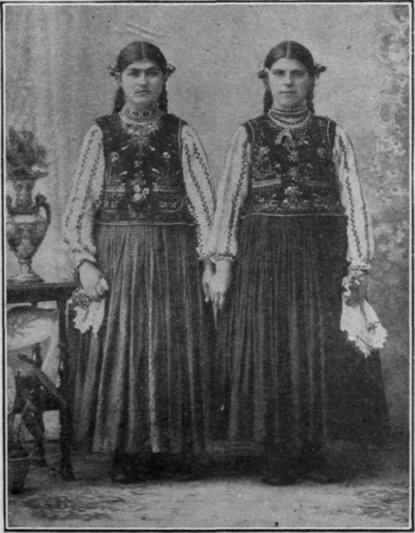
Typical peasant girls of Ruthenia, Upper Austria, in gala array. In this province old manners and customs still hold sway and are observed with due solemnity
The emissary then discloses the real object of his visit - namely, the driving of a bargain. In Austria and Hungary among the peasant class the bride is practically sold. The parents are obliged to give a good dowry, but, on the other hand, they demand large compensation for the loss of their child. This arrangement usually leaves a substantial profit to the father, even after he has paid all the expenses of the dowry and the wedding. This custom is not entirely confined to the working classes. In those which rank considerably above it a present of considerable value is sent by the bridegroom to his prospective parents-in-law.
The bargaining is not the affair of a moment among the peasantry, but often occupies two or three hours, each party being intent upon "beating down" the other. Preliminaries are then arranged, the wedding day fixed, and all goes fairly smoothly after the important money question has been settled.
On the day before her marriage the bride calls upon all her neighbours and acquaintances, taking a cake with her. On entering each cottage she breaks off a piece, which she proffers to the occupants, and at the same time invites them to the wedding. Then she kneels down and begs for pardon for any offences she may have committed in the past. Before rising she receives a benediction from each person present. This is to clear the decks, as it were, for the new life upon which she is about to enter.
In the evening of the same day her friends arrive for supper and dancing. The bride-to-be must be extremely fatigued at the end of her wedding day.
Just before the hour for the dispersal of the party, all laughing and talking suddenly cease, the family being supposed to remember unanimously and all at the same moment that they will lose their daughter on the following day. Accordingly, they begin to wail vociferously, and the guests join in the discord, and wail the whole way to their homes. This might be impressive were it not for the suddenness and the extraordinary supposed unanimity of the wailers in the midst of a scene of enjoyment.
On the wedding day the bride dons her very best costume, consisting of the elaborate peasant costume with laced bodice, silk apron, and fichu, adding a veil. She is then led by her mother to the kneading trough, which is covered with a piece of newly woven fine linen. Upon this she seats herself while her mother cuts off three locks of her hair, which are solemnly burnt and the ashes scattered to the wind. This takes place immediately before going to church.
Sometimes the bridegroom goes to fetch his bride from her house, and they walk together to the church. The service which follows is generally according to the Roman Catholic rite. Two-thirds of the population of Austria-hungary are Roman Catholics. When returning, the bridal party walk slowly, so as to permit the bride's mother to arrive first at her house. The particular meaning of this is that the daughter is no longer one of the family, but is a visitor to her paternal home.
The mother receives her, and the other guests, with the time-honoured Slavonic offering of bread and salt. All then enter and remain standing while the bridegroom walks three times round the table on which the marriage feast is set out. Then the feast begins.
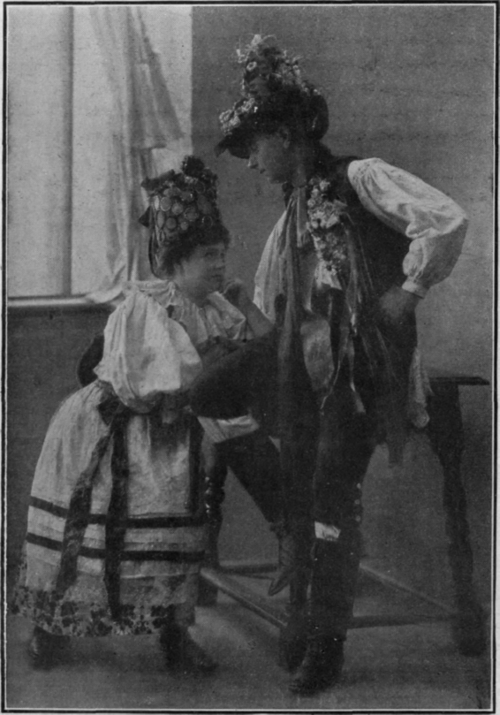
A bridal couple in the elaborate and beautiful costume which still survives in parts of Austria
Continue to:


My Books

