


The Five Food Principles
Description
This section is from the book "Practical Cooking And Serving", by Janet McKenzie Hill. Also available from Amazon: Practical Cooking and Serving: A Complete Manual of How to Select, Prepare, and Serve Food [1919].
The Five Food Principles
Now, there are in every food product certain compounds upon which its food value almost entirely depends, and there is danger that the full nutritive value of these may not be retained in the process of cooking. Then, too, we have become accustomed to combine, in cooking, materials that are widely different in chemical composition. All this tends to make the process of cookery very complex. As, for instance, in making an English cream, in which cornstarch, or flour, and eggs are used. Starchy substances are made more soluble (digestible) by long cooking at a moderate temperature, or by shorter cooking at a high temperature, while albumen is made less soluble by heat. If the eggs be added with the starch, one constituent of the cream will be sacrificed, and the chances are that it will be the most valuable of the two, including also the vegetable albumen of the vegetable compound. Hence, if cooking is to be conducted successfully, the composition of the product in hand must be accurately known, and the effects of the heat, at different temperatures, and of moisture, upon the various constituents must be clearly understood.
The several compounds that enter into the composition of our food products may be grouped under five heads, as follows:
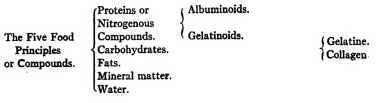
Relating to cookery, the distinction between albuminoids and gelatinoids is worthy of attention, in that the former are made less soluble by heat and the latter, of which gelatine and collagen are the most important, more soluble.
Where These Compounds Are Found
Water is found in all kinds of food, but largely in fruits and vegetables; in cooking these the water, which has been lost by evaporation (as in dried beans, etc.), needs be restored.
Under the head of mineral matter are grouped iron, sulphur, lime, potash, magnesia, chloride of sodium, etc. Some one or more of these are found in all natural products, especially in vegetables, milk and meat. When vegetables are cooked in water and the water is thrown away these, oftentimes the most valuable constituents present, and other soluble elements, are lost.
Butter, cream, vegetable oils, and the fat of meat, visible and invisible, represent the fats.
The carbohydrates are known principally as starch and sugar. Discarding the woody fibre, which envelops and forms the framework of vegetables and which is in reality a form of starch, starch is their most important constituent.
The cereals contain from sixty to seventy per cent, of starch. It is also present in the leaves and stems of plants. In rice seventy-six pounds in one hundred are pure starch.
Common sugar is a chief constituent of sugar-cane and a few other grasses; it is found also in the juices of some roots, as beet, and occasionally in the juices of trees; milk sugar is found in the milk of cows and other mammalia and grape-sugar in ripened fruit.
The nitrogenous food compounds, proteins, are the most important, because they are the only compounds that contain nitrogen.
Of these the albuminoids have precedence in point of value. White of egg, which is nearly pure albumen, is the type of this group; to this same group belong the casein of milk, the musculin of animal flesh, the gluten of wheat and the legumin of peas, beans, and lentils. From bones, cartilage, and connective tissue, boiled in water, are set free nitrogenous compounds that form with the water a jelly-like mass. These are the gelatines.
The chief constituent of connective tissues is collagen, which is soluble in hot water and yields gelatine. It is partly due to collagen that a steak puffs up while cooking, and this is the substance in the steak that is made tender by soaking in vinegar; when meat is kept, bacterial action gives rise also to acid secretions that soften the collagen.
Continue to:


My Books

