


Begonia. Part 3
Description
This section is from the book "Commercial Gardening Vol2", by John Weathers (the Editor). Also available from Amazon: Commercial Gardening, A Practical & Scientific Treatise For Market Gardeners.
Begonia. Part 3
Bedding Begonias
Quite distinct from the Tuberous and Lorraine Begonias a large trade is done in early summer in certain fibrous-rooted kinds, one of the principal being known as semper-florens. There are now numerous varieties of this, all easily raised from seeds or cuttings. They are dwarf and compact in habit, and produce their rather small flowers in great abundance. They are valuable for edging beds and borders, and for making a carpet in beds beneath standard or half-standard plants like Fuchsias, Heliotropes, Abutilons, Acacias, etc, during the summer months. The foliage of some varieties assumes deep crimson or purple shades during the season, as in Vernon or Crimson Gem. Some good forms are carminea gigantea, rosea gigantea, alba, Princess Beatrice, Duchess of Edinburgh, magnifica, etc. Other fibrous-rooted Begonias useful for bedding purposes are Abundance, pink; Afterglow, rose carmine; and ascotensis, rose red.
Winter-Flowering Begonias
Although not yet a market grower's plant, it is possible that in the course of time the beautiful varieties of winter-flowering Begonias that have been raised by crossing and intercrossing B. socotrana with modern forms of the tuberous Begonia will become so. These Begonias somewhat resemble dwarf, sturdy, and compact-growing forms of the tuberous Begonia, with single, semi-double, and double flowers varying in colour from pink to deep-purple pink, rose, cerise, etc. They are all sterile, like the Lorraine section, and must therefore be raised from cuttings. Some of the best forms at present are Ideala, Adonis, John Heal, Mrs. Heal, Ensign, Winter Cheer, Julius, Venus, Winter Perfection, etc.
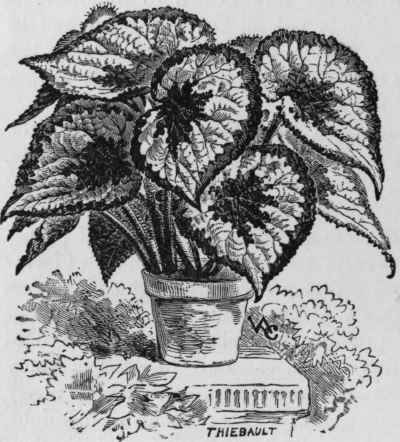
Fig. 266. - Begonia Rex.
The ornamental-leaved Begonias, like the Rex section (fig. 266), and the coloured-leaved varieties, as well as such natural species as B. manicata, B. maculata, and B. metallica, and some fine varieties are well-known plants. B. incarnata (or insignis) has given such remarkable forms as Arthur Mallet, M. Hardy, The Queen, and others, by crossing with the Rex section; while B. coccinea (or corallina), a tall-growing Brazilian species, is nearly always gay with its drooping panicles of blood-red blossoms.
Continue to:


My Books

