


Vines In Hot-House. Part 3
Description
This section is from the book "A Dictionary Of Modern Gardening", by George William Johnson, David Landreth. Also available from Amazon: The Winter Harvest Handbook: Year Round Vegetable Production Using Deep Organic Techniques and Unheated Greenhouses.
Vines In Hot-House. Part 3
Thinning The Berries
As soon as the berries are set and begin to swell, it is time to thin them. For this operation there are proper scissors, with long handles and short blades. Provided with these, some good soft matting, and with something to catch the berries in, (which make excellent vinegar or tarts, etc.,) commence the operation by tying up the shoulders of such bunches as require it, to the wires on each side of the rafter; or, if the bunches are very large, fasten some thin narrow lath to the rafter, to tie the shoulders to.
Some persons use a thin piece of lath notched at each end, to prop the shoulders off from the main body of the bunch; but I do not like this plan so well as the matting, the props being apt to drop out.
In order to have large berries, thin very freely, so much so, that the bunches look like skeletons. Of course thin according to the kind; some sorts under the best management do not swell to such a size as others; hence it is necessary to know the medium size to which every variety will swell, and thin accordingly.
Watering The Roots
Use manure water alternately with clear water. If the border be well watered once a week, it is sufficient. Remember to place boards to walk on, and as soon as the water has sunk in, and the surface becomes rather dry, go over it with a Dutch hoe and rough rake; the more frequently it is stirred the less water it will take; if, however, it is so smooth as to let the water run off, instead of sinking in, point the surface over with a fork and leave it rough.
Covering The Vines In Winter
"When the vines are not covered with glass in consequence of other fruits being grown in the house, protect them from severe frost; hay-bands may be used, and long straight wheat straw; the tarpaulin is the best, as it keeps them dry, and of course renders them more able to endure frost." - Gard. Chron.
Vines In Pots
The first week in February is the best time for planting the cuttings of vines in pots, to remain in cultivation in them. If intended to be fruited next season, plant the cuttings in thirty-twos, selecting well-ripened shoots, with only one plump bud, and cutting the shoot at each end down to about one inch and a half of the bud. Bury this bud in the earth, composed of equal parts of fresh light turfy soil and decayed leaves. Plunge in a bottom heat of 90°; temperature of frame 60o to 90°. In April, shift to the fruiting pots, twos or fours, according to the strength of plant desired. Soil, two parts light turfy loam, and one part old night-soil. Temperature, 60° to 80°. Place the pots so near the roof, that the shoots may be at once trained near the glass as they advance. Best length for the shoots, from four to six feet, though they will bear even ten feet; therefore stop each when a foot longer than required for next season. Manure water must be employed to sustain the growth of the vines, and every means adopted to ripen the wood. Early in September, the pots may be placed out of doors, on the north side of a wall, and laid on their sides, to hasten the vines into a state of rest.
In November, they may be returned under glass, and forcing commenced to ripen a crop by the end of March. If strong, and grown in No. 2 pots, seven bunches may be left upon a Hamburgh, eight upon a Muscadine, but upon weaker plants only about halt those numbers.
Mr. W. Stothard, gardener at Chant-rey House, in 1841, gives these directions: - "When the vines that are let into the house have reached the top of the rafters, instead of stopping the leading shoot, as is commonly done, and often too soon, which causes the eyes to burst, and renders them useless for the succeeding year, turn the shoot back, and having ready a pot of suitable size, well drained and filled with fresh turfy loam and rotted dung, of equal parts, place it upon the back shelf or wall of the pit, and as soon as the young shoot has attained a sufficient length to be laid into the pot, cut out two or three eyes, and as many of its leaves, and scrape oft* a little of the bark the whole length of the part intended for roots, which is bent into the pot, and covered with mould to the depth of six or seven inches. No attention is required, excepting to train the shoot as it advances in growth, and keep the mould in the pot a little moist, to encourage the emission of roots, which will appear in a fortnight or three weeks, and soon fill the pot.
When the shoot is laid in the pot, allow it to grow from four to eight feet long, according to the strength of the parent vine, to which leave it attached until it has done growing, and perfectly ripened its wood.
"Should there not be a sufficient quantity of leaders, place pots under the rafters at most convenient situations, and likewise on the front flue; but the shoots that are laid in these pots never suffer to exceed five feet in length. When the plants are severed from the parent vines, put them out under a wall, where they are protected from frosts, and take into the house as required for forcing; at that time shift into pots about a foot over and fourteen inches deep, to remain until the fruit is cut, after which they may be thrown away, sure of a fresh supply of plants every year by the same process." - Card. Chron.
Mr. H. Burn, gardener of Tottenham Park, gives the following particulars of his mode of cultivating the vine in pots: - "I invariably set the eyes in thumb pots on the first of February, and putting moss about two and a half inches deep on the flue at the back of the pine pits, I place the pot upon it, keeping the moss always moist.
"As soon as the bud or eye has grown and become well furnished with roots, I repot into sixty-sized pots, and continue afterwards to shift as fast as the pots become filled with roots; from sixties to forty-eights, thirty-twos, twenty-fours, sixteens, and twelve-sized pots successively; and lastly, into bushel-pots, which I have made for the purpose. I encourage rapidity of growth as much as possible, by feeding them with liquid manure made from cows' and deers' dung; and during the whole time keep a good drainage at the bottom of the pots. The soil I used is nothing more than three-fourths strong turfy loam, and one-fourth horse-dung; from the linings of the pine pits select the most decayed parts of the manure.
"I usually allow the shoots to run to the extent of thirteen eyes, and then stop them.
"By the middle of September the wood becomes ripened, and I then prune them back to the ninth eye, and remove them from the pinery to the open air, setting them under a south wall, on bricks placed edgewise, so as to admit free drainage. On the first of November, I generally take in fifty-pots for forcing; (this I have occasionally done on the first of October;) when they are washed with soft soap and sulphur. "After all the eyes have shown fruit, I select from six to eight of the best bunches to remain, and pluck off the others, never allowing one eye to bear more than one bunch. I syringe the vines gently with warm water three times a week, and water them twice a week with the liquid manure. Should they, however, occasionally require more moisture, I give them nothing more than soft water about milk warm. I invariably fruit annually from 100 to 120 vines, taking in after the first fifty the rest in succession.
Fig. 74.
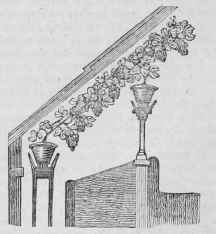
"The above engraving represents a transverse section of the vinery, with bed for tree leaves to decay and heat; frame-work for the support of front trough sixteen inches wide at the top, and ten inches deep, and the wire under the rafters on which the vines are trained." - United Gard. and Land Steward's Journ.
Vines In Frames
We have the following information on this mode of culture: - "It is well adapted for gardens where the quantity of glass is limited, and is practised by Mr. Dawson, gardener to Lord Ducie, at the Hoo, Hertfordshire. About the first week in April, a bed of partly decayed dung, to which a small quantity of raw material is added , so as to produce a slight heat, is made at about eighteen inches from the wall in front of the selected vines.
"This bed is built sufficiently deep to admit of its being about three feet high, after settling. The frame used by Mr. Dawson separates into two portions, so that the lower part can be first placed upon the bed. It contains a trellis upon which the vines are trained, fixed about a foot above the surface of the dung. The upper portion of the frame can be afterwards put on and secured to the lower by small brackets. The advantage of having the frames constructed in this way is the ease and safety with which the vine can be taken in; since, in introducing the shoots of a vine through a hole cut in the back of a frame of ordinary construction, the buds would be liable to be rubbed off. No more care is required, except in stopping, thinning, etc Air is given freely, but no linings to the bed are required. In severe weather a covering is put on, but this is not generally resorted to. By pursuing the above method, fruit of good quality has been cut by the latter end of August, for which Mr. Dawson has obtained several prizes at local horticultural exhibitions." - Gard. Chron.
Continue to:


My Books

