


Design XXI. Descriptive Notice Of Bedford Lodge, The Villa Of Her Grace The Duchess Dowager Of Bedford, At Campden Hill, Near London
Description
This section is from the book "The Villa Gardener", by J. C. Loudon. Also available from Amazon: The Villa Gardener.
Design XXI. Descriptive Notice Of Bedford Lodge, The Villa Of Her Grace The Duchess Dowager Of Bedford, At Campden Hill, Near London
344. Ground Plan, Etc
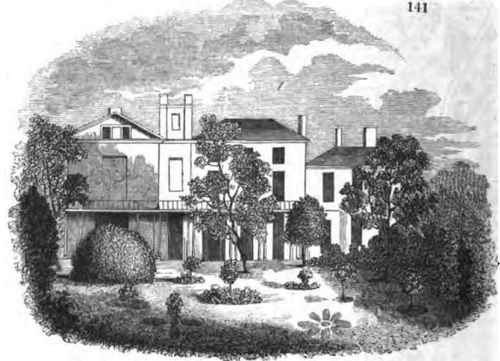
Fig. 141. is a view of the south-front of the house, showing the verandas, the flower-beds, and the scattered trees and shrubs on the lawn; with an ivied arbour on the right, and a large arbutus, clipped into a hemispherical form, on the left. This tree has since been cut down.
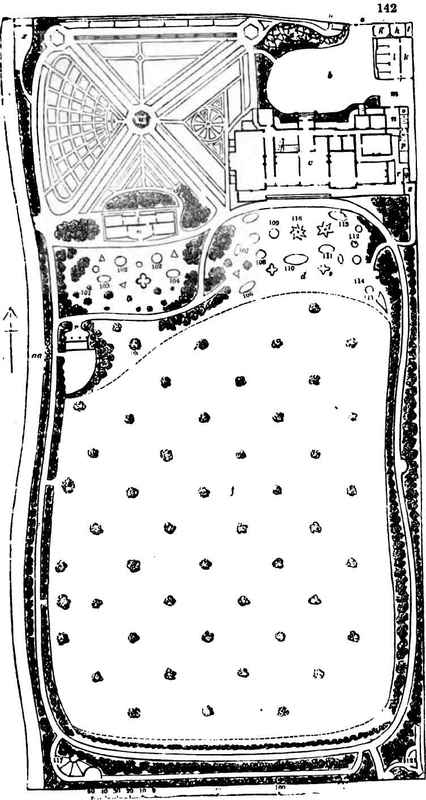
Fig. 142. shows the general plan of the entire place, and the following axe references to it: a, Entrance gates. b, Entrance csnrt. c, Mansion.
d, Lawn on the south front, which is entered from a veranda extending the whole length of that front. e, Flower-garden on the west front.
f, Orchard. g, Porter's lodge. h, Groom's room.
i, Cistern for supplying the offices. k, Coach-house. l, Stable, m, Stable-yard. n, Wood and coal-shed. o. Servants privy, p, Larder. q, Dust-bin. r, Sunk area. s, Tool-house.
t, Gardener's working-sheds, etc. u, Green-house, in three divisions.

v, Rustic seat, at the back of which is a green-house, and beyond that a frame-ground, for bringing forward plants for the flower-garden. w. Marble basin and fountain, in the centre of the flower-garden, covered with a bower of trellis-work and climbers, a view of which is shown in fig. 143. x, Potting-shed and compost-ground.
y. Cistern for supplying the fountain at w. z, Rockwork.
&, Arcade of climbing roses, seen from the house a a, Public lane, which separates the grounds of Bedford Lodge from those of Holland House.
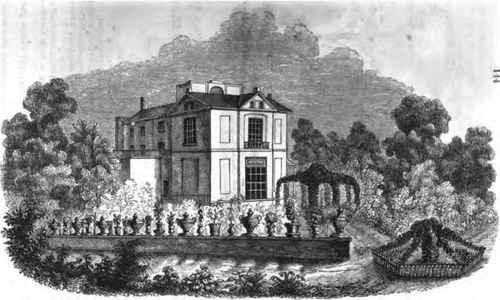
Fig, 144. shows the dwarf or terrace-wall in the flower-garden; the west front, and part of the entrance front, of the house; the basket near x, in fig. 142.; and the central arbour (to) in the same figure, and shown, also, in fig 143.
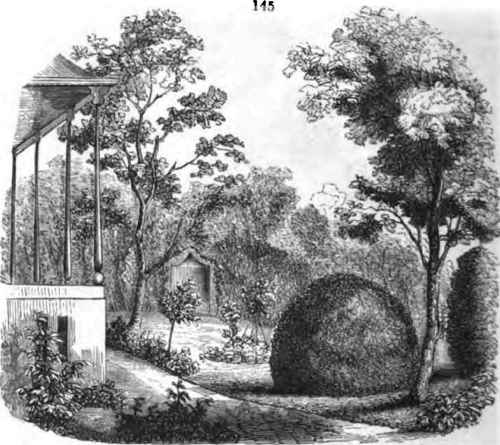
Fig. 145. is a view from the flower-garden, showing the arbutus, a front view of the ivied arbour, and part of the veranda.
Fig. 146. is a plan of the flower-garden on a larger scale, and the following are references to it: a, Grand drawing-room. b, Veranda. c, Green-house.
d, Fountain and arbour. e e. Pedestals and vases.
f, Dwarf or terrace-wall, surmounted by vases, as shown in fig. 144.
ggt Flower baskets. h, Potting-shed and reserve ground.
i, Shrubbery. k. Entrance from the lane.
i, Lawn sloping from the veranda. m, Part of the entrance court,
1, Rookwork, on which are planted alyssums, arabises, iberises, chetranthuses, aubrieties, campanulas, cardamines, achilleas, sedums, antirrhinums, gilias, nemophflas, lasthenias, violas, saxifrages, verbenas, nierembergias, geraniums, wallas, anagallizes, heliantbe-mums, cistuses, and pentstemons.
2, A basket filled with Provins roses, pegged on the ground, and China roses; and with iron rods from each of the angles to the centre, forming a crown, on which Convolvulus major is trained.
3, Anemone hortensis, purplish; Helianthemum roseum, pink; and Fuchsia globose scarlet.
4, Wall in front of which are planted summer and autumn-flowering roses, as well as green-house creepers, which are trained against it. Many of the autumn-flowering roses require to be protected from frost; but some of these were preserved throughout the severe winter of 1837.8, without protection, by having hardy roses budded on their extreme shoots; as, for example, the Brennus or Brutus rose, on the Lamarque rose. In this case, the Brennus rose (rich crimson) flowered first, luxuriantly; and was followed by the Lamarque (a pale yellow rose), which 'also flowered well; though the Lamarque rose, in all cases where the shoots were not budded, was killed back by the frost It thus appears that the rigorous growth of the scion had thrown the Lamarqne stock into a state of rigorous growth, at a time at which the Lamarqne would otherwise hare been quite dormant. 5, A border, formed into compartments, from the plants in it being arranged in masses, so that the flowers of the one may tend to show those of the others to the greatest advantage. The following list of plants will show more clearly the effect that is meant to be produced, by their being arranged in the list, in the same order as they were planted in the border.
The first effect produced was from the following Californian annuals: - Nemophila insignis, blue; Platystemon californicus, cream colour; Collinsia grandiflora, purple; Collomia coccinea, scarlet; Eschscholtzia crocea, deep yellow; Gilia tricolor, lilac, white, and black; and 6. achilleoef olia, purple. These are all annuals, and were sown about January in the compartments, where they come into flower about the beginning of May, and continue flowering till the end of June or beginning of July, when the greater part of them should be cleared away, in order that they may not draw op, and weaken the plants which are to succeed them, and produce the second effect. The flowers for this second exhibition are all perennials, and consist of Œnothera macrocarpa, yellow, for the first compartment, which remains there as a permanent plant, the seeds of the Nemophila having been sown amongst it in January, is above. The next compartments contain Verbena Tweediamd, crimson; V. Lambertiona. purple; Calceolaria angustifolia. yellow; Petunia vioacea, purple; scarlet geraniums. and Verbena Drummondi. These are all half-hardy perennials, which are kept in pits daring the winter, and planted out as soon as there is no danger to be apprehended from frost.
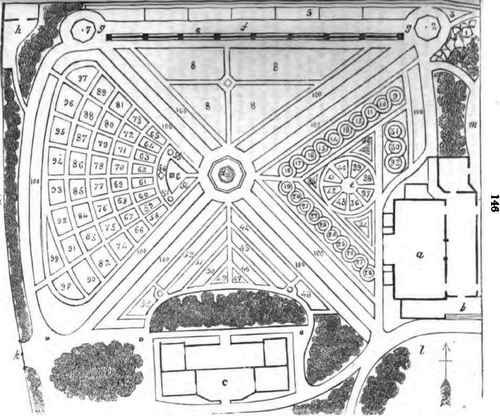
6, The dwarf or terrace-wall, before mentioned, on which vases of different shapes and colours are arranged and filled with plants; those plants being chosen, the colours of the flowers of which will produce the greatest contrast with the colour of the vases is which they are planted. Different kinds of nasturtiums have been planted at the foot of this wall, on which they climb and hang over. On the south side of this wall are Scotch roses, and on the north crimson perpetual roses; the former having a border in front of it filled with the Campanula speculum (Venus's looking-glass), and the latter with Convallaria majalis (the lily of the valley). These borders relieve the eye, when contrasted with the green of the roses which they are in immediate connexion with.
Continue to:


My Books

