


Parlour Cultivation - Ferns
Description
This section is from "The Horticulturist, And Journal Of Rural Art And Rural Taste", by P. Barry, A. J. Downing, J. Jay Smith, Peter B. Mead, F. W. Woodward, Henry T. Williams. Also available from Amazon: Horticulturist and Journal of Rural Art and Rural Taste.
Parlour Cultivation - Ferns
"In princely balls and courts of kings Its lustrous ray the diamond flings, Yet few of those who see its beams, Amid the torchlights dazzling gleams, As bright as though a meteor shone, Can call the costly prize their own; But gems of every form and hue Are glittering here in morning dew; Jewels that all alike may share As freely as the common air".
WE are glad to see that the taste which has sprung up among the ladies for hanging baskets of growing plants, is extending itself to Wardian cases and Aquariums. We would not insinuate that a cultivated woman was not the greatest attraction a drawing-room can present; but when we see adornments of living plants in a living apartment, the first impression that a cultivated mind inhabits it is rarely erroneous. No matter how simple the vase, or how common the flower, if the first is neat and the second in health, we know that it is a matter of interest; we also soon discover that cultivation of the mind is in progress; that the caretaker reads, observes as she goes, and enjoys accordingly. A plate of moss under a simple glass vase, or even exposed and well sprinkled thrice a day, attracts us; and we feel at home here, a thousand times more than in the presence of gilded furniture or the most expensive or-molu ornaments.

PARLOUR CULTIVATION - FERNS.
When once the mind receives pleasure from such cultivation as can be accomplished within doors, it is surprising how readily we learn the simple conditions of health which plants require; that difficulty conquered the pleasure daily grows by success, and home becomes a place of delight; the aid of books brings new thoughts, new pleasures; the possessor no longer seeks in vain show, admiration from abroad; her love turns to her pets whose daily progress is the theme of thoughts gradually growing in intensity till curiosity is awakened, and she gains a life-long pleasure in the study of nature's works; exclaims "Who would live contentedly, or consider a sitting-room furnished, without either a Ward's case or an Aquarium?" As to outlay and trouble of management these are the cheapest and most interesting adornments of a dwelling-house. The expense may bo considered at an end when the case has been purchased and stocked; after that the less it is touched the better; dust cannot creep into its crevices, to mar the freshness of the gems within, while daily, whether in library or boudoir it is an object of intense interest.
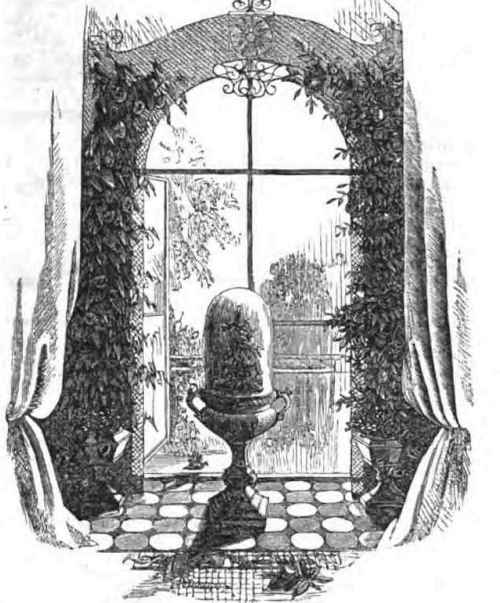
A simple plan is to procure a vase of any material and throw over it a glass shade, as represented. Ferns grown within, exceed greatly the beauty of those grown in the open air. Though we cannot have the mountain dells, the creeping woodbine coverts or the rocky water-fall, we may have the emblems of them in our little rural paradise; we may have the Ferns to suggest such things when frost and snow cover all nature's bosom, and to keep in remembrance the pleasures of the scenes of spring; remembrances of fragrance from the green world that sweeten the oft otherwise weary pilgrimage in the march of life.

It must he a pure and simple taste which finds pleasure in the culture of plants with no gaudy blossoms to attract vulgar remark, which have few claims on our attention beyond their botanical interest, and chaste, simple, outlines, their rare shades of green and brown, and methods of growth neither noticed nor cared for by minds unschooled to simple elegance and exquisite delicacy of form.
Procure your ferns in country rambles in the vicinity of the woods, along the banks of brooks where there are many decayed tree trunks, and amongst rocks, In removing these it is necessary to dig out the root-stock in as complete and uninjured a state as possible, and if a portion of the soil can be brought away with the plant it is all the better. A tin box to bring them home in, covered over with wet moss, is useful; plant as speedily as possible, using potsherds fur drainage, keep them in the shade, and moisten the earth occasionally. The small ferns are most suitable for parlour culture.
In gardens, select a shady, moist situation, and with a little care you may have as fine a hardy fernery as you can desire. The soil which suits most ferns, is three parts of rather light fibry earth, and one part fibry loam; but the beginner cannot err who employs the earth the plant was found luxuriating in out of doors. It need not be made fine, but used on the surface in pieces varying in size, the finer near the roots, the surface as rough as in nature's treasury.
We do not urge these pleasures on any; but certain we are, that few more refining ones can be pursued. The mind gradually learns.
"To mark the structure of a plant or tree,
And all fair things of earth, how fair they be".
Charlies Lamb.
A few good specimens of mosses add greatly to the appearance of a fernery, particularly if some of the scarlet caps be introduced. Ferns and mosses seem naturally to be inseparable companions, and should not be parted; a fact enunciated in the following lines, which contain a valuable moral:

Continue to:


My Books

