


The Orchard House, Cultivation Of Fruit-Trees In Pots Under Glass. Part 3
Description
This section is from "The Horticulturist, And Journal Of Rural Art And Rural Taste", by P. Barry, A. J. Downing, J. Jay Smith, Peter B. Mead, F. W. Woodward, Henry T. Williams. Also available from Amazon: Horticulturist and Journal of Rural Art and Rural Taste.
The Orchard House, Cultivation Of Fruit-Trees In Pots Under Glass. Part 3
* These respective heights of front and back are a matter of choice: they may be exceeded; for I find that trees in pots make most vigorous growth.
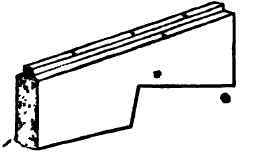
Fig.1. Top end of Rafter.
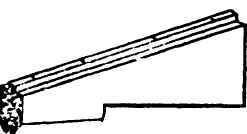
Fig.2. Bottom end of Rafter.
The front and ends (except the doorway) must have also three-quarter-inch boards, nailed on outside the posts; one of them, the upper one in the front, to be on hinges, so as to let down the whole length of the house: these, with the back shutters, when all open in hot weather, will ventilate thoroughly. To add to this, and it is all required in summer, the boards will shrink and let in air: a fierce sunlight is thus admitted by the large glass, and abundance of air, in which all fruit trees thrive to admiration. The boards and rafters should be painted with stone-colored paint, which will give the house a very neat appearance. So much for the timber and glass; but when one sees that to walk along the centre of the building, which is about four feet nine inches in height, a person must be of very diminutive stature, the inquiry arises, how is head-room to be made? Simply by making a trench two feet six inches wide, and fifteen or eighteen inches deep in the centre of the ground plan: this will leave a border on each side four feet nine inches wide, and form a path at the same time.
The front border need not be raised, as the trees in two or three years will require all the head-room they can have, but the back border should be raised about eighteen inches above the surface, supported by the brick or boarded edge to the path, - for the sides of the path must be supported with boards or four-inch brickwork. It will be found a great improvement (for which I am indebted to a friend) to divide the back border into two terraces, by raising the back half twelve or fourteen inches, building a four-inch brick wall, and filling in with earth, so that the back row of trees is elevated, and thus escapes any shade given by the front row; the effect also is very good. Now, as every thing depends on these borders - for there must be no benches and no shelves - care must be taken to make their surface loose and open: loose materials, such as lime rubbish from old walls, and road sand, mixed with manure, may be laid on them, about four inches deep; they may then be forked over to about nine inches in depth, well mixing the above materials with the soil: you thus have two borders not too far from the glass, and on which your orchard will thrive admirably.
It will appear odd to read about trees thriving on instead of in a border; but when I explain that this is to be an orchard in pots, it will not seem so contrary to our usual garden culture.
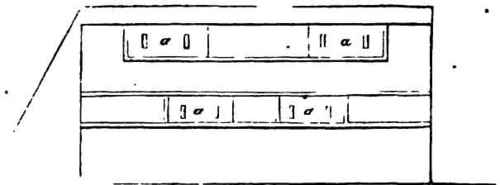
Fig. 3. Back of Orchard House. a,a,a,a, Sliding Shutters in Grooves.
It will be seen, I think, by the description I have given, that the lean-to orchard house is merely a low greenhouse, with its roof sloping to the south or south-west, such as may be seen in many of our small villa gardens; only, instead of having a path in the centre and a bench on each side for the flower-pots to stand on, it has a sunken path and a border of earth on each side, on which fruit trees in pots are to be placed. The foregoing rough section will perhaps convey an idea of this structure and its use.
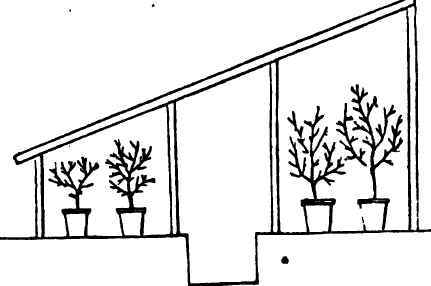
Fig. 4. Section of a Lean-to Orchard House.
Builder's Estimate
To---. An Estimate for erecting an Orchard House, 30 feet 6 inches long, 12 feet 6 inches wide, 3 feet 3 inches high in front, and 7 feet 9 inches at back.
3 feet oak door sill, 4 by 3. | |
64 feet of fir for plates. | |
84 feet ditto for end rafters and door posts, etc, 3 1/2 by 2 1/2. | |
309 feet ditto for middle rafters and sill, 4 1/2 by 1 1/2. | |
110 feet ditto for posts, 5 by 3. | |
30 feet deal for top and bottom rails, 9 by 1 J. | |
560 feet (super.) ditto for boarding fillets, etc. | |
90 feet (super.) fir for sides of path, piles, latch, joints, and buttons. | |
Painting with anti-corrosion paint, 2 coats. | |
187 squares, 16 ounce sheet-glass, putty, and labor. | |
£28 5 0* |
By using larch poles instead of squared timber for the posts, a saving may be effected; by being one's own carpenter, a larger saving. By using oak for posts, unless small oak trees can be bought cheaply, £1 15*. must be added to the above estimate.
The foregoing estimate and sketch are for a Lean-to Orchard House standing by itself: where there is a brick or other wall to serve as a back wall, it may be built against it, with a great saving; in expense; but as sliding shutters cannot conveniently be let into such walls, ventilators may >Boards to be milled but not hand-planed, and finished in two coats stone-wash if desired, - but the cost of stone-washing not included in the estimate. From $27 to $33 should be added, if the work is band-finished for paint. About $15 should be deducted if it is built against a stable or other wall.
* The following estimates of the cost of similar houses in America have been kindly famished us by Richard Morris Smith, architect, of Philadelphia. - Ed.
AMERICAN ESTIMATES. | |
Fig. 4. Lean-to, or single-pitch Orchard House: | |
570 feet of hemlock scantling at 1 1/4c..... | $7 12 |
680 " popular for boarding, etc., at 2d. | 13 60 |
450 feet, 15 by 20 glass, (per 50 feet), $1 95...... | 17 55 |
Labor, putty, etc., etc. | 32 00 |
Complete, without wash or paint. | $70 27 |
Fig. 5. Small span, or double-pitch Orchard House: | |
456 feet of scantling, (hemlock), at 1 1/4c....... | $5 70 |
544 " poplar, at 2c.......... | 10 88 |
550 " glass, (per 50 feet), $1 96 | 21 45 |
Labor, etc., etc.......... | 31 00 |
$69 03 |
$25 to $32 should be added, for band-finish and painting. Figs. 6, 7. Large span, or double-pitch Orchard House: Finished in the first manner as above described, about - - - - $120 00 Paint-finished............ 160 00 be made at the top of the slope of the roof, by having every alternate square fixed in a wooden frame, with a hinge at top and a flat piece of iron with holes in it suspended to the bottom corner: an iron peg should be placed in the rafter to fit into the holes; with this, the ventilators can be raised or sunk at pleasure.
The most complete house of this kind, built against an old garden wall, with a S. W. aspect, is in this neighborhood. The wall is 12 feet high, and covered with full grown peach and nectarine trees; the house is 200 feet long and 15 feet wide, 4 feet 6 inches high in front, with front sashes 5 feet by 3, on pivots, so as to ventilate thoroughly; the rafters are 4 1/2 by 1 1/2 inches, and fixed 20 inches apart; glass, 20 inches by. 15, and every alternate square at the top next the wall is framed, and on hinges opening upwards (these should be arranged so as to open all at once with a line and pulley); the path in the centre is 3 feet wide, and on each side, 3 feet from the path, is a row of espalier peaches and nectarines; between the front row and the glass are bushes in pots, so that in one house are three modes of culture. It is also divided into three seasons by partitions of glass, forming three compartments; two of these are fitted with hot water pipes, and one left without, as in a common orchard house.
Continue to:


My Books

