


The Orchard House, Cultivation Of Fruit-Trees In Pots Under Glass. Part 4
Description
This section is from "The Horticulturist, And Journal Of Rural Art And Rural Taste", by P. Barry, A. J. Downing, J. Jay Smith, Peter B. Mead, F. W. Woodward, Henry T. Williams. Also available from Amazon: Horticulturist and Journal of Rural Art and Rural Taste.
The Orchard House, Cultivation Of Fruit-Trees In Pots Under Glass. Part 4
In one house forcing is commenced early, so as to have ripe peaches or other fruit in May; the second succeeds it with peaches in June and July; and the third, without heat, gives its crop in August, September, and October: peaches and nectarines are thus in perfection from the middle or end of May till the end of October. The fruit on the wall is the first to ripen, and is* very early, owing to the warm aspect. This is the most complete lean-to orchard house I have ever seen; and although 15 feet wide, it can be built at a less cost than the narrow upright houses in front of the walls at Trent-ham, which are only 5 feet in width.
The lean-to house, whether against a wall or standing alone with its boards for walls, forms a most excellent vinery for grapes not requiring fire-heat, such as the Black Hamburg, and the Sweetwater, and Muscadine grapes. The vines should be planted inside the front wall, and 2 feet apart, trained under the rafters, 14 inches from the glass, and managed on the spur system, which is the same as that given for the training of grapes in pots. In the south of England, the sorts above named will never fail to ripen in this kind of vinery. So much do they love free air, that I have for some years opened my ventilators in the middle of July, and have never closed them till the end of September. My grapes have invariably been of the finest quality.
I now propose to give a sketch and description of a Span-roofed House, a little wider and cheaper. A house of this form is more agreeable as a promenade, and I think the trees are attended to with more facility. But unless placed in a warm sheltered garden, peaches and nectarines do not ripen quite so early in it as in a lean-to house. I think, however, it has a more agreeable look, and I must confess a preference to it. The following is a section of what I shall call the Small Span-roofed Orchard House. Height at sides, 4 feet; at centre to ridge. 8 feet; width, 14 feet; rafters, 8 feet in length, 3 inches by 1 1/2, placed 20 inches apart; posts of oak, 5 inches by 3*, 5 feet apart: plates, 3 inches by 2; central path, 2 feet 6 inches wide. The borders in this description of house need not be raised, but the path may be sunk 2 or 3 inches, and each side sloped so as not to crumble into it; the expense of a brick edging is thus saved. The borders should have a dressing of manure and sand, or manure and burnt earth, - in short, of any lose materials, - and be well forked over and mixed to 6 or 9 inches in depth. Two rows of trees may be placed on each border, thus -3 feet from stem to stem, so that the sun may shine on every leaf.
This is most essential; for I have occasionally had some of my peaches deficient in flavor, and on examination have always found the trees too much crowded, so as to shade each other. In these small span-roofed houses, the trees placed as above form a charming avenue, and are looked down upon by the cultivator, so that every leaf and fruit is seen. It will add some trifle to the expense of building, if the sides, 1 foot or 18 inches from the eaves, are of glass, the wooden ventilating shutter being beneath the glazed part. The doors and ends may be partially glazed: the extra expense is fully repaid by the light and agreeable appearance given by this mode of building.
* Oak posts of this size, I find on referring to the wooden tombs in the churchyard, last from 50 to 60 years.
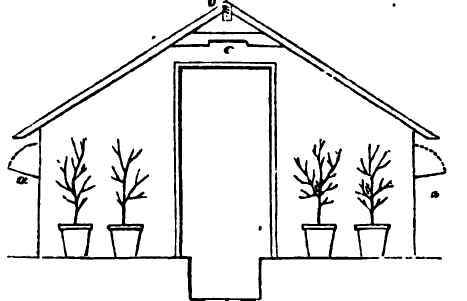
Fig. 5. Section of the Small Span-roofed Orchard House.
Small Span-Roofed Orchard House.
"a, a. Shutters on hinges, 12 inches wide, one on each side. The upper edges should be 1 foot from the eaves. b. Ridge board, c Shutter over the door.

The cost of a plain-boarded house, as given me recently by Mr.Rivett, Builder, Stratford, Essex, is as follows: -
A span-roofed orchard house, 30 feet long, 14 feet wide; sides, 4 feet, middle to ridge, 8 feet high; oak posts, 5 inches by 3; close boarded, glazed with 16-ounce glass, painted twice with anti-corrosion paint: complete, £27 10s.
The small span-roofed house will be found an agreeable and economic structure; but, as large gardens require large houses, I am induced to recommend for them the following, which I shall term the:
Large Span-Roofed Orchard House
My large houses are twenty feet wide, the sides four and a half feet high, and nine and a half feet in height to the ridge; the paths are two and a half feet wide; the brick beds at the sides are four feet wide and fifteen inches high, the central bed seven feet wide and eighteen inches high. These dimensions may of course be varied at the pleasure of the builder*; I give mine exactly as they are. The posts to support the side plates are of oak, six inches by four; they are two and a half feet in the ground, and placed four feet apart; on these are nailed deal boards three-quarters of an inch thick, the upper one of which, on each side, one foot in width, is on hinges to form the shutters for ventilation; the rafters are four and a half inches by one and a half, and placed twenty inches asunder. (In large span-roofed orchard houses used for forcing fruit, and in which artificial heat is employed, one or two shutters on hinges at the apex of the roof are necessary to let off the heated air in sunny weather; but I find them quite unnecessary in houses without fire-heat). This is the most economical method of building large span-roofed orchard houses; but they may be varied, and iron, and brick, and glass, employed at pleasure.
One recently built at Audley End is, I think, worthy of a short description: its sides are brick walls, two feet six inches high; on these, sashes two feet six inches by three feet, are fixed with pivots, so as to admit a large quantity of air; width twenty feet, length ninety feet, height ten feet; the roof is supported by a row of two-inch iron pillars along the centre, about seven feet apart; the central and side beds are twenty inches high, the paths three feet wide. This is really a noble as well as a nobleman's orchard house, and forms a healthy and most agreeable promenade. In all orchard houses where expense is not heeded, the water should be conducted from the roof into a tank or tanks underground, either outside or inside. Rain water is the best of all to syringe or to water the trees with.
Continue to:


My Books

