


The Waltonian Propagating Case (2)
Description
This section is from "The Horticulturist, And Journal Of Rural Art And Rural Taste", by P. Barry, A. J. Downing, J. Jay Smith, Peter B. Mead, F. W. Woodward, Henry T. Williams. Also available from Amazon: Horticulturist and Journal of Rural Art and Rural Taste.
The Waltonian Propagating Case (2)
FREQUENT references to the Wardian case have made most readers familiar with its uses, but little has been urged in this country to a special form of a plant case known as the Waltonian, in which the principle of a heated plant house is brought to perfection. Strictly speaking, it is not a Wardian case at all, but a propagating pit - in fact, a hot-house suited to the drawing-room; and it is considered of such practical value, and withal so simple in structure and management, that it may be accepted as an adjunct to the very best cultural contrivances, as it will also be found the most efficient scheme the inexperienced lover of flowers can adopt. We copy from a new English book on Rustic Adornments.
"Mr. Walton himself never struck a cutting before he invented the case for himself; but after setting his first case to work, he learned to perform operations that in the ordinary way require years of tuition and experience. Now that the boat form, the best measurements, and the exact details of construction have been determined by experiment, no one, however previously ignorant of ordinary gardening operations, need find it difficult to produce an abundance of stock for the garden, the green-house, or the window; for it may be a hot-house, an intermediate house, or a cool pit, just as you please, by a very simple regulation.
"The Waltonian case is fashioned in the style of a garden-frame, the framework being of wood, with side and top lights, a boiler and lamp for supplying heat, and a tray of sand on which the pots are placed. The annexed figures are drawn from the one which I have in use, supplied me by Mr. West, of Surbiton, who is the original maker of the cases, to whom, indeed, we are indebted for many improvements based on Mr. Walton's first idea, and the suggestions of that eminent horticulturist, Mr. Donald Beaton.
"As this description must be brief, I will at once refer the reader to the perspective view of the structure, closely stocked with seeds and cuttings, as it adorns my study window at the moment of writing this. The framework is of wood, and may be either plain deal, as mine is, or any ornamental wood with elegant mouldings. The front and the two ends are fitted with glass; the back is wholly of wood; and on the top are two lights laid on loosely. There is room inside for thirty-two four-inch pots, in four rows of four each, under each light, and these pots stand on a thin layer of silver-sand kept constantly damp, and heated by the boiler immediately beneath it. The lamp in front is a common tin one, burning colza oil, and the cost of working is barely a shilling a week. The lamp is understood to burn eight hours, but I find I can, if necessary, to trim it that it will burn twelve, or even fourteen; so that five minutes twice a day is all the attention the case ordinarily requires.
"Having glanced at it so far, let us now take the case to pieces. The top lights lift off without troubling with hinges, hooks, or attachments of any kind. They are simple squares of glass let into a zinc binding, and with a ring by which to lift them. This plan allows them to be shifted to give air to any extent that may be necessary. Having removed these, we find the pots standing on clean damp sand. When the pots are removed, it is an easy matter to lift out the whole of the heating apparatus by means of the two handles attached to the zinc tray, and its appearance is that in figure 1, The upper tray B B, is an inch deep, and in this the sand, an inch deep, is evenly spread all over. Attached to it is the boiler A, which is in reality double, one portion enabling the hot air and smoke of the lamp to circulate around the tank, and escape by means of the flue D, to which the funnel E is attached when in operation, the tank itself being filled by means of the vapor-tube C, on which a cap fits to prevent any excessive escape of steam. The boiler holds about two quarts of water.
If we turn the tray upsidedown, we have the appearance presented in figure 2, where F is the boiler, and G the entrance to the hot-air chamber, into which the flame of the lamp enters when the case is at work.
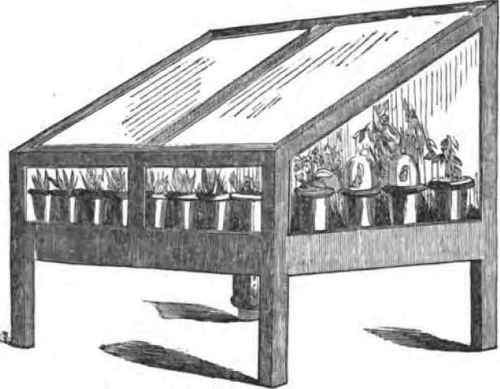
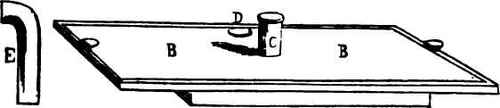
Fig. 1.

Fig. 2.
"Replacing the tray, it will be seen that the hole in the boiler fits over the box which contains the lamp. The flame of the lamp plays upon the inside tank, and the smoke escapes by means of the flue G, which conducts it out through the back of the case, quite away from the plants. Practically speaking, there is very little smoke, and whatever soot forms inside the hot-air chamber flakes off and falls on the lamp, so that in these respects the case is self-acting, and cleanses itself. The exact measurements of these several parts are, in the case I am describing, as follows: Length of the tray B B, thirty-four inches and a half; breadth, seventeen inches. As the pots stand inside the tray and the latter fits the frame, there is therefore a working space for plants of five hundred and sixty square superficial inches. Depth of the boiler A, two inches. The entire case measures outside along the front, thirty-six inches and a half; from back to front, eighteen inches and a half. The price of this size and make is forty-eight shillings.
"When placed in a window or green-house, light is admitted only at the top, but the case might be made with lights at the back, to suit a low window, and additional light would be obtained. But as the chief use of the Waltonian Case is to raise seeds and strike cuttings, a partial admission of light is usually sufficient.
" In managing a Waltonian Case, it is important that the sand should be kept constantly moist, or the heat will not rise freely, but any excessive moisture may lead to damping off. It is a good plan to sprinkle a little silver-sand over the surface of the soil in pots containing cuttings, as this is a great safeguard against damping; it is also important to strike cuttings, and indeed to sow seeds in small pots for such a pit - the smaller the pots the greater the safety. Those which require the greatest amount of heat must be placed towards the centre, immediately over the lamp, to be succeeded by others as soon as they are sufficiently started to be moved towards the sides. I find it a good plan for lessening trouble to keep one side partially open, and the other quite close, and to keep a regular shift from the close to the open side, as the plants make root, and demand more air. The work of re-potting and hardening off is as simple as in any other form of tank-bed - the great point being to shift them before they get drawn through close confinement with bottom-heat. Watering must be regularly attended to, and the water must be of the same temperature as the air of the case.
The pots may be removed for watering, and drained well before being returned to the case; though I use a fine rose, and water them as they stand, so as to irrigate the sand as well as the plants; and if the sand gets a little too moist, I get rid of it by a little extra ventilation.
"When set to work, it is really astonishing how much* may be done with a Waltonian Case. It is a little plant factory, in which seeds and cuttings of all kinds may be started, and carried so far with the aid of bottom-heat, that they may be safely hardened off for the green-house or the window, or, during spring, for planting out in the garden. It has many advantages over a common hotbed. In the first place, we are certain of heat, and can regulate temperature from any degree up to nearly 90°; the ordinary temperature, with a partial admission of air and the lamp freshly trimmed, being 75° to 80°. It requires an experienced hand to make up a hotbed with dung that shall give a steady heat for any length of time, and with the most experienced, accidents are not at all uncommon, such as damping off, burning up, failure of heat, and necessity for linings; but here we have simply to fill the boiler, and light the lamp, and then keep the case as close and damp as we please, or give air and light according to circumstances.
Besides this, there is no soiling of the hands, no wetting of the feet, no anxiety about frosts and mats, and the most serious part of gardening economy is brought within reach of a lady's delicate fingers, and the merest beginner's unripe judgment The limited size of the case may seem to militate against it somewhat; but though it is not intended for the commercial florist, who must strike cuttings by the thousand, it nevertheless will perform such an amount of work when well managed as to meet the wants of most amateurs who delight in a garden of limited dimensions, or who require the aid of close bottom-heat in connection with a green-house or conservatory. Geraniums, fuchsias, calceolarias, everything which comes from cuttings with bottom-heat, may be struck safely, and in quantities sufficient for all ordinary wants; the work of propagation being kept up during winter, and till the close of May, after which time most half-hardy plants may be propagated out of doors, without any artificial heat whatever.
In other respects there is no difference in the management of seeds and cuttings in a Waltonian Case and in a common hotbed." - Hibberd's Rustic Adornments, London.
Continue to:


My Books

