


Want Of Progress In Rural Taste
Description
This section is from "The Horticulturist, And Journal Of Rural Art And Rural Taste", by P. Barry, A. J. Downing, J. Jay Smith, Peter B. Mead, F. W. Woodward, Henry T. Williams. Also available from Amazon: Horticulturist and Journal of Rural Art and Rural Taste.
Want Of Progress In Rural Taste
To the men or women brought up in cities, an apple is simply an apple; they have no other name for it, and scarcely appreciate, if they distinguish its good or bad qualities. To the same individuals one tree is much like another; shade and grass are of the same quality, provided they are shade and grass.
So it is in all matters; true education to the masses is denied. To those who are only familiar with gardens, and trees, and flowers, and grass, a star is a star; we have about as much relish, perhaps, for the pleasures of the astronomer, as the dweller of paved streets has for our favorite studies. These considerations should teach us humility; because we know a little more than our visitors, there should be no one who has lived long enough to learn one thing well, but would acknowledge his ignorance.
The first step in rural adornment, we heard a lady remark, was to plant a hop-vine or a gourd-seed; the progress to greater enjoyments is thus begun, but how many in our great country live their whole lives without the true enjoyment which Nature provides. We dined once with a wealthy individual, who was his own architect and designer, but who did not know the name, the species even, of the fine tree under whose shadow he had built his costly mansion. The planting of a hop-vine was to him an unknown problem. His gardener had all the enjoyment of the employer's wealth, in this line at least.
Schools should make a beginning in this matter; they do attempt to instruct the tyro in astronomy and botany, but where is the elementary book on horticulture, or has any one ever known half a dozen teachers that have passed an examination at the High School, and who were going to devote a life to teaching others, that could give the name of the most common plants and trees which surround every rambler in the woods?
The next step to planting a hop-vine is the acquisition of a knowledge of the fact that vines yield shade; a grape-vine follows, and delicious fruit rewards the planter. Would that all the desolate looking farm-houses we have seen in the course of many thousand miles of travel the past season, had even the luxury of a hop-vine I We could wish that, in many places, a single tree had been planted coevally with the erection of the house, or that some trees that did once exist had been left to increase. It is a sorrowful fact, that in a very large extent of this great Union, the very beginning of taste is not seen. The beautiful garden, or even the single ornamental object, is the exception and not the rule, if we take a survey of the entire United States, and include the out-of-the-way roadsides, the mountain homes, and the whole interior. We have had no horticultural schoolmaster; taste has been omitted in the schedule of the school. Look at the result, and regret that it is so to continue for generations to come.
But, says the possessor of rural taste, a love of gardens and of planting is rapidly progressing. It is true they are increasing, but observation will show that they do not increase in the ratio of the population. A love of profit is increasing; money is the one thing that the masses worship. There formerly was respect for station, for age - is there any now? • Will any one say this is taught any more than respect for a kind of learning which is not to produce a moneyed result?
How can we change this want, and bring up the mind of the country to a love of nature? We answer, by teaching a knowledge of the common things around us, and doing this in schools. "How to observe" is a thing rarely taught. "A farmer in repairing his fences will sometimes notice in splitting a decayed rail or stake, holes excavated therein and filled with young spiders, commonly of bright, beautiful colors, which lie still and quiet, with only a slight quivering of their limbs, and is puzzled to know why, when thus broken in upon, they do not awake from their lethargy and run away, little suspecting the manner and purpose of their being accumulated there. They have been stung by the parent bee or wasp just sufficiently to stupefy her victim without killing it, and will remain so till required for the food of the young not yet perhaps born. And a thousand similar interesting and curious phenomena are passing under the farmer's and gardener's eyes daily, as he pursues his labors - phenomena which, if In nature's infinite book of secrecy A little he can read, aid in rendering his vocation beyond all comparison the most pleasant of any pursuit known to man".
Though the mission of our age may be to conquer the desert, we can see no reason why whole generations should pass away without those enjoyments which contribute to the softening of man's nature. The prairie annually springs up with beautiful flowers, and even fruit like the wild strawberry is said to redden the hoof of the traveller's horse as he takes his solitary journey. Why should we not incite Nature round our dwellings to perform the duties imposed by the Creator, and taste, amid the bitter cups too often offered to our lips, a little of the sweets, which are all but spontaneous, when we have learned to know their value and read them aright.
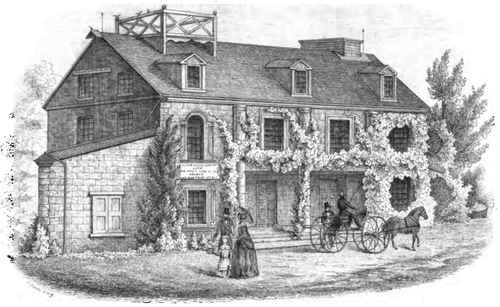
THE OLD BAPTRAM HOUSE.
Want Of Progress In Rural Taste #1
There is great difference in the constitution of the intellect, in matters of taste of any kind. Occasionally, one has a nice appreciation of rural objects from early childhood; another has a strong indication of native taste in art; another in mechanics; another in philosophy; another in science; and so on, through the whole catalogue of Divine creations and human inventions. These are God's own endowments, and those thus favored become the schoolmasters to others in whom original tastes of like kind are absent, yet possessing the faculty of cultivating them by the instruction of others. In the creative faculties of original minds, on all these different subjects, "there is a divinity that stirs" within them. The chronicles of all time which lie before us, give striking examples. Abraham and Lot were distinguished farmers, grandly possessed of fine taste in what was both beautiful and useful in rural life. Jacob was a physiologist, circumventing the dishonesty of his wily old father-in-law, Laban. Who had so grand an appreciation of the magnificence of creative power as David, as witnessed in his sacred psalms? While Tubal Cain, descendant of the first murderer, long before either of the others, was as cunning an artificer in brass and iron.
Solomon, great in architecture, also displayed matchless taste in the rural adornments of his pleasure-grounds. Several of the prophets show that they had exquisite perceptions of the grand and beautiful in nature; while Christ himself, greater, diviner than all, drew most of his parables from those delightful rural objects strewed along the paths of his own brief wanderings. Virgil possessed not only a natural, but a highly cultivated taste in rural affairs, as shown in his Georgics. Cicero was refinedly ornate in the rural embellishments of his own celebrated villa. In later time, Michael Angelo, with an opulence of original genius and cultivated taste, was a wonder in architecture, painting, and statuary. Lord Bacon, not only in philosophy and letters, but in planting and gardening, was a deep and profound teacher. In later time, Sir Walter Scott and Professor Wilson charmed the world with their appreciations of refined taste in landscape and natural scenery; and our American Downing, had he lived to mature age, would, perhaps, have been equal to any of them in the delightful aptitude of his teachings.
So much for minds in which an original taste for their chosen pursuits, or recreations, was planted.
In America, grappling with a stern necessity, even down to a recent day, we have, comparatively, few striking examples of refined rural taste in the labors of those who have passed before us. Yet, there are some grand old places in the Revolutionary States, indicating the presence of both a strong original taste, and well cultivated art, in selecting, laying out, planting, and preserving them, well showing that their founders were no pretenders in what they did. Within the last thirty years, a better opportunity has been afforded us. With considerable original taste, increasing wealth, and leisure, to pursue the proper study of rural embellishment, many new and beautiful places have arisen from the wild wastes around them; and, although many bald and bastard examples, where a large expenditure of labor and material have been thrown away, exist among them, we have many spots which, when time enough has elapsed to give growth to their plantations, and antiquity to their erections, will present choice specimens of a discriminating taste, and a serene beauty. Yet, in the mass, man is wofully unin-structed. We saunter along, heedless of the native beauty which surrounds us, and which we might appropriate to ourselves almost for the asking.
We do want schools of taste, and of art, in rural embellishment. But who are to be the teachers? A few only of the English books and authors, from which we draw our ideas, are possessed of either correct taste or competent instruction. Of native authors we have any quantity; and how few of them are of any lasting account? The number indeed is small. What we, in America, need is, the understanding of first principles. Scarcely any two places are alike in natural position, capabilities, and soils. They require different treatment, and that treatment varied and diversified by the delicate, discriminating exercise of taste, founded in well-established principles, and appreciation of the art to be exercised. We have no such schools; and if we had, where are our schoolmasters? There is scarcely a rural paper in the country but has advertisements of such, and we see some of their labors in the paltry checker-work of door-yards, lawns, and, now and then, a so-called park, stuck full of inappropriate things of no meaning! But we must live in hope, and, meanwhile, strive to do the best we can till a better day shall dawn upon us, or the rising spirit of a few master minds shall teach us with an unction both impressive and lasting.
Continue to:


My Books

