


Visits To Country Places-No. 8. Around Newport, R. I. Continued
Description
This section is from "The Horticulturist, And Journal Of Rural Art And Rural Taste", by P. Barry, A. J. Downing, J. Jay Smith, Peter B. Mead, F. W. Woodward, Henry T. Williams. Also available from Amazon: Horticulturist and Journal of Rural Art and Rural Taste.
Visits To Country Places-No. 8. Around Newport, R. I. Continued
Here is a surprising list for a Northern home; the beneficial effects of the proximity of the Gulf-Stream are clearly traced, and we cannot wonder that so many people are selecting Newport for both a summer and a permanent residence.
At Mr, Kane's, we saw aa example of the value of Swift's Lawn Mower, that sets at rest every possible objection to the success of that instrument. The lawn is as perfect as any one can desire - a smooth, even, green carpet, that gives more effect and expression than can be imagined by those who have not witnessed a good example of high keeping. Two men and a horse mow six acres in a day, also cutting round the shrubbery, and this includes taking away the short grass picked up by the machine at the same time that it gives a good rolling to the ground.
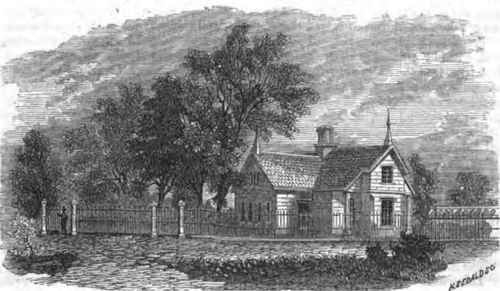
The whole effect of Mr. Kane's grounds is eminently satisfactory. Neatness prevails throughout. The visitor to Newport will recall the place by the very chaste entrance lodge of brown stone, of which the foregoing is a sketch. The orchard-house is seen on the right, and this has for neighbor a large and successful grapery, and a most productive garden, Ac. etc. In short, Mr. Kane's already presents the air of an old European place, and when the hospitality of its owners, the elegance of the entire manage, and the charming family of children (who are great-grandchildren of John Jacob Astor), are taken into the account, we know of no more agreeable spot in America.
The following cut represents the mode of laying out Mr. Kane's grounds by Mr. Leucars: -
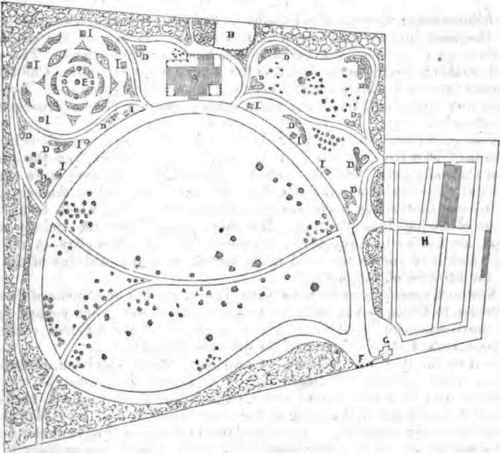
A. The mansion.
B. An open vista to the sea. D. Beds for shrubbery.
E. Flower garden.
F. Entrance gate.
G. Gate lodge.
H. Kitchen garden, graperies, orchard-house, etc. L Vases and statues.
Thomas R. Hazzar&s, at Vaucluse, about five miles from Newport, is an example of a well-planted place, now somewhat old, and, we must say, a little neglected by its owner. It was the residence of Samuel Eland, who laid it out in the English style of gardening, with artificial water, and groves in abundance, but time has so intermingled the trees and shrubs, that the traces of the original design have been nearly lo6t. A thorough improver who would go to work judiciously, might make much of Mr. Hazzard's grounds. Even as it now is, it is attractive. The owner is understood to be more attached to rendering his own species happy by charitable acts to the suffering, than to the inanimate but beautiful vegetation around him.
Miss Gibbs', near to Mr. Hazzard's, is a fine old place, with some remarkable specimens of trees, bat we took no notes here of a short walk in the plantations now fairly grown into "woods".
J. Prescott Hall's place, some distance above Newport, is a good example of successful farming and of open-hearted hospitality. Here stands the original • Buffum Pear-tree, in full vigor, though it has seen many a blast, and has twice been repaired with cement in its old body. Mr. H. has begun to plant, and already his screens promise protection.
Alfred Smith, an enthusiast in new Evergreens and other horticultural matters, resides in Newport, and was an esteemed correspondent of Downing's. His garden possesses a great variety of the newer trees and shrubbery; a visit to it will be a treat.
Our fellow-citizen, General Cadwallader, is making great progress in laying out one of the finest sites for building in all this region. It is near the sea, on the south shore, at Coggershall's Point, and commands very fine views. The planting and levelling has been in progress for several seasons. Mrs. Cadwallader takes great interest in this work, and her taste is eminently successful. Ere long, the Newport visitor will no doubt see a stately mansion rise to ornament this superb situation.
William S. Wetmore has one of the largest and most costly mansions in Newport, built of Fall River granite. It is situated in the "Neck," on the road to General Cadwallader's. Mr. Wetmore has about forty acres, very large and well constructed graperies, conservatories, etc. He has a fine view of the ocean.
Mr. George Calvert has a cottage with about three acres, which he has made the most of by judicious planting. His literary tastes, and the vicinity of Mr. Bancroft, are not to be forgotten in any notice of Newport society - a residence among which is of course rendered more agreeable by a knowledge of the families of the habitues of the place.
At Newport, especially at Edward King, Esq.'s, are fine specimens of Cembran Pine, twelve to fifteen feet in height; a slow-growing tree, when young, but one of the most ornamental. Also, very fine specimens of the different varieties of evergreens, Oak, Purple Beach, and the different Junipers.
In front of the Redwood Library, we noticed the finest specimen, probably, in America, of the Fern-leaved Beech, fifteen or twenty feet in height, which we hope those who read this sketch, and visit Newport thereafter, will not fail to remark. A speciality of the place is the great produce, and the beauty of the Quince-trees; they attain a size, and bear fruit of a quality, nowhere else realized in our observation; in fact, they remind us of the finest Orange-trees in their greenness and luxuriance.
Before concluding, we may observe that Mr. Kane has planted some three hundred Rhododendrons, quite large; they are employed as "under growth," and are to be cut down when they become too tall; he has tried this method, and finds it to be the only way to get well furnished, stocky plants. In fact, he thinks if the Spruces, Pines, and most of the Evergreens, were headed in, they would be much improved, by being more compact; the soil at Beachclyffe is so rich, and the warm, moist climate, so favorable to these trees, is of so forcing a character, that nearly everything grows too quickly, or, rather, too tall and slender.
We shall watch the progress of these places with much interest.
No sketches " Around Newport" can be complete without mentioning the capital fishing that is to be enjoyed here, both from boat and shore. We are constantly reminded, by a wish to throw in a sketch of character here, and a hint of some elegance now and then, that we are encased in a kind of armor which forbids the use of one'a natural taste for accounts of conversations, or the introduction of anecdotes of home circles. Were we more unshackled in these respects, and less confined to particular topics, Newport would afford opportunities to sketch pleasant people no less than scenes; we should, in fact, close every sketch withont the mortifying reflection that "kindness," " hospitality," the ladies and the gentlemen who people the delightful places, are to be omitted; for, after all, the paradise is more frequently in the inhabitants than in the most cultivated scenery.
Continue to:


My Books

