


Kirtland's Mary Cherry - Kniphofia Uvaria (Saw-Edged-Leaved Kniphofia)
Description
This section is from "The Horticulturist, And Journal Of Rural Art And Rural Taste", by P. Barry, A. J. Downing, J. Jay Smith, Peter B. Mead, F. W. Woodward, Henry T. Williams. Also available from Amazon: Horticulturist and Journal of Rural Art and Rural Taste.
Kirtland's Mary Cherry - Kniphofia Uvaria (Saw-Edged-Leaved Kniphofia)
Kirtland's Mary Cherry
During the Cherry season, I discovered that a graft labelled Kirt-land's Mary proved by its fruit to be the Elton. From it have been distributed, during the lost two years, grafts to horticulturists in various parts of the country. The error is no doubt one of my own, but how it occurred I do not know. It would be well for all cultivators of fruit having the first named grafts from me, to test them before they propagate any number. J. P. Kirtland. - East Rockport, Ohio.
Kissena
This variety has proven entirely satisfactory. I started two years ago with three plants. I now have exactly that number. Have lost nothing, and am perfectly satisfied with this variety, as it has proven much better than many others with me. Fruit very handsome. A perfect duplicate of the cut in catalogue. Entirely destitute of that delicate and rich flavor claimed for it.
The Kittatinny And Wilson Blackberries
We find a large number of Southern growers this year very much dissatisfied with the Wilson Early, and the tide seems to be turning again in favor of the Kittatinny. In the West, one cultivator says: "No other named variety is worth a moment's notice, in comparison with the Kittatinny. One great requisite of success with him is not to cut back the canes in spring, as they never furnish more blossoms than they can perfect in fruit. But thorough pinching back the previous season is of the greatest importance".
The popularity of varieties in New York varies with each season. Last year the Wilson was most popular; this year the Dorchester was the favorite.
A Kittle Bed Of Herbs
Every family should have its little patch of "Herbs." They are easily obtained; some of them are perennial, and require replanting only once in several years. The seed can all be found at our agricultural and horticultural stores. The list is as follows : Sweet Marjoram, Marigold, Thyme, Winter and Summer Savory, Coriander, Aniseed, Rosemary, Lavender, Sweet Basil, Caraway, Fennel. .Thyme, Winter Savory, Fennel, Lavender and Sage are perennial; the others require the seed to be sown annually. - Germantovm Telegraph.
Knight's Early Black
For private gardens or sheltered localities this is one of the most desirable varieties, as its fruit matures early and is of the highest excellence; but the tree is a little tender, and unless it can be grown so as to be somewhat protected, it is liable to die out. In habit it is short-jointed, and makes a tree of only medium size. The fruit is large, black, juicy, half tender, very rich and sweet, and fine flavored.
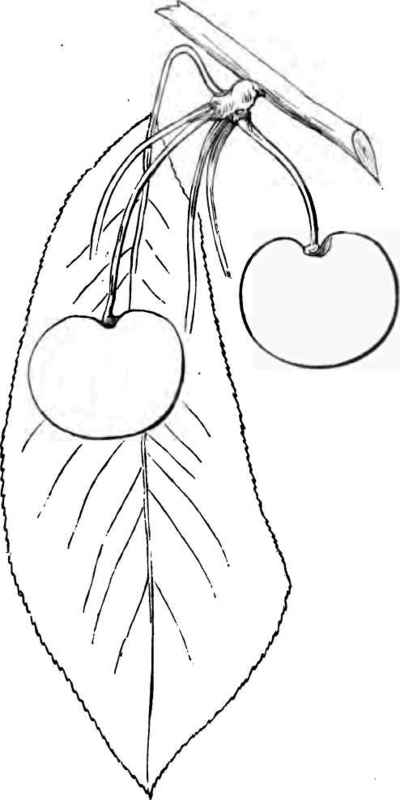
Fig. 56. - Governor Wood.
Kniphofia Uvaria (Saw-Edged-Leaved Kniphofia)
Long but erroneously known as Tritoma uvaria; but it has had many other names, such as Tritomanthe, Aloe, Atetris, and Veltheima. It is of the natural order of Asphodels. The leaves thin and three feet long, grow in thick tufts; the flower-stems are about the same length, each crowned with a dense, branched dropping spike of bright red flowers gradually becoming yellow. " Although a native of the Cape of Good Hope, no plant can be more hardy, nor more easily cultivated, and, assuredly, none more worthy of a place in every garden." It blooms in August (Ibid. 4816).
Continue to:


My Books

