


The Mountain Laurel - Mowing Strawberries
Description
This section is from "The Horticulturist, And Journal Of Rural Art And Rural Taste", by P. Barry, A. J. Downing, J. Jay Smith, Peter B. Mead, F. W. Woodward, Henry T. Williams. Also available from Amazon: Horticulturist and Journal of Rural Art and Rural Taste.
The Mountain Laurel - Mowing Strawberries
The Mountain Laurel
ED. Western Horticulturist: In the March number of The Horticulturist, I notice an article, " Notes from my Garden," by my old friend, Porte Crayon. If not out of place, I should like to ask him to give, through your columns, his experience in transplanting the Kalmia Latifolia - commonly called Mountain Laurel - a beautiful, fragrant, and hardy plant. I am anxious to obtain some of the plants, if they can be grown in this locality. I might ask for this information direct from my friend, but no doubt there are others, among your readers, who would be pleased to hear of the success of growing this much admired plant. This coming summer, three years ago, I made a visit to his place of residence, Berkely Springs, West Va., and in his grounds saw a number of plants which had been transplanted there. I am desirous to know with what success he has grown this Kalmia Latifolia.
St. Joseph, Mo. A Subscriber.
Mountain Laurel - Kalmia
The kal-mia, or laurel as it is commonly called, is one of the finest evergreen under shrubs. It is perfectly hardy in any exposure, but it chooses a soil largely composed of vegetable loam and sand. Near running water it grows and blooms most freely, but natu rally it is found often in the most barren rocky situations imaginable. As an under shrub it is particularly desirable, as it bears the drip of other trees without perceptible injury. Its flowers are produced most freely in June, but it continues more or less of bloom for a month or six weeks in succession. The latifolia, see engraving, and au-gustifolia and narrow-leaved, or sheep laurel, are the most valued varieties. The flowers of the former are a white or light pink delicately spotted, while those of the sheep laurel are dark red.
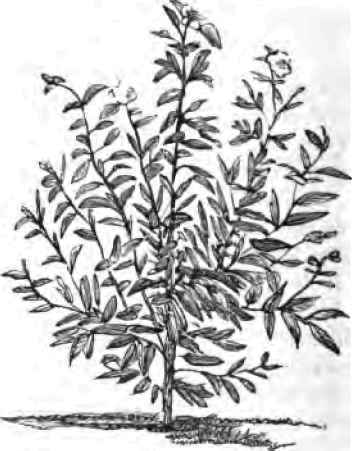
Fig. 68. - Kalmia.
The Movean Pear
This is a seedling of Monroe Co., N. Y. A large, handsome fruit, of good quality, though rather variable. Tree very vigorous, and an abundant bearer. It is not much disseminated, and may not prove worthy of extensive culture.
Moving Trees
In removing trees early in the past month, it was interesting to remark that nurserymen who had underdrained their grounds, were enabled to commence their deliveries at least ten days, or two weeks, before their neighbors who had neglected this highly important precaution. A commentary, this, on draining, which speaks volumes. It is stated that land worth but a dollar and a half an acre, in England, has been converted to the value of fifty dollars, by drainage alone.
Mowing Machines For Lawns
Your Ilartford subscriber must be mistaken in Shanks & Sons address. I have seen the mowing machines used in small places where there were no regular gardeners, to mow short grass. I think Shanks & Sons advertised them some years since in Arbroath, Scotland - not New Brunswick. A Nurseryman. - Mt Pleasant, C. W.
Mowing Strawberries
During one of the winter meetings of the Massachusetts Horticultural Society, the subject of mowing off the leaves of strawberries came up for discussion; most of the speakers agreed as to its highly beneficial effect. It resulted in producing a growth of more vigorous and healthy foliage; the flower buds for the next year being formed at this time, such a quality of foliage is of great importance. Further observation has also shown that not only the tops but the roots are renewed at this time, giving a new and vigorous set of roots to furnish nourishment to the growing fruit.
Continue to:


My Books

