


The Northumberland Fill-Basket Raspberry - Nostra American Sylva
Description
This section is from "The Horticulturist, And Journal Of Rural Art And Rural Taste", by P. Barry, A. J. Downing, J. Jay Smith, Peter B. Mead, F. W. Woodward, Henry T. Williams. Also available from Amazon: Horticulturist and Journal of Rural Art and Rural Taste.
The Northumberland Fill-Basket Raspberry - Nostra American Sylva
The Northumberland Fill-Basket Raspberry
We present for a frontispiece, this month, the Northumberland Fill-basket Raspberry, from a drawing made by a lady artist. This Raspberry is sometimes called the Northumberland, sometimes the Fill-basket, but its full name is the one at the head of this article. It is a comparatively new variety here, and ranks among the hardiest The canes are short and stout; the fruit is firm-fleshed, of ing. We have fruited it only one season, but consider it desirable, since we have found it to do well without covering, though it may possibly need protection fur-good size, and good quality; it is productive, and continues some time in bear-ther North. Mr. Ferris, of Throgg's Neck, has grown it two or three years, also without covering.
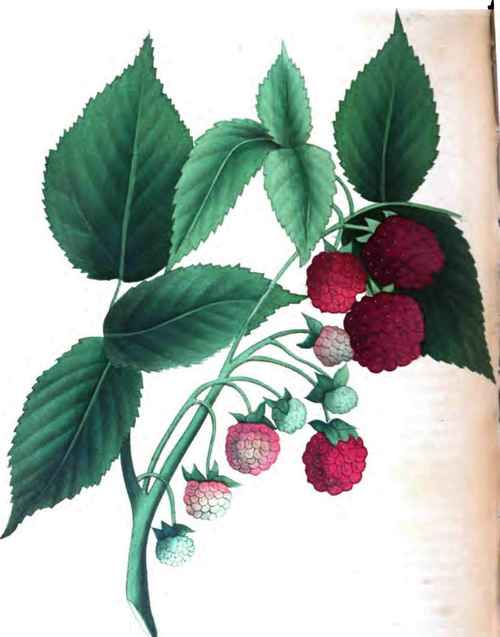
NORTHUMBERLAND FILLBASKET
Northwestern Pomological Convention
The next Annual Meeting of this association will be held at Burlington, Iowa, commencing on the last Tuesday (26th) of September, at 10 o'clock A. M., and continuing four days. Then "come one, come all" interested it fruits and fruit trees.
Communications are solicited on any or all branohes of horticulture - which, together with any boxes of specimens, may be directed to the "N. W. Pomological Convention, care of Messrs. AverY, Burlington, Iowa".
Editors friendly to the cause, please notice. By order. F. K. PhOenix, Cor. See'y.
The Norway Pine. Pinus Resinosa
The Red or Norway Pine is of rapid growth, quite handsome while young, its foliage being a dark rich green; but as it acquires age it becomes sometimes too open and sparse of foliage to render it specially desirable, except in large grounds. Where there is room for several trees of a like habit and color of foliage in the formation of masses, we should use one or more of this variety.
The Norway Spruce
The Norway Spruce is admirably adapted to extensive lands and parks, where there is no want of room for the attainment of its full size and fair proportions. They should always be placed in wild, broken, and picturesque scenery, where they will appear perfectly in keeping, and add wonderfully to the peculiar beauty of the situation. On all grounds where there are abruptly varied surfaces, steep banks or rocky precipices, this class of trees lends its efficient aid to strengthen the prevailing beauty, and to complete the finish of the picture.
Whether as a single tree upon the grass, or as a standard in the shrubbery, towering above all others, it has great claims for us, and may justly be called a graceful and magnificent tree.
Nostra American Sylva
The recent issuing of a second and improved edition of Michaux d. Nuttal's Sylva Americana is an evidence that public taste in the United States is advancing in the right direction. Demands for it are coming from every part of the Union. This is all right; for it can hardly be excelled for beauty and usefulness, by any other publication. By its aid any intelligent person can easily render himself familiar with the history and habits of our forest trees. It is equally valuable for the farmer, arboriculturist, botanist, and individual of taste. A place should be assigned for it on the center-table of every well regulated family, in lieu of the trifling trash which too frequently abounds. It should be found in every public and extensive private library.
"The Managers of State and County Agricultural Fairs would diffuse much greater benefit by offering it as one of their main premiums than by bestowing their thin and alloyed stuff called plate. JARED P. KRITLAND.
Continue to:


My Books

