


The Dielytra Spectabilis
Description
This section is from "The Horticulturist, And Journal Of Rural Art And Rural Taste", by P. Barry, A. J. Downing, J. Jay Smith, Peter B. Mead, F. W. Woodward, Henry T. Williams. Also available from Amazon: Horticulturist and Journal of Rural Art and Rural Taste.
The Dielytra Spectabilis
This charming plant proves to be such an acquisition, both to the garden and green-house, that we have thought it fully entitled to a place among our colored plates, and therefore present it as our frontispiece for the present month. We must say, however, to those who have not seen a good specimen in bloom, that the meagre raceme which we have space to represent, conveys but a very imperfect idea of its rare grace and beauty. To see a plant measuring three or four feet in diameter, and bearing twenty or thirty flower stalks, each with numerous gracefully drooping racemes of the most unique and brilliant rosy flowers, is to see the Dielytra as it should be. We beg to assure our readers that whatever has been said in praise of this plant, has not been exaggerated - that it is no novelty lauded to-day to win it favor with the public, and in six months hence to be cast aside as a "humbug".
It is now some ten years or upwards since it was sent from China to England by Mr. Fortune, the collector of the London Horticultural Society, and since that time it has bloomed among the finest collections of plants in Europe, and in all cases, it has elicited unqualified praise. For many years its culture was confined to greenhouses and conservatories, as most rare plants are; but latterly, as it became more multiplied, it has been trusted to the garden.; and there, in a rich soil, with ample room to spread its roots and gather food, it has developed its native luxuriance and beauty. The finest specimen plant we have seen in this country in the open ground, was in the garden of Abijah Reed, Esq., of Hulberton, Orleans Co., N. Y., a year ago. That gentleman loses no opportunity to enrich his little garden with whatever is new and excellent, and this he considers one of the finest hardy herbaceous border plants he has seen. What adds immensely to its value is its entire adaptation to either house or garden culture, and that it requires only the simplest treatment, out doors or in, to ensure perfect success. It is a plant for the million.
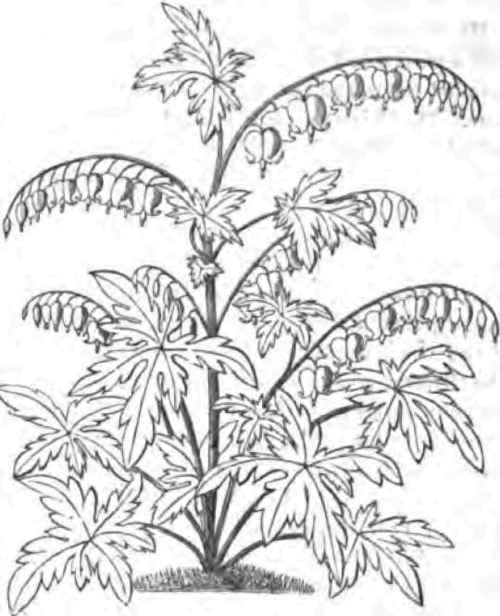
Our correspondent, Mr. Sanders, has given an account of his success in forcing it, and we have been able from our own experience to endorse all he has said. In the garden it is as easily grown as a common Paeony, requiring no more than a good deep and rich soil - the richer the better. It is also one of the easiest of plants to multiply - just as easy as a Dahlia. We propagate it exactly in the same way, viz., by cuttings of the young shoots, taken off in spring, and placed on a gentle bottom heat. Plants struck thus, and bedded out as are Verbenas, Petunias, etc., will bloom finely a long time toward the latter part of the season; and by these succeeding nearly all summer. It can also be very easily increased by taking up the plants and dividing the roots in spring, before it commences to grow. We feel confident that it will make an excellent window or parlor plant A large plant put into a pot or box in October, and kept dry the early part of winter in a cool room, where the temperature will be about 40°, or just above freezing, and then brought into a temperate heat about the middle of February or 1st of March, will in a short time be a beautiful object. The annexed wood-cut is given to illustrate in some degree its habit of growth.
We remember seeing in an English journal an account of a plant that measured upwards of thirty feet in circumference and five feet high, with upwards of two hundred perfect spikes of blossoms at once. The shoots are succulent, almost transparent, and attain the height of two to three feet. The leaves are somewhat like those of the Paeony in form, and the flowers are produced on the young shoots in bending racemes, each having from ten to twenty flowers. These are a brilliant rose color, and in form resemble somewhat a small fancy work bag. The corolla consists of four petals; the two large ones, forming the most showy part of the flower, are compressed and turned backwards at the point, and the two small ones, which project below the others, adhere to each other, and cover the stamens. These latter are whitish. On close examination, the flowers are no less curious and wonderful than they are beautiful.
Mr. Fortune described it as one of the most popular plants in China, cultivated with a passionate fondness by the Chinese mandarins among their rarest and most beautiful plants, and that figures of it in bloom embellish some of their finest china-ware. The Chinese name is "Hong-pak-Montan-wha," or flower of the Montan red and white. They give it this name on account of the foliage resembling that of the Montan Paeony, and the flowers being red and white.
It belongs to the natural order Fumariacae - Fumeworts of Lindley's "Vegetable Kingdom " - and, as a French writer truly says, is the queen of them all. It has been variously called Dicentra, Dielytra, and Diclytra. In England and in this country it is now almost universally written Dielytra. The French have it Dicentra, on the ground that this is the oldest name and the most significant, as it is composed of two Greek words having reference to the peculiar form of the two large petals. The Germans usually write it Diclytra; and Prof. Berkley, who is good English authority, seems to consider this correct In a note which appeared in the Gardener's Chronicle in July, 1853, he said the vexed question as to the comparative claims of these names is solved beyond a doubt on reference to the original paper in which the genus was proposed. In "Romer's Archiv. fur die Botanik" (Romer's Botanical Records), 1797, Borckhausen, in a paper on the genus Fumaria, proposes Dicly-tra for Fumaria cucullaria Linneaus. resting its character on the peculiar struc.

DICENTRA or DIELYTRA SPECTABILIS.
Continue to:


My Books

