


Gathering And Preservation Of Fruits. Part 4
Description
This section is from "The Horticulturist, And Journal Of Rural Art And Rural Taste", by P. Barry, A. J. Downing, J. Jay Smith, Peter B. Mead, F. W. Woodward, Henry T. Williams. Also available from Amazon: Horticulturist and Journal of Rural Art and Rural Taste.
Gathering And Preservation Of Fruits. Part 4
" When all the fruits are thus arranged in the fruit-room, the doors and windows are left open during the day, unless in wet weather. Eight days exposure to the air in this way will be necessary to deprive the fruits of their surplus moisture. After that, a dry and cold time is chosen to close hermetically all the openings. The doors must be opened no more, except when necessary to enter.
"Until the present time we have employed no other means to remove moisture from the fruit-room but by creating in the interior, currents of air more or less intense. This mode is attended with serious inconveniences for the preservation of fruit In the first place it produces an equilibrium of temperature between the atmosphere of the fruit-room and the exterior, and this change is very injurious to the fruits. In the second place a glare of light is instantly admitted to the fruits, and this is no less injurious than the change of temperature. In fine, this vicious method should not be practiced unless the exterior temperature is not below the freezing point and the weather is dry. In the winter, however, the weather is generally the reverse of this, and the fruits have to be abandoned to a destructive moisture.
"To escape this difficulty, we advise the use of chloride of calcium. This has the property of absorbing so great a quantity of moisture, (about double its own weight,) that it becomes liquified after being exposed for a certain time to a moist atmosphere. Fresh lime has the same property of absorbing moisture, but at the same time it absorbs the carbonic acid set free by the fruits, and it is important to save this gas, as it aids materially in preserving them.
"To employ the chloride of calcium, a sort of wooden box should be constructed, (A, fig. 7,) lined with lead, (F,) about 18 inches wide and 4 inches deep. It is raised abont 18 inches from the floor, on a small table (B) having one of its sides (C) about 1 1/2 inches lower than the other. At the middle of the lowest side of the box a small mouth is fixed for the liquified chloride to run over into a stone jar (E) placed below it. The chloride is spread in the box in small porous particles, very dry, and about 3 inches thick; and if the quantity employed be entirely liquified before the fruit is consumed, a fresh supply may be added. About fifty pounds applied at three times is sufficient for a fruit-room such as the one described above. The liquid which results from this operation should be carefully saved in the jar, and be kept covered until the following season. When the fruit-room is filled anew, the liquid may be put in a brass kettle and placed over the fire, where it will soon evaporate to perfect dryness, and may be employed again in the same manner as before.

Fig. 7.
"Such are the cases necessary to fill the conditions we have indicated for the preservation of fruits. The fruit-room should be visited at least once in eight days, to remove the fruits which begin to decay, set apart those which are ripe, remove the decaying berries from the grapes, and renew the chloride of calcium".
In the London Gardeners' Chronicle Mr. Robert Thompson gives the following description and plans of the fruit-room of a gentleman near London, who has for several years exhibited pears in fine condition at a season when the same varieties are generally gone. It illustrates the leading principles to be observed in building a fruit-room; but it must be remembered that in our Northern States at least, greater precautions must be taken to prevent freezing. Thick walls with air spaces, or filled with some non-conducting material, are among the esentials in this regard.

PLAN OF MR. MOORMAN 8 FRUIT-ROOM.
Description And Plans Of Mr. Moorman's Fruit-Room
The room was not originally constructed for a fruit-room; but by a little adaptation Mr. Moorman has succeeded in rendering it a most excellent one, as is proved by the prizes awarded for the productions exhibited from it, - not in any one year, but repeatedly, year after year. It is a partitioned-off portion of a loft which extends over a coach-house and stables, and is that part which is above the coach-house. It was originally fitted up for a harness-room, the walls, as is usual in such places, being lined with wood. The roof is slated. The range of building is detached, and faces the southwest.
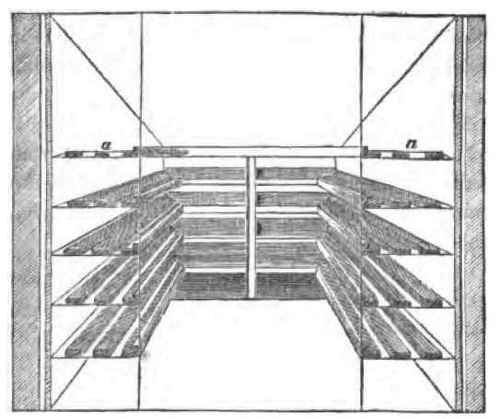
"It will be observed that there is a cavity (c) between the boarding and walls. This, I believe, is an important circumstance, and so is the wooden lining, because air and wood are known to be slow conductors of heat. The ceiling on the north side is double, and the floor is wood above a ceiling. We may therefore conclude that a uniformity of temperature in the interior of the room is insured to a considerable extent There is a small stove, (d,) but it is seldom used, and never with the view of warming the air of the room, unless the temperature is actually below freezing. The fruit is therefore kept cool. The swing-window (e) is occasionally a little opened;
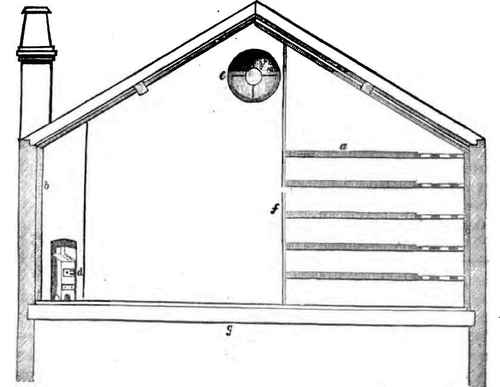
LONGITUDINAL SECTION.
Explanation Of The Letter
a, Shelves made with battens, 11/2 inch wide and 11/2 inch apart. b, Close bottrding around the sides of the room, c, Air space between the boards and we wall. The roof has also an air space on the north side, between the two plaster ceilings, as shown on the section. d, Stove. e, Circular window hung on pivots, and fitted with but it is at all times covered with a roller-blind, so that the fruit is kept in the dark. A little fire in the store, air being freely admitted by the window at the same time in a dry day, is useful for speedily removing any damp which may arise from the fruit. The shelves (a a) hare a layer of clean-drawn straw laid across them; on this the fruits are placed singly.
"From a consideration of all the above details, it may be inferred that if a fruit-room be built over a place where there is a free circulation of air, its roof double ceiled, the walls lined with wood, a cavity being left between these two, it will possess the essential properties of the one under consideration.
"The more important principles necessary to attend to, with regard to the long-keeping of fruit, are uniformity of temperature, coolness, and darkness. If the temperature is uniform, there can be little or no deposition of moisture on the surface of the fruit; but if the air of the room should be say ten degrees warmer than the fruit, then the relative coldness of the latter will cause a condensation of the moisture contained in the air in contact with the fruit, just as a cold glass becomes dewed over when brought into a warm atmosphere. If the air is indeed very dry, then a proportionately greater difference of temperature is necessary to produce the above effect; but in winter the hygrometer seldom requires to be cooled more than a few degrees before it indicates a deposition of moisture. Fruits with smooth, glossy skins, in close contact with the cold substance beneath them, are those most profusely covered with moisture from the above cause. In russeted varieties, their dry, rough coats serve as non-conductors of heat, and hence less moisture is deposited on them. When the air becomes colder than the fruit, a contrary action - that of evaporation - takes place, and the surface of the fruit becomes dry.
But this wetting and drying must prove very injurious, while its cause - alternations of temperature - must likewise affect the specific gravity of the juices of the fruit. Mr. Moorman's fruit is not exposed to such vicissitudes; for when the weather becomes frosty, it is several days before the thermometer in his fruit-room is affected as much as one degree.
"It may be remarked that in giving air, a period of the day should be chosen when the thermometer outside indicates the same temperature as that in the, room. No deposition of moisture can then take place in consequence.
" With regard to coolness, it is well known that this condition is favorable to the long-keeping of fruit; for we act on the contrary when we wish to render any variety fit for use before its usual time. The fruit-room in question must be cooler on an average than if it had been on the ground; for the latter, under a, building particularly, is much warmer than the air in winter.
"Light accelerates the maturity and ultimate decay of fruit exposed to its influence. If the soundest specimens are picked and placed opposite a window, they soon become much inferior in appearance, compared with those from which the light is excluded, all other circumstances being the same. In Mr. Moorman's fruit-room the light is excluded by a blind, even when air is given.
"By such arrangements as those above detailed, Mr. Moorman keeps the Marie Louise in fine condition till after Christmas, He possesses a selection of the best varieties of pears, which he grows chiefly on espaliers, which are well managed by his gardener, Mr. Tucker, in the Clapham-road. He had some remarkably handsome specimens of the Winter Nelis in his fruit-room in January, much larger than that excellent variety usually grows. We have also seen very large specimens of the Marie Louise, grown at his seat at Box Hill, in Sussex. The tree which produced them is trained against the gable end of a barn, about a quarter of a mile from the sea, and this tree is exposed to the strong sea-breezes from the southwest. It was planted in good soil, and a spring below it was discovered when digging the hole for the compost, previous to the tree being planted.
Continue to:


My Books

