


Leg Movements
Description
This section is from the book "Massage And Medical Gymnastics", by Emil A. G. Kleen. Also available from Amazon: Massage and medical gymnastics.
Leg Movements
Leg movements, as a rule, deplete the head and upper part of the body. They also have the above-mentioned general effects of active movements. It should be noted that most leg movements do not in any way impede respiration, and on this account they may be given to weak patients and to certain cases of heart disease earlier than arm exercises. An exception to this is made by all those exercises in which the flexors of the hip work, because the abdominal muscles must also be brought into action to fix their origin.
Movements in the Ankle Joint.
Reach-grasp-high-standing
Free-standing
Foot-bending and -stretching.
Half-lying Foot-bending and -stretching (Fig. 56). - The gymnast sits in broad stride-sitting position, facing the outer side of the patient's foot. This is placed over the gymnast's knee so that the heel in strong plantar flexion lies on the inner side of the knee. The gymnast grasps the anterior part of the metatarsal bones, with one hand placed on the dorsal and one on the plantar surface. Against the resistance of the gymnast the foot is bent and stretched alternately five to eight times each way, when the above mentioned over-stretching is made at the limit of each movement. Usually the movement is finished by a passive dorsal flexion with gentle shaking.
As a rule, and when no other special way is prescribed, the exercise is given in the above manner, i.e., so that the muscles work concentrically, but it can of course also be given concentrically and eccentrically, or with only eccentric work, or as a purely passive movement.
If the muscles are to work both concentrically and eccentrically the patient bends the foot upwards (dorsally flexes) while the gymnast resists, and then the gymnast extends (plantar flexes) the foot while the patient resists; the dorsal flexors work concentrically and eccentrically. Afterwards the patient extends against the resistance of the operator, who then flexes the foot against the resistance of the patient; the extensors work concentrically and eccentrically.
If the movement is to be double - 2 Foot-bending-stretching-the gymnast sits in front of the patient, whose feet rest on a stool or on a cushion on the gymnast's knees.
It can also be given in the first way by two gymnasts.
High-Reach-Grasp-Standing Foot-Bending And Stretching
The patient stands on a stool in Reach-grasp-st. position, places one foot so that the heel is supported close to the edge of the stool, while the anterior part of the foot lies beyond it. The operator, in Half-knee-standing position (on one knee) at the side of the patient, grasps with one hand (the inner) the patient's heel to fix the foot, while with the other hand he resists the movement, which, as in the preceding, is finished by a passive dorsal flexion.
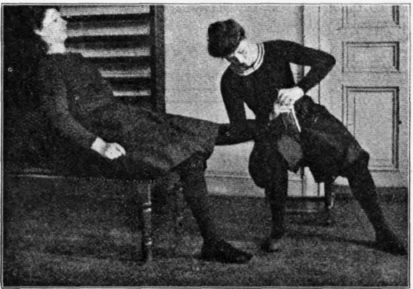
Fig. 56.
Free-standing 2 (double) Foot-bending and -stretching = Alternate Toe- and Heel-raising. - The patient raises alternately the heels and toes (front part of the foot) as high as possible from the ground.
Practised at first in Reach-grasp-standing position, later in Wing-standing.
(N.B. - No flexion in hip or knee joints. Movement takes place in ankle joint (astragalo-tibial joint).)
The working muscles are: -
For flexion (dorsal flexion), muscles in front of leg; for extension (plantar flexion), muscles at back of leg (calf muscles).
Special Effects
(a) Blood supply, metabolism, and production of heat in the feet and legs are increased.
(b) Depletes the head and upper part of the body, especially if given double.
Uses
1. For cold feet and legs.
2. After massage of these parts, to increase the flow of arterial blood and fresh fluid to the tissues.
3. As a gentle leg exercise in general gymnastic treatment. The Effects of the various Starting Positions. - (a) Half-lying position allows the effect of the exercise to be as pure as possible.
(b) High-reach-grasp-standing is slightly harder, because many muscles must work for maintaining the position. Seldom used.
(c) In Free-standing position the resistance is made by the weight of the patient's own body, and consequently cannot be modified.
Half-lying Foot-inversion (= Supination) and -eversion (= Pronation). - The position of the gymnast and the grasp is similar to Half-lying Foot-bending-stretching, but the grasp is modified so that the resistance acts on the sides of the feet. The foot is kept strongly dorsally flexed throughout, in order that the astragalus may be fixed by its anterior broad surface being pressed between the malleoli, and the movement thus limited as much as possible to the tarsal joints. The movement is usually given so that the muscles work concentrically, but if the pronators or supinators alone are to be exercised it is then done so that they work concentrically and eccentrically, and usually only in the inner part of the range of movement, i.e., the patient does pronation or supination as far as possible against the resistance of the gymnast, who then turns the foot back to the starting position, but no further, against the resistance of the patient. Repeated five to eight times.
The working muscles are : -
In eversion, the Peronei; in inversion, chiefly Tibialis Anticus and Posticus.
Effects And Uses
(a) Principally as in Foot-bending-stretching.
(b) Inversion only is used in flat foot.
(c) Eversion only in treatment of club foot and in paralysis or paresis of the Peronei.
Continue to:


My Books

