


Azo Dyes
Description
This section is from the book "Chemistry Of Chelation In Cancer", by Arthur Furst. Also available from amazon: Chemistry Of Chelation In Cancer.
Azo Dyes
The most extensive studies of azo dye carcinogenesis were made on agents that produce tumors distant from the site of application. Thus hepatomas were obtained by adding certain dyes to the diet. It is difficult to fit some of the unmetabolized carcinogenic azo dyes into the framework of the chelate hypothesis on the basis of initial structure alone; but the dyes are absorbed from the intestines and are transferred by the portal system, and metabolic alterations would be expected. The first azo dye carcinogen found was scarlet red (XXIV); it is a chelating agent. It caused proliferation on the epithelium of rabbit ears.
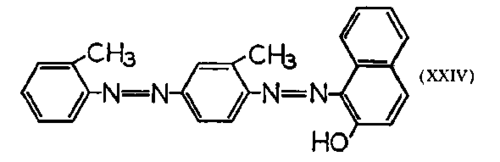
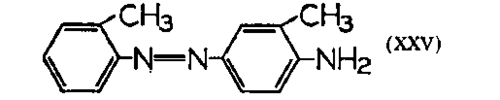
This dye can be reduced metabolically to o-toluidine or I-amino-2-hydroxynaphthalene, a chelating agent. Both of these compounds were found carcinogenic after being injected sub-cutaneously with o-aminoazotoluene (a better name would be 4-amino-2',3-dimethylazobenzene) (XXV). Mice developed hepatomas. Other organs were also affected by this dye. An isomer which had a methyl group in the 4'- rather than 2-position was found non-carcinogenic.
Perhaps the most work on dye structure-activity relationships has been done on the so-called "butter yellow," p-dimethylamino-azobenzene (DMAB) (XXVI) since it was discovered to be an effective oral carcinogen in rats. Sprague-Dawley rats develop hepatomas after ingesting a diet containing 0.06% of this dye. Among the derivatives reported most active were those with 3'-methyl or 4'-fluoro substituents. Excellent reviews are available on the behavior of this class of compounds. Among the other azo dyes found to be carcinogenic are the isomeric azo naphthalenes, either the 1,1'-(XXVIIA) or 2, 2'- derivative (XXVIIB). Included in food colorings some years ago (but no longer used) were azo dyes that are carcinogenic, such as Sudan I, J-phenylazo-2-naph-thol (XXVIII). This dye contains a chelating structure resembling that in scarlet red.


Have all other food color additives or cosmetic dyes been tested and found safe?
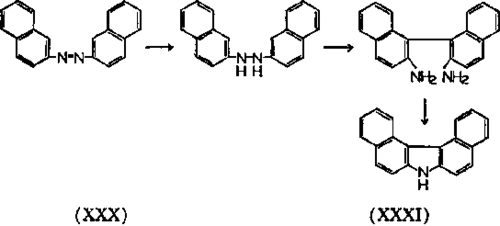
A survey of the metabolic products to which azo dyes are transformed would be necessary to show if the chelation theory is really applicable to these compounds. There are three major possibilities to consider: reduction, hydroxylation or alteration of the dimethylamine group. Azo dyes are presumably reduced in the body to hydrazos and then can possibly be cleaved to the aniline products. Only one report lists unsubstituted aniline as a possible carcinogen. The hydrazobenzene once formed can perhaps even undergo a benzidine or semidine rearrangement (XXIX); this has been considered. The semidine type rearrangement is the more likely possibility. The 2-aminodiphenylamines formed can be metal-binding agents. However, there is a suggestion that the semidine compounds are not the true carcinogen. But the fact that an unsubsti-tuted 2- position in the original dye is necessary for carcinogenic activity cannot be overlooked. Similar rearrangements have been proposed for the azo-naphthalenes (XXX), and in this case the final product, the dibenzocarbazole (XXXI), is carcinogenic. Further metabolism of this compound is possible.

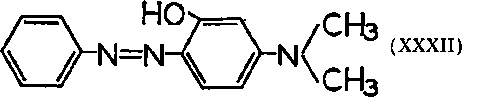
The second possible metabolic pathway of azo dyes may include hydroxylation at any of the chelating sites, the 2-(XXXII), 2'-, 6-, or &- positions. Both the 2- and 6- position of the original dye molecule must be unsubstituted if the compound is to remain a carcinogen, as shown by tests with some 2- or 2'-hydroxy azo compounds which proved inactive (223, 384,454). A further consideration is that the initial introduction of a 2-hydroxyl group will prevent the molecule from assuming a coplanar conformation which is a necessary condition for carcinogenicity. The lack of activity of some 2-hydroxy azo dyes does not preclude the possibility that metabolic pathways would involve the formation of the 2- hydroxy derivative, perhaps as a result of the combination of the dye with protein. A hydroxy derivative was indeed postulated to explain correlation between hepatocarcinogenicity of the azo dye and the dye's ability to lower p-phenylenediamine oxidase activity.
The nature of the protein-azo dye binding may give a clue to the carcinogenic activity. If the binding site is at the 2- or 2'- position, the dye may then be subsequently reduced and split to form the protein-bound 4-dimethylaminoaniline derivative (XXXIII) which could be a chelating agent.
If the binding positions are specific, this could possibly explain why so many azo dyes predicted to be carcinogenic on a chelating theory are actually inactive. Other factors to be considered may include ease and rate of conjugation as sulfates or glucuronides. Preformed chelating agents may be conjugated too soon and thus excreted too rapidly. Or, the preformed chelate may have a partition coefficient that may prevent the absorption or later accumulation of the potential carcinogen in the liver. More recently the 3-methoxy DMAB has been found active; this would again illustrate the importance of a favorable partition coefficient.

To pursue the chelate hypothesis further, consideration must be given to metabolic alterations in the dimethylamino group. An early proposal suggested that one N-methyl group was transformed to N-hydroxylmethyl and protein-binding resulted at that position. Although this molecule could bind metals, a four-member ring would be required. This is not an unknown type of chelation, but it is unusual and is not very likely to occur. If the second methyl group were removed, the nitrogen could be acetylated (XXXIV) or N-hydroxylated (XXXV); both could bind metals. The last possibility could be the formation of the 4-N-hydroxy, N-acetylamino azobenzene from the 4-amino-azobenzene. This completely demethylated metabolic product has already been isolated from rat bile.

Practically no papers were found on the effect of inorganic ions on azo dye carcinogenesis. Copper salts have been the only compounds investigated, and reports indicate that this element does modify the carcinogenic process. Addition of 0.25% copper (nature of salt not given) to a diet containing 3'-methyl DMAB exerted an inhibitory effect on tumor formation in rats. This action was confirmed when copper sulfate was administered to rats maintained on a low riboflavin diet. The addition of copper acetate, with and without iron citrate, was also effective in retarding the formation of hepatomas; during the experiment the added copper had no effect on liver function tests.
How copper functions as a retardant of hepatic tumor formation is not known. The metal may possibly compete with azo dye for protein-binding sites. One possibility that must be contemplated until proven otherwise is that the copper may simply catalyze the air oxidation of the dye and thus destroy the carcinogen under the conditions of the experiment. The result is that the rats are exposed to a lower carcinogen level. Evidence that copper does play a role in the carcinogenic process comes from the experiments showing that azo dyes which lower p-phenylenediamine oxidase level, an enzyme related to copper protein ceruloplasmin, are carcinogenic. The mechanism of enzyme dye interaction may involve a copper-dye complex. More work should be done with copper as well as other trace metals on the induction of hepatomas by azo dyes.
The chelate hypothesis can well explain the action of the carcinogenic aromatic amines. This group has a common structural pattern best represented by XXXVI. If the dotted lines are redrawn as continuous lines, the molecules represented can be 2-aminofluorene, or 2-aminodiphenyleneoxide if an oxygen is placed in the 9- position. If only the top set of dotted lines becomes a bond, the "open models" of aminofluorene are represented, i.e., xenylamine (4-aminobiphenyl) and benzidine. If both sets of dotted lines are removed and the two rings fuse, 2-naphthylamine results. AU of these aromatic amines metabolize into chelating agents, and these may actually be the true carcinogens. This metabolic pattern may be the third requirement for carcinogenicity, the first two being lipid solubility and a planar structure.
Many aromatic amines have been tested in experimental animals for carcinogenic activity (240, 499); only a few have been implicated as being sometimes responsible for cancer in man, especially for the workers in aniline dye industries. Reviews of these agents and their possible mechanism of action are available (23, 222, 227, 276).
Continue to:


My Books

