


3. Lipase
Description
This section is from the book "Chemistry Of Enzymes In Cancer", by Franz Bergel. Also available from Amazon: Chemistry Of Enzymes In Cancer.
3. Lipase
The next example touches, in a chemical and functional sense, on properties of the surface or membrane of the cancer cell in comparison with those of homologous normal cells. After Coman74 had observed that certain tumor tissues had a diminished adhesiveness, Abercrombie and Ambrose 1 reported on a similar phenomenon with tissue cultures of sarcoma cells and normal fibroblasts (see also Ambrose et al.8). When Ambrose, James and Lowick 11 submitted a suspension of hamster kidney epithelium cells, of hamster kidney tumor cells 138 and red blood cells to an electric current (electrophoresis), they established that the tumor cells carried a higher negative charge than the normal ones (see Fig. 23). This charge could be reduced by the basic macromolecular polyethyleneimine but not by polylysine.10 Taking into consideration also the observation 12 that similar differences in surface charges have been found with sublines of mouse sarcoma cells (MC1M), distinguishable one from another solely by their smaller or greater tendency to form ascites and by their tumor virulence, it became desirable to study the cell surface with the help of enzymes. In the first place, Easty et al.64 investigated the effect of a large range of biocatalysts on the adhesiveness of ascites tumor cells to glass. The only enzymes which showed a noticeable effect were trypsin and elastase (proteolytic), acid phosphatase and wheat germ 'lipase' (hydrolytic). Another series of experiments were carried out by Ambrose et al.9 with first generation cultures of normal hamster epithelium cells (see above) and the cells of a transplanted autonomous kidney tumor.
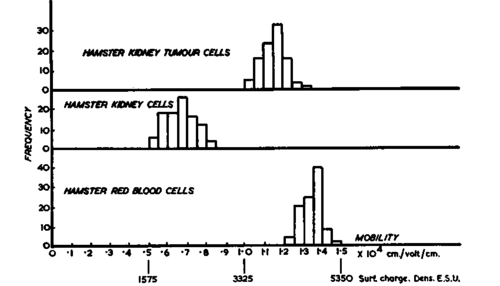
Fig. 23. Histograms of surface charge density of normal and tumor cells of hamster kidney. (From Ambrose et al.: Nature." Courtesy of Macmillan and Co. Ltd., London.).
Apart from microscopic differences between untreated normal and tumor cells, which tallied with the behaviour of material previously studied,18 the only enzyme which produced a selective action on the tumor cells was wheat germ 'lipase' (see Fig. 24a. and b). Whether this is a genuine distinction and is only produced by this plant enzyme which in its action is more like an ali-esterase, or also by lipases from mammalian and bacterial sources, and whether the difference in growth rates between the tissue cultures used in these experiments is at the bottom of the observed effects, has to be seen.98 If the observation were of a more general nature, then the cellular changes claimed with the enzyme preparation would be of considerable importance as they might reflect on special properties of some fatty acid derivatives in the cell surfaces of tumors.
Continue to:


My Books

