


2. Ribonuclease And Deoxyribonuclease
Description
This section is from the book "Chemistry Of Enzymes In Cancer", by Franz Bergel. Also available from Amazon: Chemistry Of Enzymes In Cancer.
2. Ribonuclease And Deoxyribonuclease
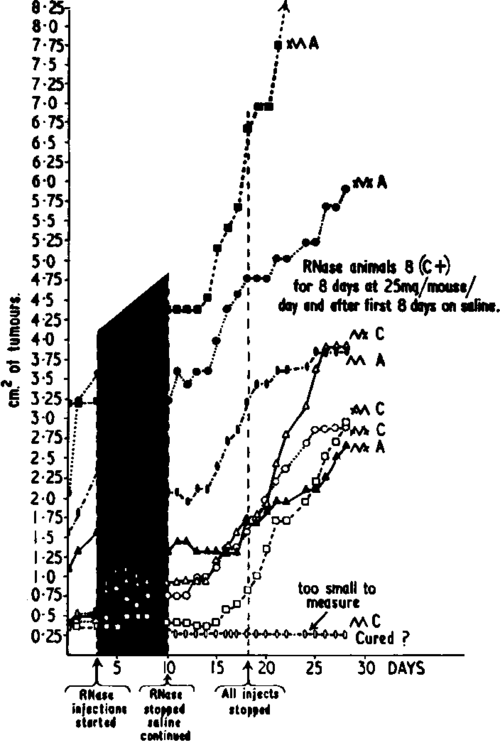
On previous pages it was pointed out that ribonuclease (a generic term referring in its experimental use to RNase of bovine pancreatic origin) might be lower in some malignant cells than in normal ones. There is little doubt that it shows cytological effects on different biological systems. It interferes with the growth 55 of B. megatherium,114 and inhibits the multiplication of tobacco mosaic128 and influenza 158 viruses; amoebae 4647 are stopped by it in their movements and killed, unless yeast ribonucleic acid is added to their medium, when a portion recovers. Division of amphibian eggs is prevented if they are injected with a certain form of ribonuclease.184,165 It was therefore not surprising that the enzyme exerted an action on in vitro suspensions of Ehrlich and Landschiitz tumor ascites cells.161,194 When Ledoux159 injected it i.p. into mice bearing Ehrlich and Krebs ascites, and into rats with Walker carcinoma 256 in ascites form, he claimed an increase in survival time of the animals, dependent on the purity of ribonuclease, the number of injections per week, and the number of ascites cells implanted. However, it was surprising that even solid tumors, such as the Crocker mouse sarcoma 180, although somewhat erratic, and spontaneous mammary tumors in C3H and C+ mice (the latter being the same as mentioned above in connection with xanthine oxidase), responded according to Ledoux 190 with a temporary arrest of growth by daily injections i.p. or s.c. of 25 mg. per animal of a commercial ribonuclease (Armour) without further purification. Hadjiolov and Zacharieva128 found a short lasting effect on the Guerin rat tumor but no increase of survival time. The writer and C. Smith35 could confirm Ledoux's observations with the spontaneous mammary carcinoma (see Fig. 22a and b). When comparing the growth rates of the tumor in a group of animals injected with saline with a group treated with RNase (Armour, 25 mg./day/animal) for 7 days and another for 15 days, it was found that the tumor growth in the animals given the enzyme was arrested. On cessation of treatment the growth rates of the neoplasm increased and the representative slope (see Fig. 22a) became finally the same as that of the control group. The situation is very reminiscent of that which obtains with xanthine oxidase, except that a larger amount of RNase was given and that its toxicity was seemingly lower than that of XO (200 mg./animal according to Ledoux 160 was not lethal). When the experiment was repeated35 with a fifth of the original dose (i.e. 5 mg./day/animal) a less pronounced slowing down of the tumor growth rate was observed, but still noticeable when compared with that of animals treated with bovine serum albumin (2 mg./day/animal).
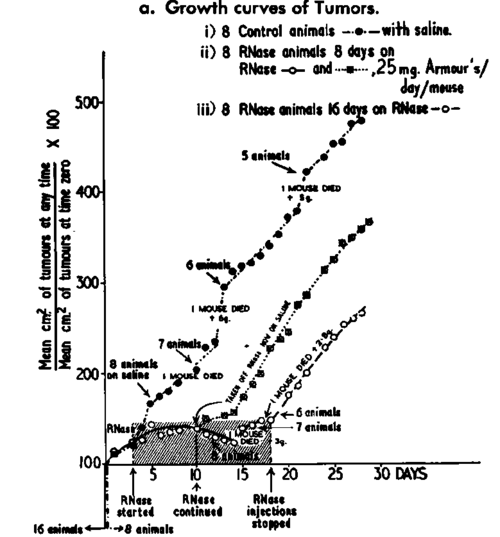
Fig. 22, a and b. Effect of RNase injections on the growth of spontaneous mammary tumors in C+ mice. (From Bergel and Smith.).
b. Actual Tumor Surface Area and Single Growth Curves of 8 Animals
In order to understand the mode of action of this enzyme, it is necessary to recall some of its chemistry and biochemistry, although it should be remembered that there are a number of RNases which can be distinguished by their pH optima, their derivation from different organs,270 and their biological effects, even when prepared from beef pancreas.162 However, most of the crystalline preparations, if sufficiently purified, contain an enzyme with a molecular weight of ca. 13.000; it is relatively stable and consists of a peptide chain with a disulfide bridge. The amino-acid sequence of the chain has been elucidated by several groups of workers (e.g. Hirs, Stein and Moore 132; Redfield and Anfinsen 210; Bernal et al. 87). Studies of the catalytic center of this ribonuclease have shown that as long as the main structure, particularly with regards to steric arrangements, is preserved, some amino-acids can be removed by the action of carboxypeptidases at the C-terminal end without loss of activity218 but pepsin destroys the activity with the elimination of a tetrapeptide, containing an aspartyl residue.18 While the latter may form a part of the catalytic site, more recent work by Barnard and Stein23 has shifted the emphasis to histidine. Whatever the fine-structure of the enzyme, its action on RNA, its relatively low molecular weight and weak antigenicity make it an interesting object for investigation of enzymic action on tissues and cells. Concerning its enzymic action, it catalyses the transfer of the 3'-phos-phate of a pyrimidine ribotide residue from the 5'-position of the adjoining nucleotide to the 2'-position of the pyrimidine ribotide itself, whereby a cyclic phosphate is formed; it activates the latter to react in the 2'-position with water, amounting to a hydrolytic breakdown or to react with alcohols or other nucleotides, representing a synthesising process (see reference 83 or 266). Of course one has to distinguish between the RNase as a normal cellular constituent (mainly in mitochondria) of organs such as pancreas, liver, spleen, intestines and exogenous ribonuclease of different degrees of purity and activity. This extraneous enzyme—which from the point of view of this chapter is the more important one—is capable of penetrating into cells.48,50 188 This process, as in the case of amoebae6889106 is achieved at least in some instances by pinocyto-sis (uptake of drops of medium by undulating motion of the cell surface). Easty, Ledoux and Ambrose,85 using interference microscopy, have shown with Ehrlich and fast-growing Landschutz ascites cells that the application of the enzyme produced an initial increase in the cellular mass. Considerable changes in metabolism follow which could, considering the nucleolytic properties of ribonuclease, consist of breakdown of RNA and interference with protein synthesis. However, apart from the observations that normal bone marrow cells in vitro 194 are not altered by the impact of the extraneous enzyme, and that cancerous tissue from human uterine cervix appeared to have lower RNase levels than a normal one from the same organ 163, the principal effects of exogenous RNase on Landschutz ascites tumors was mainly of an anabolic nature, according to Ledoux and Vanderhaeghe.169 The ratio of RNA to DNA was increased and the rate of orotic icid incorporation (not that of adenine or phenylalanine) was doubled. In comparison,187 fresh ascites cells, with high levels of endogenous acid RNase and in absence of added enzyme, had in vitro a ratio of pyrimidine to purine metabolism, three times greater than that shown by older cells. Under in vivo conditions, this difference was less marked as the cell population aged progressively. To summarize recent ideas about the mode of action of the extraneous enzyme, which is at present being tried clinically, it seems that following its application the metabolic disturbances in the tumor cells might be due to the synthesis of an abnormal RNA containing more pyrimidine than purine units. This macromolecule cannot be utilized by the cells for protein synthesis, but may, as such, act as a product inhibitor. The whole situation is rather complicated and calls for extended work, especially with an enzyme preparation completely identified.
As mentioned before, deoxyribonuclease (DNase), particularly of bacterial origin,235 has been used clinically in the treatment of purulent exudates. Interesting studies of toxicity, plasma levels and excretion rates have been carried out with an enzyme from beef pancreas by Johnson et al. No side effects were noted after intravenous or intrathecal injections. De Lamirande 152 has recently tested the effects of DNase on mice carrying Ehrlich ascites tumors. He found that the mean survival time of the animals was significantly increased and that in the intraperitoneal cavity the number of ascites cells, which according to histochemical tests showed loss of nuclear DNA, was diminished as compared with the control mice.
Continue to:


My Books

