


Conclusions And Outlook
Description
This section is from the book "Chemistry Of Enzymes In Cancer", by Franz Bergel. Also available from Amazon: Chemistry Of Enzymes In Cancer.
Conclusions And Outlook
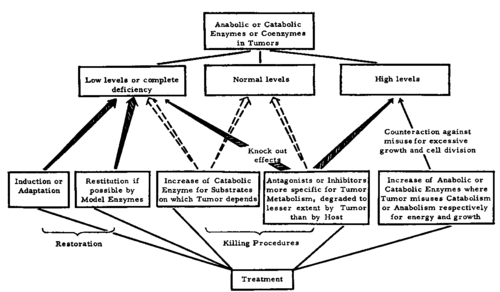
An organism, whether plant, animal or man, can suffer lesions which if not inflicted by purely physical means, represent, generally speaking, biochemical lesions. In the case of poisons this may lead to damage of normal physiological functions and to death if not prevented by antidotes. With microbial diseases the host might be unable to deal with toxins and endotoxins and thus would succumb to their continued noxious effects unless they are counteracted by antisera or drugs which possess a preferential selective toxicity for the invader. However, if it comes to viruses (other than tumor forming) and carcinogenesis, one is dealing with a situation where the cell is forced to change profoundly its normal processes and character. As to the development and establishment of malignant states especially, this could amount to a change or replacement of the phenotypical DNA, such alterations brought about by endogenous or exogenous means, chemical (carcinogenic agents), physical (radiation, polymer films, etc.) or biological (viruses, subcellular particles). In consequence this could reflect on the biosynthesis of functional proteins in general or in particular on EFS and on the pattern of anabolic and catabolic events. At this point one may discover, and indeed as the foregoing story tells one has discovered, alterations, always compared with the corresponding normal cell, in the levels of enzyme activities or in the functionally available amounts of holo-, apo-, co-enzymes and co-factors. Such losses and gains (mainly the former following the deletion hypothesis) could befall only certain EFS and enzymes in the first instance but the interdependence of these factors with many others might bring about a situation where whole metabolic pathways are blocked or stimulated, whereby whole systems undergo processes of modulation and adaptation, respond to positive and negative feedback mechanisms or obey the exponential law of autocatalysis. All this has been discussed on previous pages. It was also postulated that while there are no clear-cut methods available yet to repair biochemical lesions residing in the DNA which controls the genetical make-up of the cell or in the EFS which governs the synthesis of the biocatalysts, it should be possible to influence the enzymes by various means (see Fig. 29). As it emerges from the chapter 'How can Enzyme Activities be Influenced by Exogenous Means?', the prevalent practical approach consists of using antagonists and inhibitors, if possible more effective on tumors than on the host, but unfortunately still interfering with enzymes which play a part outside the cancerous tissue. However, the aim is to kill the tumor cells and damage the healthy ones as little as possible. This requirement seems to be satisfied best when the cancerous growth shows lower or very low levels of enzyme activities or of coenzymes in comparison with the normal tissue and when the antimetabolic drug is more rapidly destroyed by the healthy parts of the organism than by the neoplastic cells. These 'knock-out' procedures which, maybe, include also those aiming at an augmentation of enzymes degrading substrates on which the malignant tissue or cells depend more than their normal counterpart, have to be contrasted with ventures to restore somewhat the normal functions of the aberrated cell. This, so it is proposed, could be tried by restitution or replacement, induction or adaptation of enzymes which may control a bottle-neck in catabolism, or by increase in anabolic enzymes where the tumor is misusing breakdown processes for unnecessary energy production and growth. Whether this can be achieved with respect to successful carcino-chemo-therapy, only the future will tell.
This carries one to the point where a cautious forecast of work to be done could be attempted. There is no doubt that a continued expansion of reliable analytical procedures, including histochemical ones, is very much desired in order to have a better and more complete picture of EFS, enzyme, coenzyme and metal contents in true proportion to the normal cell most closely related, or its particles. Biochemistry generally will help to give a better knowledge of DNA- and RNA from different sources and their fine structure and a better understanding of the role of these DN A's and RNA's in the control of the synthesis of functional proteins. Biology, immunology and virology, playing their part in this huge undertaking, will contribute to knit together all the single pieces of which the enzymological piece is only one of many. Then, so it is hoped, the application of polynucleotides and nucleopro-teins for replacement of faulty cellular macromolecules, the use of tailor-made antagonists, including serologically produced anti-enzymes, the availability of model enzymes effective in vivo, may not only achieve a control of malignant diseases but also help to create a more complete concept of the chemistry of life itself.
Fig. 29. How to influence therapeutically enzyme, etc. activities.
Continue to:


My Books

