


Conjugated Fatty Acids And Induced Carcinogenesis
Description
This section is from the book "Research In Physiopathology As Basis Of Guided Chemotherapy With Special Application To Cancer", by Emanuel Revici. Also available from amazon: Research In Physiopathology
Conjugated Fatty Acids And Induced Carcinogenesis
We have investigated the influence exerted by the fatty acids—conjugated or not, and their mixture, upon the induction of tumors by carcinogens. From the various experiments, some were eliminated, either because the dose of methylcholanthrene employed did not produce tumors in a sufficient number in control animals to permit any conclusive comparison, or the death rate from intercurrent causes was abnormally high so that the entire experiments had to be discarded.
The experiments that were satisfactorily completed are summarized in the following three tables. In the first group of experiments (Table XXXVIII), 4 groups each composed of 40 adult Swiss mice (20 male and 20 females in each group) were employed. Each animal received in the right flank a single subcutaneous injection 0.2 mg. of methylcholanthrene as a 0.2% solution in tricaprylin. These animals also received subcutaneous injections of a mixture of fatty acids extracted from cod liver oil, or a mixture of cod liver oil fatty acids conjugated by treating them with KOH. The fatty acids were administered as a 5% solution in cottonseed oil. Animals treated with fatty acids received 0.3 cc. of this solution in the contralateral side twice a week for three months. The control animals received the same volume of cottonseed oil in the same number of injections. In addition, one group of animals treated with the conjugated fatty acids received four injections during the two weeks preceding the methylcholanthrene injection. Thirty three animals died without tumors during the course of the experimental period. The number of animals surviving for five months plus the number in which tumors developed during this period of time are listed for each group.
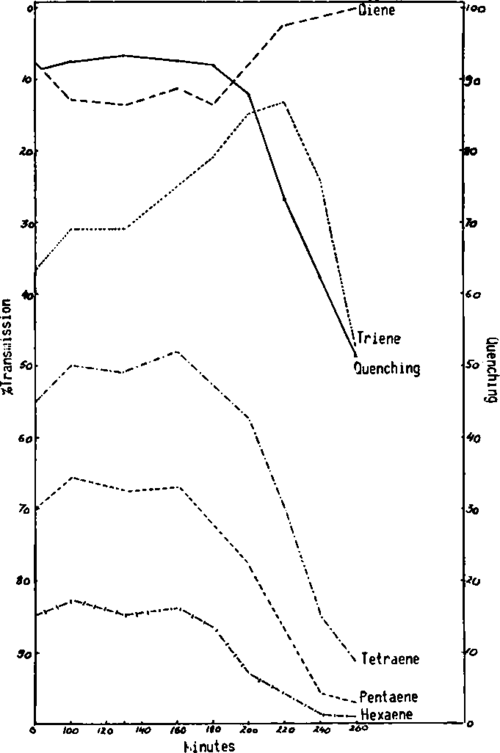
Fig. 286. The changes in the quenching of the treated mixture parallel the changes induced in the amounts of conjugated tetra-, penta- and hexaenes.

Fig. 287. Spectral analyses of fatty acids of cod liver oil, treated with KOH in ethyl alcohol. They show the appearance of high amounts of tetra-, penta- and hexaenes.
Table XXXVIII
Died | % | ||
Treatment Without Tumors | Tumors | With Tumors | |
Cottonseed oil controls | 10 | 12/30 | 40 |
Fatty acids from cod liver oil | 3 | 18/37 | 48 |
Conjugated fatty acids from | |||
cod liver oil | 6 | 7/34 | 20 |
Conjugated fatty acids from | |||
cod liver oil (*) | 14 | 3/26 | 11 |
* Received 4 injections of fatty acids before methylcholanthrene was administered.

Fig. 288. Changes in the total quenching capacity of samples of cod liver oil during isomerization with KOH in ethyl alcohol. While the quenching effect is reduced— even for high concentration—for the sample having only Yi hour of conjugation, it is high for that obtained after 24 hours. It remains almost the same for the sample after 84 hours of conjugation. The quenching appears related to the presence of conjugated isomers, with 4 or more double bonds.

Fig. 289. Quenching effect of parinaric acid upon the fluorescence of methylcholanthrene. The relationship between the quenching effect and the presence of conjugated tetraenes is seen in the fact that parinaric acid has a quenching effect of 96.2 for a dilution of 0.006% and still one of 62% for a dilution of 0.0002%.
In a second group of experiments (Table XXXIX) six groups of 40 mice each received one subcutaneous injection of 0.25 mgm. of methylcholanthrene of an 0.2% solution in tricaprylin and a second similar injection one week later. Groups were treated twice weekly for three months with 0.3 cc. of 5% solutions of the following fatty acids in cottonseed oil: Fatty acids from cod liver oil, conjugated fatty acids from cod liver oil, eleostearic acid, linoleic acid and conjugated linoleic acid. A control group of animals received 0.3 cc. of cottonseed oil in the contralateral flank twice weekly for three months.
Table XXXIX
Died | % | ||
Treatment Without Tumors | Tumors | With Tumors | |
Cottonseed oil—controls | 4 | 31/36 | 86 |
Fatty acids from cod liver oil | 3 | 33/37 | 89 |
Conjugated fatty acids from cod | |||
liver oil | 6 | 15/34 | 44 |
Eleostearic acid | 10 | 24/30 | 80 |
Linoleic acid | 0 | 29/40 | 72 |
Conjugated linoleic acid | 6 | 25/34 | 73 |
In the third group of experiments (Table XL), four groups of 30 mice each were employed. Mixtures of the methylcholanthrene and of the fatty acids used were prepared by adding 0.5 cc. of the 5% fatty acids in cottonseed oil solutions to 0.25 mg. of methylcholanthrene of 0.25% solution in tricaprylin. The injections were made subcutaneously immediately after mixing. Each animal received three injections at intervals of one week and the observations on tumor incidence were followed for 5 months. The fatty acids employed were fatty acids from fish oil, conjugated fatty acids from fish oil, a mixture of equal parts of eleostearic and conjugated linoleic acids, and cottonseed oil as a control. The quenching effect is shown as the percent of residual fluorescence of methylcholanthrene when mixed with the fatty acid mixtures.
Table XL
% Residual | Died With- | % With | ||
Treatment | Fluorescence | out Tumors | Tumors | Tumors |
Methylcholanthrene + | 95 | 6 | 33/44 | 86 |
cottonseed oil | ||||
Methylcholanthrene + | 85 | 4 | 20/46 | 43 |
fatty acids from | ||||
fish oil | ||||
Methylcholanthrene + | 19 | 4 | 6/46 | 13 |
conjugated fatty acids | ||||
from fish liver oil | ||||
Methylcholanthrene+ | 92 | 11 | 24/39 | 61 |
eleostearic and | ||||
conjugated linoleic | ||||
acid |
These results indicate a certain relationship between the quenching action of the conjugated fatty acids upon hydrocarbon carcinogens and the ability of fatty acids to reduce the carcinogenicity of these hydrocarbons. It is not sufficient to have a conjugated fatty acid present, in order to have the effect upon carcinogenesis. Eleostearic acid did not significantly reduce the incidence of tumors and conjugated linoleic acid was no more active than its nonconjugated isomer.
Conjugated fish oil fatty acids (which contain di-, tri-, tetra-, penta and hexanes) when mixed with methylcholanthrene reduced the tumor incidence to 13%, while a mixture of eleostearic and conjugated linoleic acid (di-, and triene conjugated acids) which have a limited quenching action gave an incidence of 61%. Although the incidence of tumors was much lower in the group receiving conjugated fish oil fatty acids, the non conjugated fatty acids from the same source has a limited influence upon the cancer inducing property of the hydrocarbon. When fatty acids were not mixed with the carcinogen, but were injected separately, the nonconjugated acids appeared without effect.
Statistical analysis of the data from these three experiments show the following: the results are significant for the group treated with conjugated fatty acids from cod liver oil before and after methylcholanthrene was administered as compared with control group treated with cottonseed oil in Experiment I (x^2 = 6.65 on basis of tumor/no tumor). In Experiment II, the results are very significant for the group treated with conjugated fatty acids of cod liver oil as compared with the control group (x^2 = 13.09). In Experiment III, the results are very significant for all three groups in which fatty acids were added to the methylcholanthrene (x^2 = 13.3, 41.56 and 8.32 respectively).
Table XLI. Quenching Of Methylcholanthrene 0.062% In Ethyl Alcohol By Substances Other Than Fatty Acids
Substance | % Dilution Used | Fluorescence |
5.0 | 106.8 | |
n Butanol | 4.5 | 96.4 |
Butyl mercaptan | 1.0 | 102.5 |
Hexyl mercaptan | 2.0 | 92.0 |
Dodecyl mercaptan | 2.0 | 82.0 |
Hexadecyl mercaptan | 2.0 | 70.0 |
Na thiosulfate | .05 cc. from | 97.0 |
50% solution | ||
Ethyl sulfate | 1.0 | 95.0 |
Nitrogen mustard | 0.1 | 79.9 |
Allyl K xanthate | 1.0 | 3.8 |
Nitromethane | 1.0 | 7.4 |
Ethylene trithiocarbamate | 1.0 | .2 |
Cholesterol | 1.0 | 93.0 |
When comparison is made on the basis of tumors/no tumors between groups receiving nonconjugated and conjugated isomers of the same fatty acid mixtures, the results were significant in all three experiments (x^2 = 8 in Experiment I, 22 in Experiment II, and 12 in Experiment III).
In the light of the relationship between quenching activity and the reduction of the carcinogenic activity, we are investigating different other agents. Table XLI shows the values of this effect.
Continue to:


My Books

