


Precancerous Conditions
Description
This section is from the book "Cancer Manual For Public Health Nurses", by National Cancer Institute. Also available from Amazon: Cancer Nursing: A Manual For Public Health Nurses.
Precancerous Conditions
There are some authorities such as Ackerman, the pathologist, who have stated that use of the term "precancerous" should be reserved for those lesions which will at some future time inevitably become cancerous. By this definition many of the conditions commonly listed as precancerous would not be acceptable, since only a certain percentage actually undergo change from a benign to malignant state.
Regardless of the way in which one classifies these conditions it is generally agreed that certain lesions warrant medical evaluation since some of them may become malignant. Among these can be cited:
Moles
Dark, blue-black, or pigmented moles showing a sudden change in size or activity should have prompt attention. Light brown and flesh-colored moles are usually harmless, but if they are subject to chronic irritation or friction from tight clothing they should be removed.
Senile Keratoses
These are dry, scaly, brown patches which are frequenty seen on the temples, forehead, ears, and backs of the hands of elderly people. These should be evaluated by a physician since some of them may develop into skin cancer, particularly in people who are exposed to the sun and wind. (Figure 4).
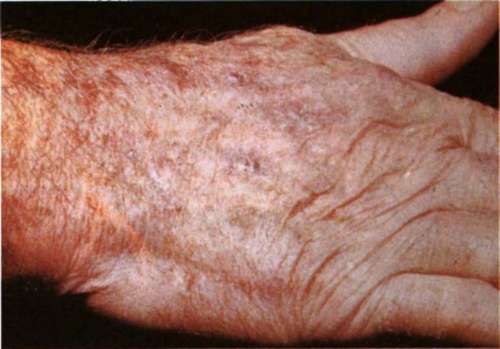
Figure 4. Keratoses of the Hand
Leukoplakia
This is a thickening of the mucous membrane which occurs in some persons in response to any form of irritation such as excessive smoking, jagged teeth, poor mouth hygiene, syphilis, and vitamin B deficiency. Leukoplakia also occurs on the vulva. It is characterized by the appearance of whitish areas which cannot be dislodged from the mucous membrane. At first the lesion is flat and smooth, but later it thickens and is accompanied by cracking, ulceration, and inflammation. Since many authorities feel that there is an association between leukoplakia and cancer, the leukoplakia is often removed as a prophylactic measure. (Figure 5).
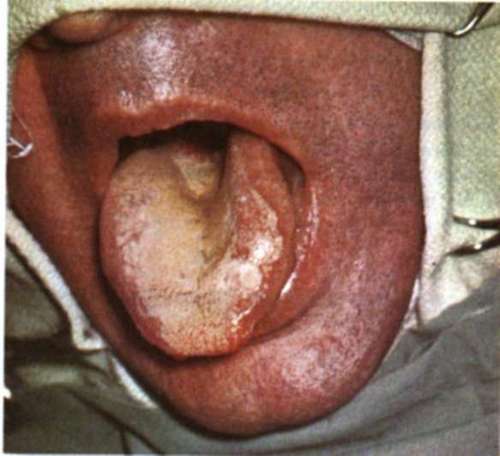
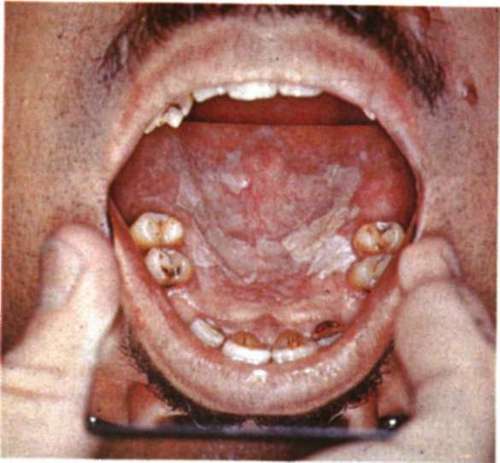
Figure 5 TOP: Leukoplakia of the Tonguo. BELOW: Leukoplakia of the Floor of the Mouth
Benign Breast Diseases
A number of investigators have reported that breast cancer is more common among women with benign breast disease. However, agreement among medical authorities is far from universal. It has been postulated that common hormonal or other poorly understood influences are active in the pathogenesis of at least some benign and malignant breast diseases.2 However, there is no question about the advisability of periodic medical examinations for any woman particularly someone in whom a diagnosis of benign breast disease has been made. Only a physician can evaluate any changes which may occur.
Polyps
These occur in many body locations such as the stomach, cervix, endometrium, nasal fossa, and bowel. The polyp may occur as a single growth or as a number of separate lesions. This latter condition, i.e., several polyps grouped in one area, is found fairly frequently in the colon. This condition is generally considered congenital and is called multiple polyposis. There is some disagreement as to the exact relationship which exists between polyps and cancer of the colon. However, the usual practice is to remove the polyp(s) and to follow the patient carefully for evidence of recurrence or malignancy.
Cervicitis
Gynecologists are not in agreement as to the importance of chronic irritation of the cervix as a precursor to cancer. However, since the predisposing role of chronic irritation in the causation of cancer in some sites seems fairly well accepted, it may be that it is also a factor in this instance. Novak suggests that some unknown constitutional predisposition or dyscrasia plays the fundamental role and that when this underlying predisposition is very strongly marked, cancer can develop even in the absence of any demonstrable irritative factor. He further states that cancer is more likely to develop when chronic irritation in a local lesion coexists with this unknown constitutional factor.3
Continue to:


My Books

