


Prevention of Cancer
Description
This section is from the book "Cancer Manual For Public Health Nurses", by National Cancer Institute. Also available from Amazon: Cancer Nursing: A Manual For Public Health Nurses.
Prevention of Cancer
Prevention against any disease that affects large numbers of people is the ultimate aim of all public health programs. Since very little is known about the etiology of cancer, primary prevention is limited. It is known, however, that certain substances are carcinogenic and that prolonged contact with them will cause cancer. The increase in the death rate from lung cancer has stimulated a large number of investigators to seek the possible cause of this increase. Both retrospective and prospective studies have implicated cigarette smoking as a causal factor in the increase in lung cancer. Chart III shows the difference in death rates among nonsmokers, smokers, and ex-smokers. (Chart III).
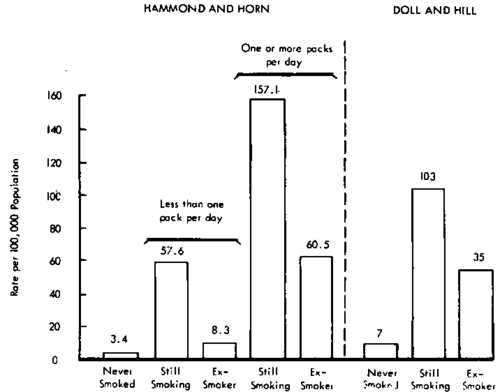
Age-adjusted long cancer death totes for smokers, ex-smokers (persons who hod given up smoking for 10 years or more when interviewed), and nonsmokers, by study.
Chart III
This illustrates very graphically that if a person does not smoke or if he stops smoking cigarettes, he may be practicing primary prevention of lung cancer. In view of the low 5-year survival for those with cancer of this site, this seems the only practical way to halt the increase in lung cancer deaths-at least at the present time.
Since there are few sites for which actual preventive measures can be applied in the control of cancer we have to depend primarily on what we often call "secondary prevention." For example, we have a potential for the secondary prevention of cancer of the cervix. The Papanicolaou smear prepared from cells aspirated from the posterior fornix of the vagina, or scraped from the cervix, provides an aid to finding cancer in its early or preinvasive phase. Survival in cancer of the cervix is directly related to both stage of the disease at the time of diagnosis and the age of the patient, i.e., the earlier the disease process, and the younger the patient, the better the chances for survival. If women could be motivated to seek this means of early detection, and to have adequate therapy, deaths from cancer of this site could be practically eliminated. (Chart IV).
Chart IV. Percent Of White Female Patients Surviving Five Years Following Diagnosis Of Cancer Of The Cervix By Age And Stage Of Disease.*
Stage | Age of the patient | |||||
All ages | Under 45 | 45-54 | 55-04 | 05-74 | 754- | |
All stages | 58 | (if) | 50 | 53 | 51 | 42 |
Localized | 79 | 83 | 70 | 75 | 75 | 80 |
Regional | 44 | 48 | 43 | 43 | 40 | 28 |
Source: End Results and Mortality Trends in Cancer, National Cancer Institute Monograph No. 6, September 1961.
*Relative survival rates are obtained by adjusting; observed rates for normal life expectancy.
It is the responsibility of the public health nurse to help inform the public about cancer and what each person can do for his own protection. She must apply this knowledge to herself, to those she serves, and to the community. Since cancer develops in individuals of all ages, regular periodic health examinations are of the utmost importance for everyone.
Continue to:


My Books

