


Scope Of The Problem
Description
This section is from the book "Cancer Manual For Public Health Nurses", by National Cancer Institute. Also available from Amazon: Cancer Nursing: A Manual For Public Health Nurses.
Scope Of The Problem
Although cancer is usually spoken of as a single disease, it is in reality a number of diseases, each manifested by an abnormal rate of growth.
Incidence
The incidence rate for each site varies in men and women. The most common cancer sites for women are the breast, cervix, and skin. These sites account for more than 150 women with cancer per 100,000 population. Also, cancer of the breast is almost 10 times as frequent as cancer of the lung and bronchus. In men, cancer occurs most frequently in the skin, prostate, stomach, lung, and bronchus.
Incidence rates for sites common to both men and women are also different. For example, in cancer of the lung and bronchus, the incidence rate in men is approximately 29 per 100,000, while the rate in women is around 7 per 100,000.
Survival
Another statistical way of assessing the cancer problem is to look at the number of people who survive 5 years after diagnosis. It should be remembered that survival rates indicate only that the patients are alive; survival rates in no way indicate that the patients are "cured" or free of disease.
Chart I shows the proportion of patients with cancer of several specific sites, by stage at time of diagnosis, who have survived 5 years. Except for bronchus and lung, there is a marked difference in the proportion of those who survive, based on the stage of disease at the time of diagnosis. For example, for cancer of the breast the proportion surviving 5 years was 82 percent when the disease was diagnosed and treated in the localized stage, but dropped to 47 percent when the disease progressed to include involvement of the areas adjacent to the original site. As would be expected where remote metastases existed, the 5-year survival was only 2 percent. (Chart I).
Relative Five-Year Survival Rates
For White Patients For Specified Sites, By Stage Of Disease And Age 1950-1957.
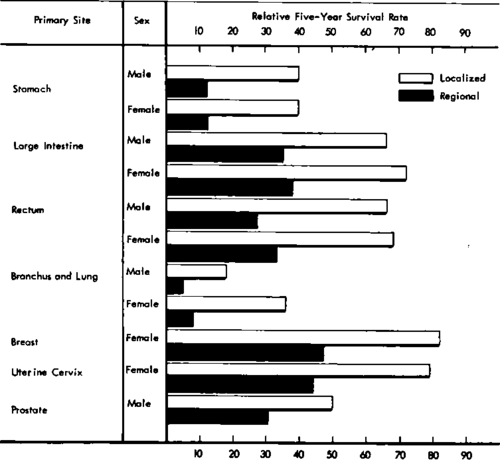
Source: End Results and Mortality Trends in Cancer, National Cancer Institute No. 6, September 1961. * Obtained by adjusting the crude rate by the normal life expectancy.
Chart I
That cancer is a highly fatal disease can be attested to by the fact that the death rate for cancer of all sites is now over 145 per 100,000 population. This places cancer second only to heart disease as a cause of death. The age-adjusted death rate has been slowly rising since 1949, with the increase being less than 2 percent from 1949 to 1959. However, the trend by site for the same period indicates that the forces of mortality are not the same for each body site.
In men, the death rate from cancer of the bronchus and lung has increased from 18.3 to 34.0 (an 86-percent increase) while the death rate from cancer of the stomach has decreased from 16.9 to 11.8 (a 30-percent decrease) during the same period of time. The trend in age-adjusted death rates for the other sites shown on chart II has been fairly stable during this period of time. (Chart II).
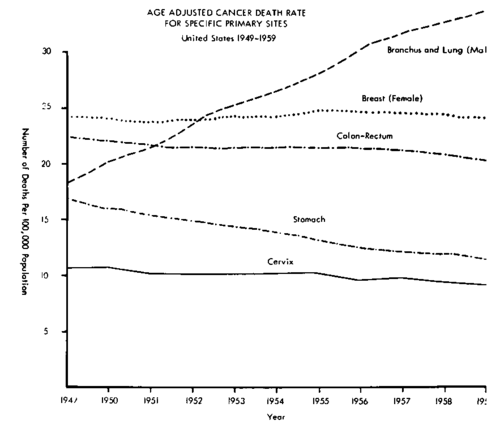
Chart II
Continue to:


My Books

