


Radium Treatment
Description
This section is from the book "Cancer Manual For Public Health Nurses", by National Cancer Institute. Also available from Amazon: Cancer Nursing: A Manual For Public Health Nurses.
Radium Treatment
Radium or one of the newer radioisotopes such as cobalt-60 or iridium-192 may also be used to treat cancer. Methods of application vary, but these are the usual ones:
1. Surface applicators which can be applied directly to any area of the body; for example, a mould or plaque to treat skin cancer.
2. Interstitial containers, usually needles or seeds which can be inserted directly into tissue; for example, needles in a tongue lesion
3. Intracavitary applicators which are inserted into a body cavity; for example, in the vagina to treat cancer of the cervix.
Whatever the form of application, the physician is attempting to destroy the tumor by utilizing the gamma rays which are emitted from the radium or radium substitute. Again, these rays are essentially equivalent to the X-rays produced by an X-ray unit.
Nursing Care
When a patient is scheduled for radiation therapy the nurse must know what this will involve for both the patient and his family. Simple explanation, geared to the patient's understanding can be helpful in preparing him for therapy. He should be reassured that he will not "feel" anything during the treatment period. Most patients are familiar with the equipment used for diagnostic X-ray and this often serves as a basis for discussion. Occasionally with the increased publicity appearing in lay literature people will ask questions which might otherwise not have occurred to them.
Patients frequently receive radiation over a period of weeks. Although the treatment is planned in advance, modification of the plan may be necessitated by the patient's reaction to therapy. This sometimes is discouraging to the patient. He must be impressed with the extreme importance of reporting for each and every treatment unless he has been told this will not be necessary.
Skin Reactions
The skin reacts to therapy in various ways depending upon the type of treatment, the location of the tumor, the complexion of the patient, and many other factors. The word "burn" is never used in talking with a patient since this may lead him to think the skin reaction was an accident, something done in error. Instead, reassurance should be given that skin reactions do occur as a part of radiation therapy.
Skin reactions vary from slight reddening of the area to a moist epidermitis in which the superficial layers of the skin are shed. Vesicles sometimes appear. Re-epithelialization takes place as the reaction subsides. (Figures 14, 15, and 16).
It is important that no treatment be instituted without specific orders from the radiologist.
There are certain skin irritants which it is well for the patient to be aware of during treatment. It would be impossible to list all of them but there are certain ones which most radiologists want their patients to avoid during the course of treatment:
1. Intense sunlight or any form of light or heat therapy.
2. Hot or cold applications including heating pads, cold compresses, hot water bottles, etc.
3. Strong chemicals such as iodine, medicated ointments or liniments.
4. Restrictive clothing over the part being treated, i.e., belts, elastic waist bands, etc.
5. Adhesive tape.
6. Soap.
7. Mechanical irritation from back rubs, contact with rough clothing or in, some instances, shaving.
8. Deodorants, ointments, powders, and similar substances which may contain heavy metals (bismuth, aluminum, zinc).
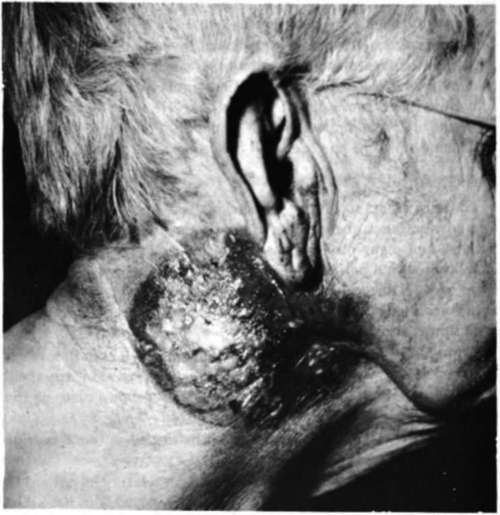
Figure 14
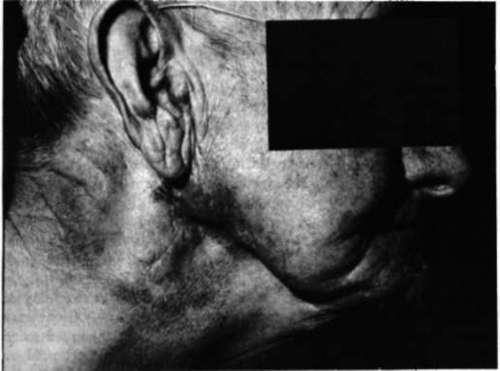
Figure 15
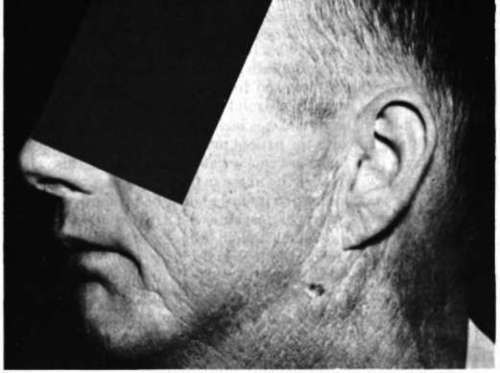
Figure 16
Reactions To Radiation Of Mucous Membrane
Mucous membrane reacts to radiation and depending upon the part of the body involved certain treatments may be needed to afford relief:
1. Oral Cavity
Swelling and difficulty in swallowing may interfere with a patient's ability to eat. Soft or liquid foods may be necessary for a time. Highly seasoned or very hot foods may irritate inflamed mucous membranes. Smoking is irritating and may be forbidden to lessen irritation during the treatment period. Irrigations with some mild solution may be ordered to remove secretions, combat dryness, and relieve distress.
2. Vagina
Douches are sometimes ordered by the physician to relieve discomfort and to remove sloughing tissue in the vaginal canal. Trauma, infection, or bleeding may preclude their use, however.
3. Bowel and Bladder Irritation
Treatment in the vicinity of either the bowel or bladder may cause symptoms. The patient may have difficulty in voiding. Treatment is sometimes suspended when complications occur. Therefore, any change in either bowel or bladder habits should be reported at once to the radiologist. No treatment should be instituted by either the patient or the nurse except on specific orders from the radiologist.
Systemic Reaction
Although with modern X-ray techniques radiation sickness is less common than it used to be, there are still patients who experience systemic reactions. Radiation sickness is a symptom complex which varies with the dose and the site of the body under treatment. Symptoms vary from mild nausea to severe attacks of nausea, vomiting, lassitude, headache, and diarrhea. There are rare conditions in which the patient may collapse. Some physicians believe there is a large psychological component in this. It is therefore not advisable for the nurse to tell the patient that nausea and vomiting may occur. Symptoms should be promptly reported to the radiologist who will institute the treatment he believes indicated. In some instances the therapy is halted temporarily. Other patients may react well to certain drugs which may be utilized to lessen nausea and vomiting. There are also some general supportive measures which may prove helpful:
1. Special thought should be given to helping the patient maintain his nutritional status and fluid balance. Many patients suffer from capricious appetites during therapy and getting them to eat may not be an easy task. Much thought may be needed to tempt the patient with small frequent feedings of foods he likes. If diarrhea occurs, it may be necessary to eliminate certain foods for a few days-foods high in cellulose or connective tissue, foods strong in flavor or highly seasoned. (See appendix II.)
2. Adequate rest should be emphasized during the period of therapy.
3. Special care should be taken to avoid exposure to known infections since the white count is usually lowered during therapy.
Late Local Reactions
Severe late skin reactions are not common with advances in modern therapy. However, they do occur. Sometimes the skin becomes blanched, discolored, or atrophic. The skin may even break down and an ulcer may form. It is for this reason that careful attention to skin care may be needed, even after the therapy is completed. Occasionally ulcers in the bowel or bladder occur, as does narrowing of the lumen in hollow organs. Fistulae may also occur in the bladder or rectum. Necrosis of cartilage or bone is another possibility. When bones around the face have been irradiated any break in the mucous membrane of the mouth may lead to osteomyelitis. The nurse should therefore be alert for sores in the mouth and should be sure that this is called to the attention of the physician. As stated, these complications rarely occur with newer types of therapy. Nevertheless the nurse should be on the alert and should instruct patients in the importance of reporting any unusual symptoms as soon as they occur.
Radium Treatment
The nursing care for patients treated with radium will not be discussed in this publication since this form of therapy is given only in the hospital. Patients or their families sometimes fear that the patient may still be radioactive even after the radium has been removed. They should be reassured that there is no further radioactivity in the patient's body once the source has been taken out.
Liquid Radioisotope Therapy
Most patients who receive a therapeutic dose of a radioisotope will be hospitalized during the period of therapy. However, diagnostic doses which are very small in amount are very often given on an outpatient basis, either in clinics or in physicians' offices.
The amount of a liquid radioisotope which is given for diagnostic purposes is extremely small and the unit of measure is a microcurie, one millionth of a curie. (A curie is a standard measure of the rate of radioactive decay.) For example, a diagnostic radioiodine study (commonly called RAI or I131 study) will usually require less than 100 microcuries (uc). Small amounts of radioactive sodium, chromium, gold, cobalt, and iron are also given frequently. Ordinary contact or nursing care can be given without provision for any special precautions. Patients present no hazard to others in the household and the disposal of body wastes such as urine or feces presents no problem. However, it is advisable, during the first few days, to wash one's hands especially well after personal contact with these patients. If a patient should vomit within a few hours following a dose there would be some radioactivity in the vomitus. Therefore any area contaminated with the vomitus should be thoroughly cleansed with running water. The person cleaning the contaminated area or articles should wear rubber gloves to protect the hands. If these are not available, the hands should be thoroughly washed under running water.
Therapeutic doses of liquid radioisotopes are much larger than those given for diagnostic purposes. They are measured in milli-curies, or thousandths of a curie. Specific directions for giving care to these patients are outlined by the institution in which the patient receives his therapy.
Continue to:


My Books

