


The Maintenance Of Neutrality In The Body. Continued
Description
This section is from the book "Chemistry Of Food And Nutrition", by Henry C. Sherman. Also available from Amazon: Chemistry of food and nutrition.
The Maintenance Of Neutrality In The Body. Continued
Phosphates are regularly present in blood and urine in notable amounts. From what has already been seen regarding the reaction of the blood, it may be inferred that in it the primary and secondary phosphates are normally present in such proportions as to produce a practically neutral mixture. In urine, on the other hand, acid phosphate predominates, because the kidney usually removes from the blood a larger proportion of primary than of secondary phosphate. Thus by virtue of this ability of the kidney to secrete an acid urine from a neutral blood, the excess of phosphoric acid produced in metabolism is readily disposed of. The disposal of the sulphuric acid produced in the metabolism of protein is a more complicated problem. Sulphuric is so strong an acid that it would soon poison the body unless quickly neutralized.
When a fairly strong acid such as the sulphuric acid produced in the metabolism of protein enters a neutral or slightly alkaline solution of phosphates and carbonates such as the blood, it reacts with secondary phosphate to form primary phosphate and with bicarbonate to form carbonic acid. Since secondary phosphate (K2HPO4 or Na2HPO4) is but faintly basic, and primary phosphate (KH2PO4 or NaH2PO4) is but faintly acid, the ratio of these phosphates may be considerably changed (i.e. a considerable amount of strong acid may be received by the phosphate mixture) without appreciably diminishing the alkalinity of the solution. Thus the blood may neutralize a considerable amount of acid without appreciable change in its reaction, or as ordinarily expressed, without alteration of its own neutrality.*
* This property is also referred to as the "buffer effect" of phosphate solutions and is of course connected with the capacity for secondary ionization, readily reversible according to the reaction of the medium:
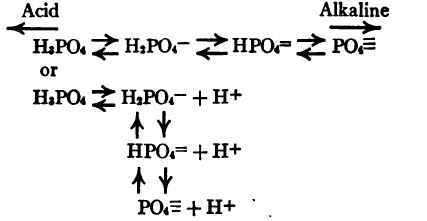
For discussion of acid-base equilibria in phosphate solutions see the works of Henderson cited at the end of the chapter.
Ammonia, which is continually being formed in the body by deaminization of amino acids in the course of protein metabolism, constitutes another means of neutralization of acid. It will be remembered that, according as more or less acid is formed in, or introduced into, the body, a larger or smaller proportion of the nitrogen eliminated appears in the urine as ammonium salts.*
Proteins, such as those of blood serum, are amphoteric substances and can unite with acid by virtue of their amino, and perhaps other basic, groups. The constant presence of proteins in all parts of the body constitutes, therefore, a further mechanism for the immediate fixation of any strong acid produced. This, however, is only a temporary and partial solution of the problem, since the acid thus fixed would remain to be disposed of when the protein is hydrolyzed to amino acids.
The relations of these different factors in the maintenance of neutrality under normal conditions are summarized by Henderson as follows: †
"The hydrogen ion concentration of the body has been seen to depend on the ratio H2CO3 NaHCO3.
Acid reacting with this system causes a diminution of the de-nominator and an increase in the numerator of the fraction, the value of the fraction increases, and with it the hydrogen ion concentration. Hereupon the lung reduces the value of the numerator by diminishing the concentration of carbon dioxide in blood and alveolar air, the value of the fraction is restored more or less exactly to its original value and with it the concentration of the hydrogen ion. But the denominator is still below normal. To offset this, there occurs, on the one hand, a pro-duction of ammonia which takes the place in the urine of alkali existing as salt in the blood. This alkali recombines with car- bonic acid, forming bicarbonate, and thus increasing the denominator. On the other hand the kidney removes less alkali in combination with phosphates than exist in this state in the blood. This alkali, too, helps to regenerate sodium bicarbonate, and thus to increase the denominator. Both of these processes are so regulated that the denominator is restored to normal. The concentration of carbonic acid responds through the activity of the respiratory mechanism, and the organism returns to its normal state.
* Two facts should, however, be kept in mind as possibly limiting the utility of this means of disposing of acid. In the first place, ammonium salts are generally regarded as somewhat toxic, their accumulation in the body being normally prevented by conversion into urea. Secondly, there is no good reason to suppose that the deaminization processes which form ammonia will always go on in the same cells and at the same time with the oxidation processes which produce sulphuric acid.
† Loc. cit., page 81.
"These processes, of course, go on simultaneously and not in succession. They are, moreover, far less simple than such an analysis admits, for on the one hand the interaction of phosphates and proteins has not been fully described, and, on the other hand, many of these variations influence other conditions and processes in the organism."
The normal fluctuations of fixed acid production in healthy man on ordinary mixed diet are apparently taken care of in part by neutralization with ammonia and in part by the formation and excretion of acid phosphate. In an experiment upon man by Gettler and the writer it was found that, of the extra acid formed in metabolism as the result of replacing the potato of a mixed diet by rice, about 33 per cent was accounted for by the increased ammonia and about 40 per cent by the increased acidity of the urine, leaving a remainder which may have been eliminated, in part at least, through the skin, since no attempt was made to measure the amount or acidity of the perspiration, or may have been neutralized by sodium or potassium carbonate in the blood or other fixed alkali from the body. In this experiment the intake and output of phosphorus was approximately the same on both diets. The increased acidity of the urine, therefore, implied an increased ratio of primary to secondary phosphate in the urine but not necessarily any increase in the amount of fixed base leaving the body. In the neutralization of sulphuric acid by means of phosphate, each molecule of hydrogen sulphate (representing one atom of sulphur oxidized in protein metabolism) changes two molecules of secondary into primary phosphate. In order that the original condition of equilibrium may continue, the surplus acid phosphate thus formed must be excreted. Whether or not this results in an increased excretion of phosphates and therefore of sodium or potassium (or only, as in the experiment just cited, an altered ratio of primary and secondary phosphates in the urine), apparently depends not only upon the balance of acid-forming and base-forming elements in the food, but also upon the quantities of fixed bases and of phosphates which are being metabolized and of ammonia available from the protein metabolism. It would seem that in any case in which sulphuric acid produced in metabolism is neutralized by the sodium or potassium carbonate of the blood, the resulting sulphate must be eliminated with corresponding loss of sodium or potassium and decrease of the capacity of the blood for combining with carbon dioxide. This is an important feature of acidosis. It is diagnosed by determining the carbon-dioxide-holding capacity of a sample of blood serum and the result is expressed as the "alkali reserve" or "reserve alkalinity" of the blood.
Thus while the phosphates and carbonates of the blood and tissues serve for the immediate neutralization of acid without appreciable change in the normal reaction of the blood or tissue itself, yet when much strong acid such as the sulphuric acid from protein metabolism is neutralized in this way, there is apt to result an increased output of the base-forming elements, which if not made good by the intake must tend to diminish the "reserve alkalinity" or "alkali reserve" of the body.
That an excess of acid-forming elements in food, even if long continued, does not necessarily lead to any apparent injury is shown by experiments of McCollum, in which rats were maintained throughout a large part of their adult lives and produced healthy young on a diet of egg-yolk, in which there is a great predominance of acid-forming over base-forming elements. Yet in man an increase in the ammonia content and acidity of the urine is usually regarded (if pronounced and persistent) as indicating an unfavorable tendency. In this connection the decreased uric acid solvent power of the more acid urine is to be considered, especially in view of the present belief that the human organism does not destroy uric acid but must transport and excrete all that is produced in the body. Hindhede * found that the eating of vegetables, particularly potatoes, increases the capacity of the urine for dissolving uric acid. Furthermore, Hasselbalch † showed that the carbon dioxide tension of the alveolar (expired) air, which is indicative of the carbon-dioxide-carrying capacity and therefore of the reserve alkalinity of the blood, is influenced in a similar way by the food. On a diet rich in meat he found a tension of 37.8 mm.; on an ordinary mixed diet, 38.3 mm.; on a vegetarian diet, 43.3 mm.
In an extended series of experiments, Blatherwick ‡ likewise finds that foods which have a preponderance of base-forming elements lead to the formation of a urine which is less acid, both as regards hydrogen ion concentration and titration acidity, and which has an increased capacity for dissolving uric acid, while the ammonia content of the urine is diminished and the carbon dioxide tension of the alveolar air, indicative of reserve alkalinity, is increased. Conversely, foods with a predominance of acid-forming elements increase the urinary acidity and urinary ammonia, decrease the uric acid solvent power, and show, through lowered carbon dioxide tension of the alveolar air, a tendency toward depletion of the reserve alkalinity of the blood.
* Skandinavisches Archiv fur Physiologic, Vol. 26, pages 87, 384 (1912).
† Biochemisches Zeitschrift, Vol. 46, page 403 (1912).
‡Archives of Internal Medicine, Vol. 14, pages 400-50 (1914).
The benefit to health which so generally results from a free use of milk, vegetables, and fruits in the diet may be attributable in part to the fact that these foods yield alkaline residues when oxidized in the body; but this point should not be too greatly emphasized, for there are several other respects in which the eating of liberal amounts of milk, vegetables, and fruits is certainly beneficial, notably in supplying calcium, iron, and vitamines, and in improving the intestinal conditions.
Continue to:


My Books

