


Chapter 22. Working With A Helper. Part 3
Description
This section is from the book "Reichian Therapy. The Technique, for Home Use", by Jack Willis. Also available as a hardcopy from Amazon.com.
Chapter 22. Working With A Helper. Part 3
The Tongue
lick the nose lick the ceiling lick the chin
tongue in directions
Here the only task of the helper is to call to the worker's attention if (1) the tongue is not fully out (it has been allowed to relax) or (2) if the lower jaw is being used to push the tongue up (in the lick the nose exercise). Figure 146 shows the mouth being pushed open.
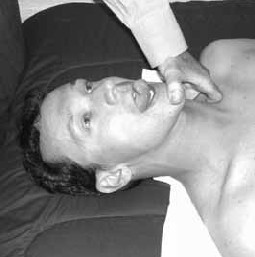
Figure 146
The Neck
head to chest
This is not a hard exercise to do once the worker has a feeling for the movement of the head. If the worker is not able to get the head movement correct, then the helper can move the worker's head the right way a few times until the worker has a feel for the correct movement. Other than that, no action by the helper is needed. If the helper sees that the worker is starting to just tuck the chin rather than bring it up and around, the helper can point that out.
head off bed, head to chest
The head over the bed exercise, bringing the head up and around to the chest, fairly quickly tires the neck muscles. If the worker does this exercise to the point that the neck muscles are exhausted then the helper can lift the worker's head while he (she) moves down on the bed so that the head will now rest on the bed.
As with the previous head to chest exercise, it the worker is lifting the head and tucking instead of coming up and around, this can be mentioned by the helper.
Mussolini jaw
Recall that this exercise is done one time, then there is a breathing-rest period, then it is done again, etc. The helper can point out if the sound is not a growl, if the shout is weak, or if the strike of the bed is weak. One caution: after a few repetitions of corrections by the helper, corrections should be stopped. If the helper continues to correct, it becomes nagging and criticizing.
roll the head
No action by helper needed.
Pressure
I have already discussed in Part One of the book how to use pressure in the neck area to help correct chronic tension. When the worker and helper get to the neck region it would be a good time to review the material on pressure in the neck region presented in Chapter nine (starting on page 162).
In this area, pressure can be very helpful and in some sense it is essential. The neck is a major area of conflict between feeling and thinking. It does not yield easily or rapidly only to the exercises.
The helper can greatly aid the worker in the area of the neck. The neck exercises can not do an adequate job of forcing the SCM, the scalenes, and the trapezius to let go of any held tension or to not be used as accessory muscles of respiration.
The Shoulders
roll the shoulders together front roll the shoulders together back tonic shrug the shoulders
The only helper action needed is to remark to the worker if the shoulders have relaxed. As always one or possibly two remarks are all that is appropriate. You are a helper not a critical parent.
The helper can point out if on the roll the shoulders back exercise the worker is arching the trunk.
shrug up and throw down shake the shoulders loose
The helper can point out if the arms or hands are being bent tending to make the shrug or the thrust come from the arms rather than the shoulders. The helper can also draw the worker's attention to other errors like moving too fast or making a sound other than the normal soft 'ah' sound.
Let me recall to the helper some of the criteria mentioned in Chapter 16 when I was discussing the shoulder exercises. These issues (that is, avoiding these errors) applies to both of the above two exercises.
1. The inhale is done during one shoulder movement
2. The exhale is continuous and does not stop to make the 'ah' sound. Rather the 'ah' sound is simply inserted into the exhale as it continues without interruption.
3. The motion is with the shoulders, not the arms or hands
4. The movement should not be rapid. If it is done rapidly, the proper shrug, throw, or thrust is lost.
5. A single inhale should be sufficient for about five motions during the exhale.
6. Even though the motions are vigorous, the soft 'ah' sound does not change
The helper can aid the worker by pointing out whether any of the above items is being violated. It is easy for me to see when the shrug, throw, or thrust is being done with the arms rather than the shoulder. I can't say how obvious it will be to the helper, but at least the helper can try to see the difference. Similarly it is common for the worker to start speeding up (not taking time to say "pause" in his head) and thus lose the force of the movement. The helper should remind the worker to slow down.
arms up and hit
arms crossed and hit choke the towel
No helper action needed. The helper can remind the worker of the need for vehemence in all three exercises. Since both the arms up and hit and the arms crossed and hit are done with a shout, the helper can listen for the shout sound and comment on when it is heard. It does no good to note the absence of the proper shout sound; as long as the worker is actually trying to get the shout sound, that is sufficient.
reach with the hands arms up and vocalize
This exercise can produce some fairly strong emotional reactions. Since many people are inhibited in allowing the show of emotion in the presence of someone else, it can be better if the helper is not present during these exercises. That is an individual difference so adjust accordingly.
If the helper is present and it does not unduly inhibit the worker, there is the potential for a big effect by the helper. What happens here does require sensitivity (or some good guess work) by the helper. As the worker is mouthing a phrase, the helper can take the place of the parent-to-the-child. Some examples: the worker is saying "please" and the helper responds with "no" or "don't beg" or "don't bother me." The worker is saying "why" and the helper responds with "because I said so" or "you know why" or "because your no damn good." The worker is saying "I won't" and the helper responds with "yes, you will" or "don't talk back to me" or "so you want a beating, is that it."
In short, the helper places himself or herself in the frame of mind of the parent to that young child and uses phrases that the worker might have heard hundreds of times while growing up.
Pressure
Some people have a lot of trouble with roll the shoulders (back or front). In that case, pressure on the wing muscles by the helper can be useful. There are two of these muscles but it is difficult to tell which muscle you are on so I will simply say to use pressure in general in the area (Figure 147).
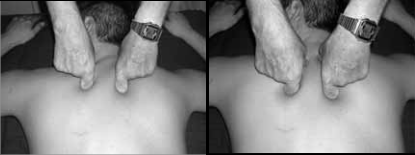
Figure 147
Continue to:


My Books

