


61. Concrete Towers And Distributing Chutes
Description
This section is from the "Safety In Building Construction" book, by The Travelers Insurance Company Hartford, Connecticut. Also see Amazon: Safety In Building Construction.
61. Concrete Towers And Distributing Chutes
With both the "skip" and the "bin" arrangements, just described, the method of delivering the mixed concrete to the forms is the same. A tower is erected in which a bucket travels, - the bucket being hoisted by an engine or motor. The mixer empties directly into the bucket, which when full is hoisted to the top of the tower, where the contents are discharged through a hopper into an inclined metal chute. This chute extends from the tower to the point where the concrete is to be poured, and the concrete slides down through the chute by gravity. Sections are added to the chute as the distance from the mixer to the delivery point increases, and the most distant section is arranged to swing horizontally so that a considerable area may be taken care of without shifting any other part of the equipment. (Fig. 84 shows a distributing arrangement of this kind).
Some of the precautions that are necessary to insure safety in connection with concrete-hoisting towers are as follows: Every tower should be substantially constructed of sound and suitable material. (See also paragraph 31.) In many cases the towers are of wood and are erected on the job. The various parts should be bolted or spiked together with as much care as if the structure were to be a permanent one, and the completed tower should be thoroughly inspected before using it. Steel towers are also used, and are stronger and more substantial than those of wood. They are constructed in sections which may be bolted together to form completed towers of any required height. Steel towers must also be erected with great care, and should be painted to prevent rusting.
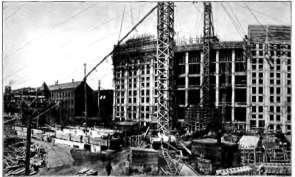
Fig. 84. Concrete Towers and Distributing Chutes on a Large Construction Job.
Each tower should be securely guyed to prevent overturning. Two sets of guys at different elevations are quite commonly provided, and if a tower is unusually high, three sets or even more may be required. The guide rails for the bucket should be carefully alined, and care should be taken to keep them in good condition so that the bucket cannot become caught while being hoisted. The sheaves over which the cable passes should be firmly secured and should be kept well lubricated. See that the hoisting cable is free from broken wires and other defects, and treat it from time to time with a suitable preservative dressing.
Provide a substantial railing about the platform near the top of the tower, where concrete is dumped from the bucket into the chute, and construct or erect a strong ladder on one side of the tower, to enable the attendant to reach this platform in safety. See that the attendant uses this ladder, and that he never rides up to the platform in the bucket. Our attention has been drawn to a number of serious accidents that have resulted from riding in a bucket in this way. The rider often grasps the hoisting cable, and his fingers are likely to be crushed by being drawn into the sheave or pulley at the top of the bucket. In one of the accidents to which we refer, the man had to have three fingers amputated in consequence of having them caught in this way.
The metal chutes through which the concrete is distributed become stopped up occasionally, owing to the use of too dry a mixture or to lack of care in cleaning the chutes at the end of the day's work. It then becomes necessary to send a man up to remove the obstruction. There is a considerable element of danger in this operation (due to the possibility of falling), against which there appears to be no effective and easily-adopted method of protection. A careful man should be assigned to this task - preferably a rigger who is accustomed to working at high elevations - and the necessity for caution should be further impressed upon him by the foreman on the job.
To prevent stoppages of this kind in the chutes, plenty of water should be used in mixing the concrete. A small amount of slaked lime is sometimes added to the mixture for the same purpose, because this tends to make the concrete slide easily. The chutes should be thoroughly flushed out with water at the end of each run, in order to make them as clean as possible, and to remove any concrete that might otherwise remain and set during the periods between pourings.
Platform hoists, instead of buckets, are sometimes used in connection with concrete towers. In such a case the concrete is discharged from the mixer into wheelbarrows which are run on to the hoists and raised to the level at which the work is being done. All the precautions mentioned above, in connection with hoisting apparatus and wheelbarrows, should be faithfully observed. In addition, chocks or stops should be provided on the platforms of the hoists to insure proper placing of the wheelbarrows and prevent the handles from projecting beyond the edges of the platforms and fouling the sides of the towers. A definite system of signals should also be arranged, so that the engineer will not start the hoists while the barrows are being put on or taken off. No one should be permitted to ride on these hoists. (See also paragraph 30).
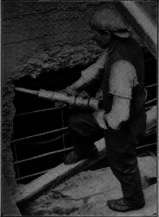
Fig. 85. Wear Goggles when Cutting Concrete.
(See also Fig.86).

Fig. 86. Goggles Broken by a Flying Chip of Concrete.
( see also Fig. 85).
62. Miscellaneous
The disposal of discarded forms used for concrete work is an important safety problem. The boards of which the forms are composed contain many projecting nails, and when the forms are removed after the concrete has set, these boards are often left lying about near the work. The projecting nails then become a serious hazard. Sometimes the boards are collected and heaped up in a disorderly pile, but the danger is only partially eliminated when this is done. On a large job it might not be considered feasible to remove or bend over the nails, but it is usually practicable to remove the boards to a safe distance and to pile them up in an orderly manner with the nails projecting downwardly, - and this should always be done. (See also paragraph 64.) Furthermore, a good deal of the lumber that is used is undressed, and considerable of it also becomes broken, when stripping the forms, so as to have jagged ends and edges. The workmen engaged in handling this material should therefore wear serviceable gloves to protect their hands against splinters and slivers, as well as against projecting nails. Considerable chipping of concrete is necessary under certain conditions. This work may be done with an air hammer or with an ordinary hammer and a cold-chisel. In either case the workmen should wear suitable goggles to protect their eyes against flying chips of concrete. Hand tools should also be dressed whenever they become "mushroomed" from prolonged use, because otherwise burrs of metal are likely to break off from them and endanger the eyes. (See also paragraph 65).
Continue to:


My Books

