


Public Baths In New York City. Part I. - Development Of Foreign And American Public Baths, General Description Of The Baron De Hirsch Rain Baths, And Floor Plans
Description
This section is from the book "American Plumbing Practice", by The Engineering Record. Also available from Amazon: Plumbing: A working manual of American plumbing practice.
Public Baths In New York City. Part I. - Development Of Foreign And American Public Baths, General Description Of The Baron De Hirsch Rain Baths, And Floor Plans
(Published In 1892 )
The subject of public bathhouses, which has been so often represented in the columns of The Engineering RECORD, has received recent increased attention and has developed into practical operation in several places in New York City. Some of the features of design and construction are adapted and modified from the practice abroad, and some are entirely of a special nature. A number of the leading characteristics and practical details will be illustrated in this and subsequent descriptions, which we have prepared from the working drawings and from special sketches. A brief resume of the subject will show the conditions and circumstances now existing. The Greeks, Romans, Egyptians, and other ancients provided and used abundant facilities for public baths, freely available to the poorest citizens, and in an article of the Dietetic Gazette of May, 1891, Simon Baruch, M. D,, says that in Russia every village has its vapor bath, where the bather, after being steamed, is well scrubbed with soap and water and receives a massage with switches, and a shower bath. Public baths are quite common in Constantinople and in the interior of Turkey, the fees being suited to the very poorest people. The same is true now in Egypt, there being 60 or 70 baths in Cairo alone. In Japan public and private baths are much frequented by both sexes, a bathhouse being visible every 100 paces in Yeddo.
Since the first one was established at Frederick Street, Liverpool, in 1842, public bath and wash houses have become both popular and cheap in England, and they are numerous and excellent in France, Belgium, and Germany, where the fees, although moderate, are often beyond the means of the poorest. The adaptation of these baths to the populous tenement districts requires that they be located near by and afford a good bath quickly, comfortably, and cheaply. The development of the system has tended to the abolition of the old-fashioned tub, and the adoption of shower baths, or, as they are termed, rain baths, for which the following advantages are claimed. First, a large economy over the provision and maintenance of tubs; second, economy of labor, time, and expense of filling and cleaning the tub for every bath, the rain bath being automatic, simple, and requiring only supervision, not attendance; third, quickness, greater efficiency, the mechanical effect of the descending stream, and the prevention of contact of soiled water with the body; fourth, economy of space; fifth, economy of water; sixth, freedom of danger of communicating diseases; seventh, stimulating and refreshing effects.
Among the requisites for public baths it is important that they should be located in the most populous districts of laborers' residences, that they should be neat, clean, inviting, and well warmed, ventilated, and lighted; that they should be substantially and economically constructed and managed, and open every day and night. The first bath fulfilling these conditions approximately was exhibited at Berlin Hygienic Exposition in 1883. It was a corrugated-tin house of about 430 square feet, and was so successful that it has since been adopted by many barracks and factories. The first public bath on this principle was constructed in the Mondscheingasse, Vienna, when an old building was divided into 72
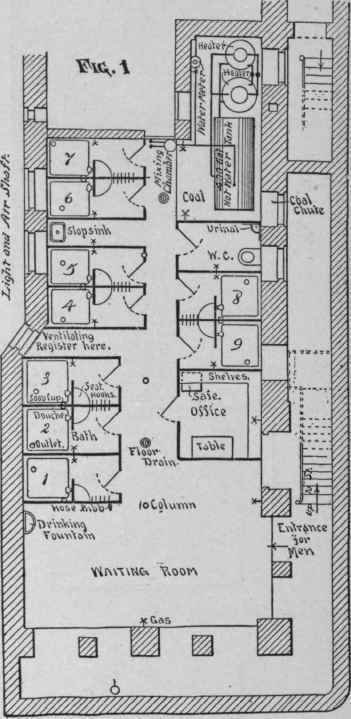
Basement Floor.
THE BARON DE HIRSCH RAIN BATHS.
bathing cells, and nine gallons of warm water, soap, and towel are furnished for about 2 cents. A public bath association in Berlin furnishes different kinds of baths for from 2½ to 12½ cents each. Rain baths have also been provided for schools in Goettingen, Munich, and Weimar, and are used daily by 75 per cent, of the pupils. Rain baths are also provided in many European factories.
In this country rain baths are of very recent public adoption. One of the first was provided at the suggestion of Dr. Baruch for the New York Juvenile Asylum. It consists of 68 sprinklers, 20 inches apart, placed near the ceiling above a bathing space, where companies of children can soap and rub themselves every 10 minutes at the rate of 280 an hour. The water is heated by the admixture of steam and delivered warm.
Recently the trustees of the Baron de Hirsch fund in America adopted the rain-bath system for the first of a series of free baths intended to be distributed throughout the tenement district of New York. These baths are located in a corner building at the intersection of Henry and Market Streets, in the eastern end of lower New York City. A basement and street floor of an apartment-house have been rented for five years, with privilege of renewal, and the place has been transformed into a bathhouse according to plans and specifications prepared by William Paul Gerhard, C. E., assisted by Messrs. Brun-ner & Tryon as consulting architects, Kennedy & McDermott being the plumbers, Hitchings & Co. furnishing the heating apparatus, and James Elgar general contractor, all of New York City.
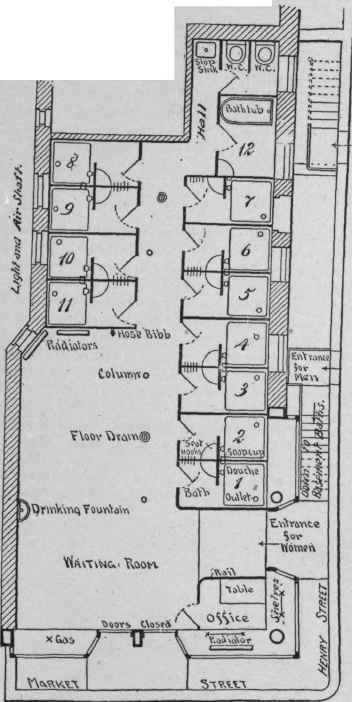
First FLOOR.
Fig.2.
Figures 1 and 2 are plans of the basement and first floors, for men and wome* respectively. Provision has been made for 30 douches in all, but only 20 are yet put up. The baths are open five days of the week from 9 a. m. to 10 p. m. and Sundays 6 a. m. until noon. A cake of soap and clean Turkish towel accompany every bath, for which adults are charged 5 cents and children 2 cents. The rooms have cement floors and are heated by direct radiators supplied with hot water from the bath heaters. The rooms are lighted by gas and ventilated by registers into a 16x24-inch galvanized-iron flue, inside of which the 11-inch smoke flue from the heaters is carried up above the roof. The bath apartments are partitioned by corrugated-iron walls on angle-iron frames with wooden caps, and have wooden screen half-doors. All walls, iron-work, pipes, etc. are painted five coats of special white bath enamel. The water-closets, urinals, slopsinks, and drinking-fountains are of porcelain, and the bathtub, Pig. 2, is of enameled iron with glazed rolled edge, and stands on high legs. It is also provided with movable seat inside for small children.
Continue to:


My Books

