


Chapter XXIII. Traps And Waste Pipes
Description
This section is from the book "Plumbing Practice", by J. Wright Clarke. Also available from Amazon: Modern plumbing practice.
Chapter XXIII. Traps And Waste Pipes
In nearly ali town houses the servants' offices are in what is called the basement or lower story. This is situated below the level of the street - in some cases only 3 or 4 feet, and in others as much as 14 or 16. Between the house and the street is generally an open space, called the area, and this is usually a few inches lower than the basement floor. In thoroughfares or streets with shops on each side these areas are mostly covered over, sometimes with gratings, in other cases with thick plate-glass, or iron frames into which are let glass prisms of such a shape that light is reflected by them into what would otherwise be dark corners. In private houses these areas are open, and anyone walking along the street can look down into them. To get rid of rain-water from these places, the most common convenience used is a bell-trap - Figure 220. The most common size is what is called a 6-inch - that is, measures that distance across the top. The water-way or size of the pipe of a trap of this description is about 1 1/2 inch, and it does not matter how heavy a storm may be, this is supposed to be large enough to take away the rain-water as fast as it falls. The part A is generally found to be choked with mud (or dust in fine weather), and the result is that, after a shower of rain, a number of servants will be found dodging about on their heels in a pool of water, with a long-handled broom, each vainly endeavouring to find out the position of the trap so as to remove the obstacle which prevents the water running away into the drain. So that this shall not occur again, it is usual to take off the bell-grating and lay it in some corner of the area. The result is that a current of air can freely pass out of the drains and through any open door or window into the house. An apologist for the bell-trap was once heard to pass an opinion that in some instances it was very useful for admitting fresh air into the drain, in which case, it may be argued, a plain grating would be much better, provided that one could be sure of the air-current being in the proper direction. In spite of all sanitarians condemning this trap, they are still sold and fixed in thousands, and, in some cases, in what is considered to be first-class houses. A small brick chamber is usually built for this trap to discharge into, as shown in Figure 220; and so that the drain may easily be got at in case of stoppage, the trap is fitted loosely into a stone, with the result that drain-air can pass out all round, as denoted by the arrows.
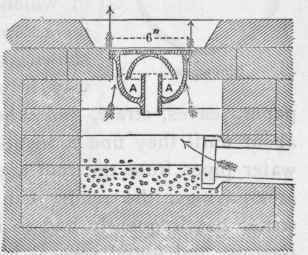
Figure 220.
Some people prefer a trap shown in section at Figure 221. This trap is superior to the last-described, in that, on removing the grating, the water-seal is not broken, and there is a larger water-way through it. This trap also necessitates a brick chamber beneath it. Another mistake frequently made is to have the stone in which these traps are fixed some 2 or 3 inches lower than the surrounding paving, as shown at Figure 220. When treated in this way it will be found that all the pieces of paper, leaves, straw, and other constituents of London dust, drift about until they find a resting-place in this hollow. If the rainwater pipes from the roof are fixed so as to discharge on to these area-pavings, the reader can readily imagine the results. The writer has frequently had to inspect empty houses for prospective tenants, and found several inches in depth of water in front and back areas after a rainfall, and more than once this water has been found to be so deep as to reach up to the gratings in the house-walls placed for ventilating any spaces beneath the floors in the basement, and pass through and lay in a pool until it soaked away into the earth beneath the floors. Further comment on this is unnecessary, as water under these conditions is nearly as bad as sewage.
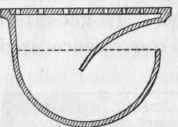
Figure 221.
To give a list of all the traps that are made, and which are suitable for the foregoing circumstances, is beyond the writer's intentions. Only one, shown in Figure 222, is selected, because of its shape, and also by reason of its having from 2 1/2 to 3 inches water-seal. This is an important item, as during a dry season a trap with a small water-seal is liable to have it broken by evaporation. The inlet portion is made large so that the grating may have as much water-way through it as the body of the trap, that being of the same size as the drain from it. The inlet-arm is for the purpose of attaching the waste pipe from a sink, bath, or wash-hand basin. By doing this the trap is always kept charged with water (that is, when the house is occupied), and the water in its trap is being continually changed, so that it may not become offensive by stagnation.
A sink is generally placed in the window of the butler's pantry, in which case the trap to receive the waste pipe is placed outside in the area. To avoid an unnecessary number of traps the area-paving should be laid so that any water falling upon it should run into the above-mentioned trap, and so save using a separate one for the surface water.
Figure 223 is a sketch section showing the usual way of arranging the waste pipe from sink and the trap under outside paving. Several sanitary engineers are in the habit of fixing the waste pipe so as to discharge over the grating of the interceptor-trap, as shown by dotted lines, Figure 223, with the result that most of the water coming out of the waste pipe is splashed over the surrounding pavement, rendering that in a continually sloppy, dirty, and unpleasant condition. Sinking the outside trap below the level of the paving, as shown in Figure 223, does not get rid of this. In some instances a raised curb is put round these places, as shown by dotted lines, with the result that they require constant attention for removing street driftings, etc, that as surely find their way to this spot as if they had been collected and placed there by someone's hands. When a raised curb is placed around a trap for receiving waste water it is necessary to fix another trap for the surface water.

Figure 222.

Figure 223.
Continue to:


My Books

