


Cylinders And Hot-Water Circulation. Part 5
Description
This section is from the book "Plumbing Practice", by J. Wright Clarke. Also available from Amazon: Modern plumbing practice.
Cylinders And Hot-Water Circulation. Part 5
Figure 456 was a rather strange experience of erratic circulation. A boiler was fixed for heating water to supply sinks in which bottles were washed at a wholesale wine merchant's. Two radiators were fixed, as shown in the diagram, for heating the offices. The coil, P, got very hot, but there was no heat in the coil, Q, so long as there was a fire under the boiler. But, on allowing the fire to go out, the water would at once begin to circulate backwards, and the coil, Q, got moderately warm, but on again lighting the boiler fire this coil would gradually get cool again. As the whole of the work appeared to be done in good and workmanlike manner, some little thought was necessary before it could be understood why one coil got hot and the other did not when the boiler fire was alight, and yet on putting out the fire the circulation was reversed. The pet-cocks on the coil-heads were opened, but as water came in each case there was proof that they were not air-bound.
Two mistakes suggested themselves. One was the pipe from the boiler was too small, being only 1 1/4-inch, and the branch to the coil, Q, was at right angles, but horizontal. The return pipe was branched into the main return pipe as shown in the sketch. This branch being upright accounts for the back action in the circulation. The alterations made were as follows: 2-inch pipes were fixed from the boiler as far as the branches to the coil, Q, and the flow pipe branch was turned upwards as shown by dotted lines. The alterations, when made, proved to be successful, as both the coils heated equally.
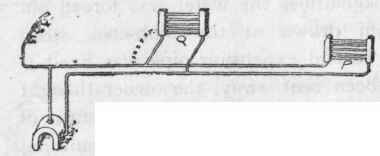
Figure 456.
In another case a long branch pipe was fixed to supply a pantry-sink. This pipe was returned so that water would circulate through it, and thus avoid having to empty the pipe of cold water before hot could be drawn. It was found that no circulation took place. The way it was branched is shown at Figure 457, S being the main flow and T the main return pipe, and U the way the draw-off pipe was branched so that any pent-up air could escape when the bibb-cock was opened. Figure 458 shows the alteration made, the branch flow being taken off the top of the main flow as shown at V. The issue was successful and hot water freely circulated through the branch pipe, which was about 40 feet in length.
The last two problems in hot-water circulation are typical of a great many mistakes made by men who may be compared to pieces of machinery, who can execute work in a fairly good way, but who lack the necessary experience or knowledge to properly plan or arrange the scheme before commencing to carry it into execution. Other examples could be given, but those cited are sufficient to set the reader thinking, and, if he is a practical man, may perhaps prevent him making similar mistakes.
In some instances fire insurance societies insist that no hot-water pipes shall be in actual contact with, or within several inches of, any woodwork. Where, of necessity the pipes must be fixed close, the woodwork has to be covered with sheet-metal or be otherwise protected.
When pipes are carried beneath wood flooring, and rooms, etc, are beneath, it is always advisable to construct a proper channel for the pipes to lay in, and line the channel with sheet-lead. This metal lining not only keeps the pipes away from the woodwork, but should the pipes leak the water is caught, and, running to the lowest end, the bottom of the channel being laid to the same declination as the pipes, can be conveyed away by means of a waste pipe fixed from the channel to a suitable position for discharging. It is also a good plan to lay the hot-water pipes on small rollers, which can be made of remnants of iron pipe, so as to keep the circulation pipes further away from the woodwork, and also allow them to move freely when expanded or contracted by differences in temperature. These rollers should not be too far apart or the pipes will sag down between them, thus allowing air or vapour to lodge in the high parts and cause a partial obstruction.
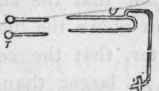
Figure 457.
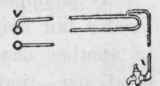
Figure 458.
It is important that the cold-water supply-cistern should be fixed a fair height above the highest draw-oft cock, and, as stated in another chapter, that the cold-water supply-pipe should be a good size - that is, larger than any of the branch or draw-off pipes. This has again been brought to the writer's notice at a house where complaints were made that very often no hot water could be drawn on the upper or chamber floor for a minute or two at a time, when it would begin to run at the tap and perhaps immediately afterwards stop again. On seeking for the cause of this it was found that sometimes one or two taps were opened on the ground floor for drawing hot water at the scullery or pantry sinks, during which time none could be drawn on the floor above.
Figure 459 is a sketch diagram showing the position of the cold-water cistern, cylinder, boiler, tinned-copper circulation and draw-off pipes, etc. To remedy the evil, all the cocks on the ground floor were pea'd - that is, a copper disc, with a small perforation, was inserted in the bosses, so that the water did not run quite so fast when the cocks were opened. A 1 1/4-inch pipe was fixed from the cold-water cistern to the boiler. The cold-water cistern was only 4 feet above the level of the highest draw-off cock, and this cock was one of great importance, as it supplied the principal bath-room, which was used by a nobleman. The above alterations were found to improve matters very much, but at times no hot water could be had at the above-named cock, so it was deemed advisable to fix a 20-gallon tinned-copper cylinder, as shown by dotted lines at W, the circulation pipes being so connected that the cylinder could only be emptied by opening the cock attached to it. This arrangement was to avoid the contents of the cylinder running back into the circulation pipes when they were being drained by cocks at a lower level, and was found to be fairly successful, although some time had to elapse before the lower strata of cold water was heated to the same extent as the upper portion of the contents of the cylinder.
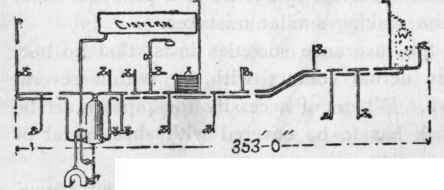
Figure 459.
In the diagram, X was a coil made of 1 1/4-inch copper pipes, nickel-plated, and was used for warming the bath-room, and also the bath-towels.
Farquharson Roberts & Phillips, Limited, Printers, 7, Upper Thames St., London, E.C
Continue to:


My Books

