


Drain-Traps For Surface-Water And Waste Pipes. Part 2
Description
This section is from the book "Plumbing Practice", by J. Wright Clarke. Also available from Amazon: Modern plumbing practice.
Drain-Traps For Surface-Water And Waste Pipes. Part 2
There are three or four patent traps in the London market, made nearly similar to the last one, but have the advantage that they are made in one piece of vitrified stoneware, or highly-glazed pottery ware. Figure 213 is one of these that is spoken well of.

Figure 213.
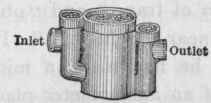
Figure 214.

Figure 215.
The inlet pipes of this trap discharge on to any matter that may be floating in the trap, but the end of the outlet being immersed beneath this matter it cannot float into the drain, Figure 214 is another trap specially designed for the same purpose. In this case the inlet and outlet ends of the pipes are both below the floating grease, but being placed outside the body of the trap the inside is open and without any objectionable corners difficult to be cleaned.
Figure 215 is another grease-intercepting trap, differing from the last in that it is oblong with round corners on plan. Figure 215 has also a galvanized-iron perforated pan, made to fit into the bottom, with a handle for lifting. This is a great convenience, as at one lift can be taken out the whole of the solid matters that may have accumulated there. These traps all have the advantage that a man with a pail of hot water and soda can wash them as clean as when new.
It is usual to fix these traps beneath the yard-paving, but this is only necessary when they are placed in a position where the contents would become frozen. There is no reason, beyond frost, why they should not be fixed above the paving; indeed, they would be better so, thus making them easier to be cleaned out. It will generally be found that all places requiring periodical attention or cleaning get done in a better manner if no difficulties are in the way.
It is important that all kinds of grease-intercepting tanks should have the covers quite air-tight, and a small air pipe fixed to them and continued to a position where any smells escaping from it would not be offensive. There are evils, and evils, and the grease-tank is a necessary evil; but a trap of this kind is out of place when fixed where there is no grease to intercept. A gentleman amateur sanitarian had five of these traps fixed in various positions round his country mansion to receive the waste-pipes from sinks, baths, etc. He thought these traps "were the best, as they were the most expensive." He also had a "great objection to a complication of traps," and "objected to any being placed in the waste pipes near the fittings." It was very difficult to make him believe that he had made a mistake, but he could not combat the evidence of an anemometer placed over the waste-pipe of the wash-hand basin in his dressing-room, which registered 380 feet lineal as having passed through in five minutes, and this air had to pass over the contents of one of these traps, which were anything but pleasant to the olfactory nerves.
For a large building the consulting engineer designed a grease intercepting tank similar to Figure 212, but it was made about 8 feet long. During the greater part of the day the contents of the tank are nearly at boiling point, the grease floating about like oil. There need be no importance attached to this, excepting that proper attention must be paid to it, and the liquid grease skimmed off before it accumulates to such an extent as to get through the syphon pipe into the drain, but this place is very offensive-smelling, and, if neglected, the grease floats down the drains.
At another large building, similar to the last one, the drains were opened for examination and found to be in very good condition and free from grease. It was naturally presumed that an elaborately-arranged grease-interceptor would be found in the scullery, but on examination nothing of the sort was discovered; the only trap was a 4-inch P-trap and a 4-inch drain from it. As the whole affair was working satisfactorily it would have been ridiculous to propose any alterations, so nothing was done beyond ordinary repairs to fittings. This last case shows that, under certain conditions, grease will retain its liquid state until clear of the house drains, but the drains themselves must be at a temperature above that at which grease congeals.
Nothing has been said about the sizes of grease-tanks for ordinary dwelling-houses, and, indeed, little can be. It may be said that the tank itself should hold sufficient cold water to congeal the grease, but, as a matter of fact, this is almost impossible without making an enormously large affair. It would be very improper to do this; the smallest traps are very offensive, and there is not the least doubt the evil would grow with the size. Then, again, in some houses more cooking (hence more grease) is done than in others; and even the kitchenmaid is an important item to be considered - one will scrape all grease off utensils into a garbage-tub, and another one will put all into the dish wash-up tub, and which eventually finds its way into the drain, or grease-tank, if one. A firm of London sanitary engineers, with which the writer is well acquainted, has been in the habit of fixing a small-size grease-interceptor, with an outer jacket, so arranged that cold water can pass between them and so keep the contents cool. Figure 216 is a sectional elevation showing the arrangement. The outer chamber, A, A, is made of stout tinned-copper, with an outlet, C, for connecting to the drain. There are two brass unions, D and E, for connecting a cold-water supply and overflow pipe. The inner chamber is also of tinned-copper, with a pair of handles for lifting out, and with an air-tight cover. There is also another union for connecting a vent pipe to the inner chamber. By a simple and ingenious arrangement the waste pipe, F, from sink can be disconnected, also the part connected to the outlet, C, so that the inner chamber and its contents can be lifted out, emptied, cleaned, and replaced with very little trouble; or the cover can be removed and the contents scooped out without taking away the receptacle. Disinfectants should always be used, and should be applied some time before disturbing the contents of these fittings. When fixed beneath they should be kept as close as possible to the sink, in which case only a very short waste pipe would be required to connect them; but when fixed some little distance away, or out of doors, it is important that a trap should be placed in the waste pipe as close to the sink as possible, to prevent any unpleasant odours from passing through the pipe. Even fresh air passing through one of these dirty pipes would be rendered unfit for respiration. There can be little doubt that to this may be laid the cause of so many cooks and kitchenmaids being laid up with sore throats.

Figure 2l6.
Continue to:


My Books

