


Pipe Bending And Elbows. Part 2
Description
This section is from the book "Plumbing Practice", by J. Wright Clarke. Also available from Amazon: Modern plumbing practice.
Pipe Bending And Elbows. Part 2
When 1 1/2 or 2-inch pipes are used for ventilating purposes, as a rule they are of light substance, although some people make no distinction between a waste and an air pipe, and use the same strength for each. But when a light pipe has to be bent to a small radius or sweep, it is very difficult to do so without crippling. As the bolt can't reach the bend, and the pipe is too small in which to work a dummy, there is only one recourse, and that is by driving through a series of boxwood balls, commonly called " bobbins.' A small one is sent first, and each successive one is larger, until the last, which is of the same diameter as the inside of the pipe. Short pieces of wood, rather smaller than the pipe, are driven after the bobbins, and these are called " followers," and the whole are forced forward by a series of blows with a wooden rod if some distance in, but if not far from the end a short piece of rounded wood is pushed in, and driven with blows from a hammer or mallet. Instead of forcing the bobbins through in the manner described, an iron or lead ball is sometimes allowed to fall on them. This necessitates the pipe being placed upright, so that the ball may fall and so generate sufficient force to drive the bobbins onward. The pipe has then to be turned the other end upward for the ball to roll out for using again. This is very tedious work, and it is very rarely that a good plumber adopts this system of making bends. They (the bobbins and followers) should never be used excepting by a good tradesman, and he, as a rule, can make his bends without their aid. Figure 24 shows that the whole of the force required to drive the bobbin round the bend is spent on the heel at E, so that instead of forcing the throat, G, outward, the bobbins strain the outside so that the lead is stretched to the utmost limit, and sometimes a large hole is made. A good tradesman, who knows how to use bobbins properly, will keep dressing the part at E with a soft hornbeam dresser, as his mate drives them through, and he hits good smart blows so as to force the part at G outward; a box dresser used for this would cut the lead. By warming G it comes out much easier. In referring to what was said above, when describing bends made with the hammer and bolt, and on looking at the position of the bobbins in sketch, it will be noticed that if the plumber is in too much of a hurry and pulls his bend around too sharp, that the lead will be driven into a buckle just below G. When this occurs, no more time should be wasted upon it, especially if the plumber has already made the bend, K, so that he cannot take them out and drive from the other end. Even when the bobbins are past the bend, a considerable number of followers must be sent after them, or else from the other end, so as to drive them back again and out of the pipe.

Figure 24.
It does not matter how skilled the plumber is, he cannot always depend upon his followers going as he wishes. If he has them too long they will get jammed in the bend, making it thin at the heel at H, Figure 25, and if he has them too short they get angled, as those at J, Figure 26. If they fit too tight the plumber cannot get them out. They ought to be so small that they will fall out of the pipe when it is held up; and then again, if they are too small they wedge together inside the pipe, and the more they are driven the tighter they get. Or perhaps one bobbin will split into halves, and the only way to remove them is to cut a slit in the pipe which has to be soldered over afterwards. When a plumber has made a bent pipe with bobbins and followers he should be careful to test if the pipe is clear of them, as it is no easy matter to get them out when the pipe is fixed, especially after water has passed through and caused them to swell. If three or four bends are to be made on one piece, say a 10-foot length of pipe, all the above evils are aggravated, and it requires about a bushel-basketful of these things to force the bobbin, A, Figure 27, through the whole length, and at every bend and turn in the pipe, one of them is sure to go wrong. On the whole, this way of bending lead pipes is not to be recommended, and should not be practised more than can be avoided. Another way of using bobbins is: have them perforated and strung on a strong cord. This is attached to a winch, and the bobbins are dragged through the pipe, pushing out all bruises, etc, as it passes. If three or four bends are in the piece of pipe, care must be taken or the cord will sometimes cut through the throat of the bends

Figure 25.
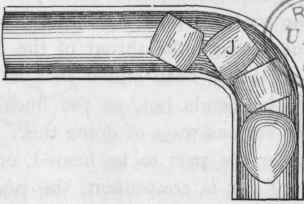

Figure 27.
It has been stated that it is a good plan to make the throats of the bends hot, as the buckles work out much easier. There are various ways of doing this: sometimes wood shavings are burnt under the part to be heated, or inside if the pipe is large enough; or if gas is convenient, the pipe can be held over a flame, or a flexible tube and nozzle or jet can be used. To test the heat of the pipe - which should never be allowed to get hotter than about 2500 to 3000 Fahr. (lead melts at about 6170 Fahr., and is brittle at a much less heat than that) - pass a wet rag or sponge over it, or drop water on. If this water boils and dances about in globules, the pipe is about the right heat, but if the ebullition is so violent that the water will not stay on, but jumps off, so to speak, it is too hot, and the lead will be found so brittle as sometimes to break, especially if the pipe is not made of pure but out of old lead, with which is, perhaps, mixed other metals, such as tin from old solder, zinc, antimony from old type metal, etc, etc. A much better way to heat the pipe for bending is to pour a ladleful of melted lead on the part, taking care not to have it too hot, and letting it lay there for a few seconds. This heats the pipe just where it is required, and does not make it so black and disfigured as when a flame is used to heat it. It is not a good plan to card-wire a bend to take out the tool-marks; a little water and fine sand (not coarse grit) is all that is required to get off any stain marks; the tool marks should be planished out with a smooth-faced boxwood dresser. A good plumber does not make more tool marks than he can help, and works them out as he proceeds. There is a certain amount of tact required when making bends, as sometimes a soft dresser is required, and at other times a hard boxwood one.
Continue to:


My Books

