


Pipe Bending And Elbows. Part 3
Description
This section is from the book "Plumbing Practice", by J. Wright Clarke. Also available from Amazon: Modern plumbing practice.
Pipe Bending And Elbows. Part 3
Pipes 3 inches and upwards in diameter are bent rather differently, in some respect, to those of a smaller size, and the throat, which becomes depressed in the act of bending, can be worked out again from the inside with a long rod with a lump on the end, commonly called a " dummy." Some men prefer, for a dummy, a rod of 1/2 or 5/8-inch iron, with an iron bulb like a plumber's soldering iron on the end, and an eye or loop turned on the other end as C, Figure 28, so that it can be turned sideways when required. Very little command can be had over the plain round rod, which slips and turns in the hand when using, and the hand also becomes cramped by long usage of the dummy, so that it cannot be used in a proper manner. As shown in the sketch, the dummy is in the position necessary for working up the throat, but to work the cheeks out it should be turned sideways, so that the thick part of the bulb is used, and not the point, as this would make indentions inside the pipe, and each of these would have a corresponding bump on the outside, entailing extra labour to work them out so that they should not be seen. The reason that iron bulbs are liked is that they can be placed in the fire and heated, and so help to keep the lead pipe warm during the operation of dummying; they also keep their shape better than any other kind, and can be bent or straightened as required.

Figure 28.
If a plumber always had to carry the whole of the tools he might want at his work, he would require a strong man indeed for his mate, for as dummies require to be various lengths in the shaft or handle, and as large pipes require them to be heavier than small ones, it follows that these same tools would be a fair load, without any others, for a man to carry, so that as a rule they are rarely used made of all iron. Should one be required at a job, it is generally made out of a piece of iron rod, and if that is not to be had, a piece of 1/2-inch or 3/4-inch iron gas barrel or tubing. Iron rod is the best, because of being able to make the hand loop on the end. The other end can be jagged or cut with a chisel, and then tinned as at A, Figure 28. To cast a bulb on the rod a mould is made in moistened sand, or a piece of lead pipe is soiled inside, worked to the required shape and then buried in sand. The jagged end of the rod is then held in the proper position in the mould while molten plumbers' solder is poured in. The mould is then taken off and any roughness filed off the bulb, so as to make it smooth. If the dummy head is cast in sand there is generally a square shoulder left at B. Sometimes this is cut off with a hammer and chipping knife, but it is much better to melt it off with a heated iron or copper bit, as being less liable to loosen the head on the handle, and then made smooth with a file, as any roughness would injure the inside of the pipe. Gas piping at the best is only a make-shift dummy rod, as in spite of the end being tinned, the bulb of solder will soon work loose, and become almost useless. Gas pipe soon breaks off against the bulb by frequent bendings and straightenings to suit the angle of the bend being made.
The best way to commence making a bend in a large size pipe - say 3-inch, 4-inch, or 5-inch, and of the ordinary substance as six pound, seven pound, or eight pounds - is to slightly bend it cold, and then drive in (not work) the bulges at the sides with a soft dresser; then heat the throat, keeping the heel of the bend as cool as possible by wetting with cold water. Slightly sprinkle the throat with water, or expectorate on it, to test its heat as before described. Next get astride the pipe and take the back side of the dresser, or something similar, with a piece of carpet or other padding, and press on the place where the bend is to be made, the mate at the same time lifting up the end. The pipe is then quickly laid on its side on the bench and the bulged part driven in and toward the heel. Figure 29 - A shows how a section of the bend looks when first pulled up, and B when it has been dressed as described. The illustration B shows that this driving in of the bulged part makes room for the dummy to work. The pipe is now again heated in the throat and a block placed, as shown at Figure 30, to prevent it becoming straight again.
The mate then begins with his dummy to work or boss up the throat; he starts first to get up the centre part, and if he is not carefully watched he sometimes allows the back stroke of his dummy-head to knock against the heel of the bend and so make that part very thin. A good mate never allows his tool to touch the back side, but keeps the weight of it in his hand, so to speak, and gives a succession of quick, sharp strokes upwards.
All this wants doing as quickly as possible while the pipe is hot, but it should not be hit very hard with the dummy, as this would result in the lead being driven up into buckles instead of being worked into an uniform substance. While this is being done it will be found that a crease will form at C C, Figure 30. The plumber drives this away, or works it in with a boxwood dresser with a rounded face, at the same time as the dummy hits it inside. The pipe should be frequently tilted sideways, so that part of the superfluous lead should get worked outward into the cheeks or sides of the bend, instead of gathering in substance in the centre. The rounded part of the bulb should be used as much as possible, to avoid making the inside of the pipe rough, and unnecessary tool marks on the outside. Some plumbers can make a right-angled bend on a 4-inch pipe at two heats (a bend has been made in one heat , but it is much better to have three or even four heats, and on cutting open this bend it will be found to be the best and the most equal in substance.

Figure 29.
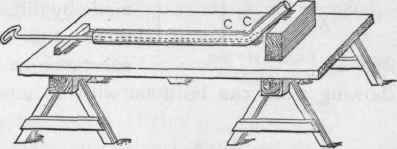
Figure 30.
After working out all the bruises, and, as far as possible, the tool marks after each bending, the pipe is pulled up again, and the whole operation described above is repeated until a bend of the required angle is made. At an exhibition of plumbers' work, held at Kensington some time ago, were about eight or ten lead syphon traps made out of 3 1/2-inch lead soil pipe, shaped as in sketch, Figure 31, made by different men, and I don't think there was one that was any less in substance at X than anywhere else, thus showing what can be done with no tools but dummy and dresser.
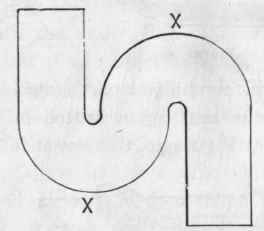
Figure 31.
Continue to:


My Books

