


Connecting Soil-Pipes With Chimney-Flues - By-Passes In Trap-Ventilation, Etc. Part 3
Description
This section is from the book "Plumbing Problems", by The Sanitary Engineer. Also available from Amazon: Plumbing Problems, or Questions, Answers and Descriptions Relating to House Drainage and Plumbing.
Connecting Soil-Pipes With Chimney-Flues - By-Passes In Trap-Ventilation, Etc. Part 3
The house being built on a damp foundation, a drain to remove the ground-water had been put in, as shown by the dotted lines. This drain connected with the street-sewer directly without a trap, which, indeed, without some means of preserving its seal against evaporation, would have been of little use. The main line of drain not removing all the ground-water which collected in the ash-pit of the furnace, a branch drain was taken, without a trap, from it to the ash-pit. Mark the result. When the furnace was fired up in the autumn, a part of the air-supply was sucked, as by an air-pump, directly from the public sewer through the branch-drain, and these foul gases were distributed all over the house through the hot-air pipes. Unfortunately, this, though perhaps the worst, is not an isolated case of a furnace taking its air-supply from a drain.
Figure 15 is ingeniously bad. It was discovered by a journeyman plumber in the employ of one of the prominent plumbers of New York. By some process of reasoning the workman who did it had come to the conclusion that he could make one and the same ventilating-hood serve for his soil-pipe and for his water-closet room. He arranged it as shown in the drawing. From the top of the soil-pipe he took a vent-pipe to the under part of a ventilating-hood. This hood was open at the bottom to ventilate the room, and consequently there was produced a very good means of bringing the soil-pipe air first into the hood and then into the room, as the arrows indicate.
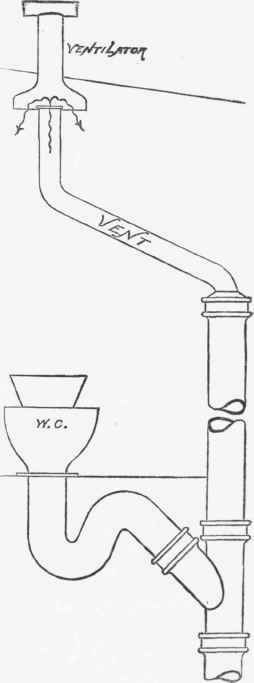
Figure 15.

Figure 16.
Figure 16 shows how a dangerous condition was produced in a Philadelphia house by a somewhat different combination of causes. A tile-drain below the cellar-floor was broken and had imperfect joints.
Then into this drain was brought a galvanized-iron rain-leader from an extension. The joint where the leader entered a hub on the drain was imperfect; the leader itself was not tight, and was carried down between the wall and the studding, so that any foul air which passed into the leader from the drain found exit into the space behind the studding, and without much difficulty entered the house. At the same time the foul air of the drain was drawn from the imperfect joints and cracks into the heater as a part of its air-supply, and so sent over the house. Another clumsy feature about this job was the connecting of two washbasins on upper floors with their waste-pipe without traps. The only trap between the basins and the drain was placed near the foot of the waste-pipe. Such an arrange ment, of course, gave free access into the room of any smells from a long and dirty stretch of pipe, extending from the highest basin to the cellar, and having no trap to cut it off from the house.
In attempting to secure the ventilation of a water-closet room an economically inclined workman produced the condition shown in Figure 17. The soil-pipe running up above the roof with open end, it was plainly inferred that if the room was connected with it the room itself would be ventilated by reason of an up-draught, which was supposed to always exist in the soil-pipe. Accordingly a ventilating opening was made in the ceiling of the water-closet room, and a ventilating connection put between this opening and the soil-pipe. The result was, of course, that very often the currents of air in the soil-pipe were downward, and its foul air and smells passed into the room.
Figure 18 may be taken as a type of what has unfortunately been a common error. It is undoubtedly a good thing to ventilate the containers of pan-closets, if that is properly done, and that form of closet is used, but the container must then be connected with an independent flue or a pipe having no connection with the drainage system. Nevertheless, so-called plumbers take the " short-cut" method, and connect the container with the soil-pipe direct, or with the trap - ventilating pipe, which is equally bad, and so, of course, do away with the protection afforded by the trap of the water-closet-for the container vent-pipe offers a direct path for the soil-pipe air into the container, and there is no efficient protection to prevent its passage from the container into the house. This is the case with the work shown in the cut, where, it will be seen, a vent-pipe from the container of the water-closet connects directly with the soil-pipe.

Figure 17.
Figure 19 contains its own explanation so clearly on its face that a definition is hardly necessary. One of the tubs of a set of wash-trays was connected into the top of the trap, which was common to all three. Of course, such a connection being outside of the trap-seal, an open course was provided for the bad air from the drains into the kitchen by way of this tub.

Figure 18.

Figure 19.
Continue to:


My Books

