


Complete Mechanical Equipment
Description
This section is from the book "Principles And Practice Of Plumbing", by John Joseph Cosgrove. Also available from Amazon: Principles and Practice of Plumbing.
Complete Mechanical Equipment
An illustration of the complete mechanical equipment of a water supply system in a building supplied with street and tank pressure is shown in Fig. 105. Two separate water service pipes from mains in different streets are cross-connected before being connected to the meter, so that water from either or both street mains can be used. The meter is shown bi-passed. Some water supply companies will not permit a bi-pass around a meter, and where such a rule prevails another meter should be placed on the bi-pass. From the meters the water passes to the filters, which are so connected that they may be used either separately or both together. A bi-pass is provided around the filters, so water can be supplied direct to the building without filtration. After leaving the filters, one branch of the house main is connected to the cold water air chamber and distributing manifold for the lower floors, another branch supplies the hot water tank for the lower floors, another branch supplies the suction tank through four ball cocks, and the remaining two branches are connected to the suction pipes of the two pumps, so they can pump direct from the city water mains.
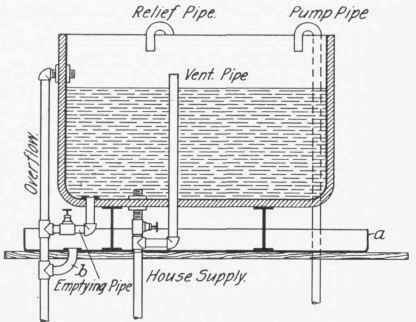
Fig. 104

Fig. 105
The pumps are also connected by suction pipes to the suction tank from which they generally draw water. The supply pipe from the house tank is connected to the supply pipe from the street, at a point between the two cold water drums. A valve is there provided so that in case of necessity water from the house tank can be turned on to the lower water supply system. A check valve is placed where marked on the illustration, to prevent water from the house tank running off into the street mains or returning to the suction tank.

Fig. 106
Continue to:


My Books

