


British Interior Architects. Part 3
Description
This section is from the book "The Practical Book Of Furnishing The Small House And Apartment", by Edward Stratton Holloway. Also available from Amazon: The Practical Book Of Furnishing The Small House & Apartment.
British Interior Architects. Part 3
Akin to this is the dining-room elevation (Plate 68) with primrose walls and decorations, this time of upright ovals. The black and white notes of these are carried out in the furniture, and, while strong colour is supplied by the lamp and bowl, the structural severity of their form should be observed.
The sitting-room (Plate 71), while attractively "different", shows how near Modern may approach Period decoration. The furniture is eighteenth century in character, and the walls, though individual in colouring and detail, are appropriate in feeling. Modern touches are also supplied by the accessories.
Decorations in the "Chinese taste" are much in vogue at present in both countries, and the very colourful example shown in Plate 63 will therefore be of particular interest. The constructional strength of the design of the coved ceiling is here also to be observed.
The hall (Plate 69) contains much strong colour, but this is confined to the details, and the architecture is not only, as was mentioned, of great severity, but the walls are white with woodwork of pale grey and baseboard of black.
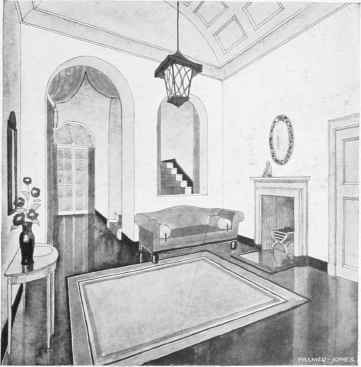
PLATE 69. A HALL DESIGNED BY W. J. PALMER JONES, LONDON.
Floor black, Walls white, Woodwork and console grey, Rug grey with blue, black and emerald green border lines, Lantern, couch, and hangings to French door vermilion other hangings emerald green.
Illustration by Courtesy of the Architect and the London Furnishing Trades Organiser in which it appeared.
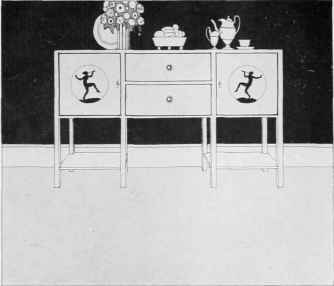
Painted Sideboard.

From a bedroom suite in whitewood, stained blue, with black lines, Brass handles, antique finish.
PLATE 70. FURNITURE DESIGNED BY W. J. PALMER JONES, LONDON.

PLATE 71. A SITTING-ROOM DESIGNED BY W. J. PALMER JONES, INTERIOR ARCHITECT, LONDON.
Illustration by Courtesy of the Architect and the London Furnishing Trades Organiser in which it appeared.
Mr. Palmer Jones designed the furniture shown in these interiors and some other attractive pieces are also illustrated in Plate 70. The sideboard is of the same character as that in the wall elevation (Plate 68) but with dancing figures in circles upon the two side doors. The other two pieces are from a bedroom-set in whitewood stained blue and with black lines. The handles of these are of brass given an antique finish.
In America where painted furniture is largely to the fore much more might be done in the directions of the combination and staining of various woods for fine furniture.
Plates 72-74 illustrate a series of six delightful wall-paintings by that versatile designer and painter Mr. George Sheringham of London. It will be seen how justly the word versatile has been used, not only because of the great variety shown in these decorations but when it is mentioned that he designs special rooms, books, drawings for papers, stage-productions, textiles, and occasionally posters. He is now designing a series of cretonnes for the largest English firm of producers, and silks have been one of his specialties.
A few years ago he did a series of large silk panels for beautiful Ilmington Manor in Warwickshire, and another set is now in the possession of Lord Howard de Walden of Chirk Castle, Wales.
His wall-panels are usually employed as overmantel decorations, but some rooms have been completely treated by the use of the fan-panels, especially a room of Lady de Walden's in which a series of about fifteen are employed. The illustrated examples are in the homes of noted people, the first being owned by Mrs. Asquith. Others have been exhibited at the Luxembourg, South Kensington Museum, and many other famous institutions.
The charming technique of these paintings is well shown in the reproductions, and the opportunity for wealth of colour in such subjects as the "Zara," "Cremorne," "L' Apres Midi" and "The Vase" is immense. The decorative treatment of the last and of the quaint, decades-past costumes of the "Cremorne" is especially attractive, while the watery depths of "Sea-flowers" make a wonderful overmantel-panel for a dining-room.

PLATE 72. WALL DECORATIONS BY GEORGE SHERINGHAM, LONDON.
"L' Apres Midi." In the Collection of Mrs. Asquith "The Vase".
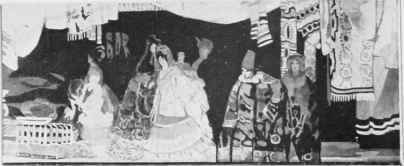
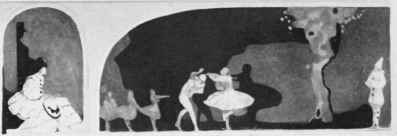
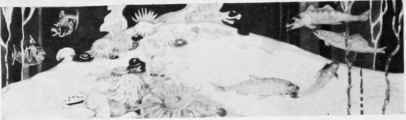
Zara Visits the Bazaar Design for a Frieze, In the Collection of Edmund Davis, Esq. "Sea Flowers." Overmantel Panel.
PLATE 73. WALL DECORATIONS BY GEORGE SHERINGHAM, LONDON.
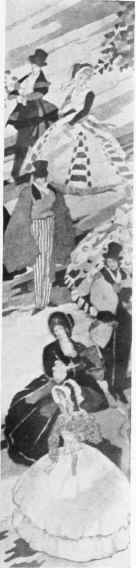
PLATE 74. "Cremorne" wall decoration by george sheringham LONDON.
The writer's appreciation of Period furnishing in its liberal use will be plain, but one with open mind must perceive the great desirability of the creation, also, of a living-style, embodying the characteristics of to-day and practically adapted to its conditions; yet which shall march with and carry on the great principles of the past but with the freshness, verve and individuality of our modern life.
It is thus that new "styles" arrive - not by an effort to produce overnight something brand-new and never before seen, evolved from one's inner consciousness or a bad digestion, but, with careful consideration of present needs, adapting what has gone before, carrying on the great tradition and using its elements in our own individual way.
Continue to:


My Books

