


The Consulate And Empire Furnishing
Description
This section is from the book "The Practical Book Of Furnishing The Small House And Apartment", by Edward Stratton Holloway. Also available from Amazon: The Practical Book Of Furnishing The Small House & Apartment.
The Consulate And Empire Furnishing
The youth of Corsica became General Napoleon Buonaparte, then in 1799 First Consul, and in 1804 Emperor of France. All things were to become new, and prominently among them the setting for this new dignity.
But Art has little to say to Self-Consciousness. The attempt to create beauty by way of a formula, a fixed determination, with hammer and tongs, will never do. Determination is an excellent quality but Beauty is illusive - and when one grasps she is not there. It is only when one creates out of love that he finds Beauty's hand on his shoulder as a guide.
With Desmalter, Percier, and Fontaine, the leaders in the movement, the basic idea was not primarily the providing of a beautiful style of furnishing generally appropriate to the occasion, but was that of devising a decoration that should be a glorification of France as a replica of the ancient empires and embodied in the personality of Napoleon Buonaparte. And the idea of reviving antiquity to this end became an obsession.
Poetry, or painting, or any other of the arts may have and should have behind it an idea as motive power, but if the promulgation of that idea becomes the first object of the creation, the result may unfailingly be labelled propaganda and not art at its happiest, greatest and best. We may term the Empire style a furnishing for "propaganda".
The attempt to transfer the furniture of antiquity proved a failure - there was too little of it for modern needs and it was too unsuitable. But Percier and Fontaine, able men, did remarkably well in supplying the Emperor with an "imperial" furnishing: we may hate it, but it was so thoroughly what it was purposed to be that we must feel for it a sort of unwilling admiration, accompanied by a smile at its pomp. Napoleon must have revelled in that bed-chamber of his!
Though the infection was universal the case of simpler domestic furniture was not so desperate and some pieces are fairly likable. The cabinet-work was composed of great expanses of flat mahogany with metal mounts. As Egypt was one of the favourite sources of "inspiration", sphinxes and other emblems of its civilisation frequently appeared in this connexion.
Especially toward the end of the period some chairs and other furniture were of such final, brutal ugliness that they rouse one to fury that the great art of France, in such short time, could have sunk so low.
Whistler's contention that there "never was an artistic period" will not be argued here: in decoration there surely was an inartistic one, and that through a large portion of the nineteenth century. It will not do to ascribe this wholly to the influence of France - great and wide-spreading as that influence was: there was a universal drying-up of the well-springs of inspiration throughout the western world.
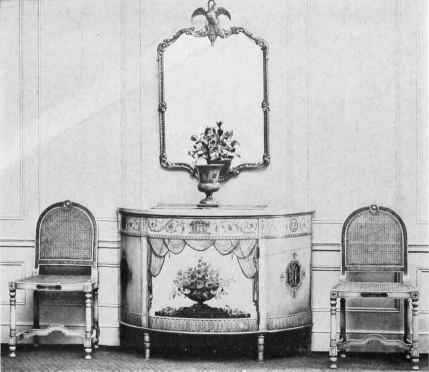
PLATE 144. "PRESTON" COMMODE, "CHATSWORTH" MIRROR AND "PADUA" CHAIRS.
Commode of English type: ground in rich cream colour, side panels and drapery in turquoise, flowers in natural tones.
Surface enriched by a fine crackle Chairs of Eighteenth Century Italian type; rich blue and cream enamel.
Manufactured by Wm. A. French Furniture Co., Minneapolis, Minn.
And so, in decoration, loveliness passed from the earth-to revive, briefly, in the work of the American, Duncan Phyfe, and then to sink into her slumber of a hundred years. The work of the moderns is not all bad: we can still accomplish simple things; the furniture of Ernest Gimson and others is sterling and individual; we have learned how to use the beautiful things of the past; but the age is one of appreciation rather than creation, and we must still exclaim, When will Loveliness awake!
Continue to:


My Books

