


The Middle Ages. Part 3
Description
This section is from the book "Dutch And Flemish Furniture", by Esther Singleton. Also available from Amazon: Dutch and Flemish Furniture.
The Middle Ages. Part 3
Before the great artists of the Netherlands arise, we must go to the miniatures of early manuscripts in order to form a correct idea of a Mediaeval interior. We usually find a very simple arrangement of furniture, which consists of a bed, a bench, an armchair and some kind of dressoir, or sideboard. The floor is tiled, or tessellated; and sometimes the bed stands on a rug or carpet, which also covers part of the adjoining floor space. The windows with small leaded panes are supplied with shutters of two or three wings: these are sometimes covered with leather fastened with large brass-headed nails. The chimney-piece is always wide and high; the funnel shape of this occurs in the earliest examples. The shelf above the opening is usually adorned with glass, plate or earthenware. The armchair stands beside, or near, the bed; the dressoir is close by; and the settle is beside, or sometimes in front of, the fire. The bed is often nothing but a long chest on short legs with a mattress and pillows on top; and this is moved out in front of the fire in case of need.
The curtains and canopy are suspended by cords from the rafters, as is also the chandelier.
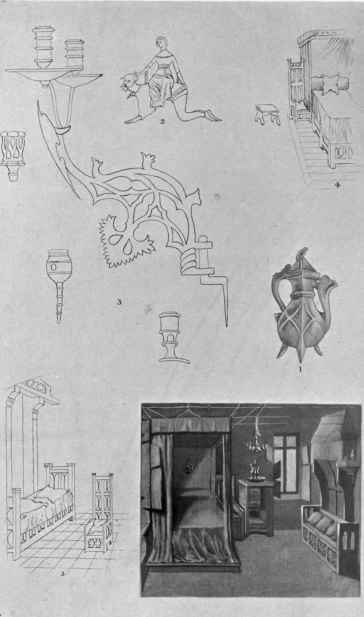
Plate II. - Bedroom (Fifteenth Century).
Fig. I: Aiguiere (Fifteenth Century); Fig. 2: Aiguiere (Fourteenth Century);
Fig. 3: Bracket Candlestick; Fig. 4: Bed, Chair. and Stool (Fourteenth Century);
Fig. 5: Bahut and Chair (Fifteenth Century).
This same arrangement of furniture occurs in a picture of the Salutation angelique in the Louvre, by an unknown Flemish painter: it has been attributed both to Lucas van Leyden and Memling. This room, reproduced in Plate II, is one of the middle class at the end of the fifteenth century. The walls are bare, the ceiling shows open rafters of natural wood, and the floor is tiled. The panes of the windows are leaded, and the inner shutters, which are trebly hinged so as at need to fold into the thickness of the wall, are, moreover, divided in two parts, so that only the top may be opened if needed. The other window has a window seat. The high chimneypiece is furnished with the lateral shelves in use throughout Mediaeval times from the twelfth century onward. The chimney diminishes in size as it rises, like an inverted funnel. In summer time, when the fire was not needed, the fireplace was masked by a wooden screen to prevent draughts. In front of this, with its back to the screen, was placed the high-backed settle, which in winter faced, or was placed laterally to the cheerful blaze of the hearth. The bench shown in this picture is made of plain boards, with a little plain Gothic carving below the seat. For comfort, it is supplied with three red cushions.
The bed, which is raised on a low platform, is also furnished with red curtains, bolster and counterpane. The tester is suspended by cords from the ceiling. Beside the head of the bed is a chair, and next to that a credence, which is used as a wash-hand stand. On it are placed a ewer and shallow basin. These, and the brass chandelier hanging above, are of the manufacture of Dinant, a metal ware known all over Europe under the name of Dinanderie. The chandelier has six branches, each a grotesque form of some animal, and the top of it is surmounted by the figure of a seated quadruped. It is raised and lowered by a pulley and chain.
The ewer, or aiguiere, standing on the credence, is an excellent specimen of Dinanderie of the fifteenth century; it has a double spout, as shown in Fig. 1. Other examples of Dinanderie of this period are represented in Fig. 2, a grotesque aiguibre; and Fig. 3, a bracket candlestick of very graceful form.
Dinanderie became celebrated as early as the thirteenth century. Although made at first in Dinant, its manufacture spread throughout the valley of the Meuse, and Dinantairs were established in various cities and towns in the Netherlands, Germany, England and France. In 1380, one Jehan de Dinant, living at Rheims, furnished some articles to the King. Among the copper and brass ware delivered at this period to the royal household and to the establishments of other great personages by this workman, we find all kinds of kitchen articles, cooking utensils, stoves of all sizes, wash-basins, kettles for heating water for the bath, barbers' basins, large boilers of all kinds, warming-pans for the beds, candlesticks, chandeliers, and aiguieres (ewers).
The permanent woodwork of the apartments in Mediaeval days was furniture, without being "movables," just like the carved oak in the choir of a cathedral. The panelling contained cupboards and wardrobes; bedsteads were contrived in the timbered lining of the walls; and the woodwork readily lent itself to the adaptation of window seats, settles and benches. It may easily be understood how the woodwork of a room might conceal a whole series of shelves to which sliding panels, or panels opening outwards as doors, gave access. These various compartments served as cabinets for curios, bookcases, glass and plate cupboards, wardrobes and larders. When one of these compartments was made as a separate piece of furniture to stand by itself out against the flat wall of a room, it was called a cabinet, or armoire. As late as the middle of the seventeenth century, however, the armoire was generally part of the fixed woodwork. Relai was another name for it. Thus in 1635, Monet defines armoire, armaire, aumoire as a "reservoir pratique en la muraille a servir et garder tout chose; and Cotgrave (1673) has: "Relai" as "armaire, a hole or box contrived in or against a wall."
The plain box, or chest, was the origin of all the developments of Mediaeval furniture. It had many uses: it contained the treasures and valuables of the lord; it was used as a packing-case or trunk for travelling; with supports at the four corners and back, and arms added above, it served as a chair or settle, with a seat that could be lifted on hinges; raised also on legs and supplied with a dais, it became a dressoir, credence, or sideboard; chest-upon-chest superimposed, developed into the elaborate armoire; and, finally, supplied with a head and foot rail and made comfortable with mattress or pillows, it served as a bed.
Continue to:


My Books

