


The Renaissance. Part 2
Description
This section is from the book "Dutch And Flemish Furniture", by Esther Singleton. Also available from Amazon: Dutch and Flemish Furniture.
The Renaissance. Part 2
Another huche, or bahut, of the sixteenth century, of more delicate workmanship, is shown in Plate VII. The subject of the central panel is taken from the story of David. Allegorical figures decorate the pilasters, and Mercury and Cybele fill the niches. This is also from Cluny and is of French work of the sixteenth century.
The Renaissance was too strong a movement not to carry everything before it; but it must not be imagined that it met with no opposition. There were people in high places who clung obstinately to the old order of things and resented innovations. Gothic art was still supreme under the short rule of Mary of Burgundy; but her daughter Margaret of Austria, Regent of the Netherlands, had to face the new ideas, and found it hard to reconcile herself with them, notwithstanding her encouragement of the arts as a whole. She kept a brilliant court, and she and her husband, Philibert of Savoy, warmly encouraged genius and talent. She gathered around her more than one hundred and fifty painters, sculptors, architects and decorators in all branches of art.
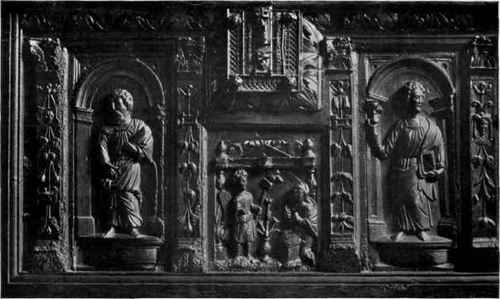
Plate V. - Coffer in Flemish Style. CLUNY MUSEUM, PARIS.
On the death of her husband she was inconsolable; and planned a splendid church in which his and her remains should finally rest side by side. In 1505, she intrusted the planning of the work to Jean Perreal. In an early letter, he writes to her that he is delighted to undertake the work, and will take advantage of all he has observed regarding convents in Italy, where the most beautiful in all the world are to be found. In another letter, in 1509, we read: "Jy me suis mis apres tant pour mon devoir envers nostre Majeste que pour l' amour que je vous doy, et ay revyr'e mes pour-traictures, au moins des choses antiques que j'ay eues es parties d'ltalie, pour faire de toutes belles fleurs ung trosse bouquet, dont j'ai monstre' le jet au dict Le Maire."
The Flemish character of Pereal's early style had undoubtedly made him acceptable to the Regent. During her residence in France, from 1483 to 1493, she had then been subjected to no other than Flemish influence in art. The Italian taste had not yet reached Paris. But Perreal crossed the Alps with Charles VIII in 1495; Louis XII went into Italy in 1502, and again in 1509. We are thus on the threshold of the Renaissance. Perreal, as the above quotation shows, instead of remaining true to the memories of his Flemish education, wanted to seek adventures in the domain of Italian art. He had the temerity to offer to Margaret for her tombs a bunch of his trousses bouquets. She was scandalized, and broke off all relations with the erring artist. She looked around her for an artist who conformed to the principles of Flemish art, one who would not be likely to betray national traditions for foreign modes. Her choice fell upon a master mason named Louis van Beu-ghem to build the great church of Brou. A member of one of the corporations of St. Luke, faithful to Gothic art, van Beughem produced a work that shows that style in its latest development and decadence.
He showed so much zeal and ability that Margaret forced him to take charge of not only the masonry, but of the woodwork and windows too. With him were associated John of Brussels for the decorative work, and Conrad Meyt for the carving. Conrad of Mechlin was Margaret's favourite "image-maker." She paid him the generous salary of five sous a day. She paid her head cook twenty-six. Conrad carved the choir-stalls and other woodwork that demanded decorative treatment. He also executed all the great sculptural work on the tombs, including the life-size figures of Philibert of Savoy, Margaret's dead spouse, and herself, represented both alive and dead, Margaret of Bourbon, ten children, a couching lion and many armorial devices.

PLATE VI. - Flemish Coffer or Huche. CLUNY MUSEUM, PARIS.
This instance is interesting as showing that the greatest abilities in that age were applied to the smallest matters of art as well as the greatest. Among the objects for which Conrad was paid in 1518-19, we find two Hercules in wood, and two portraits of the princess in wood (for these he received eight Philippus in all), a wooden turret for the Regent's cabinet and a carved stag's head for her library chimney-piece.
Margaret's tastes are easily learned from the inventory she drew up with her own hand of her possessions in Mechlin shortly before her death. She seems to have cared almost exclusively for paintings, rich embroideries and curios. She made a complete list of her pictures, many of which were undoubtedly painted to please her by the artists of her Court. Among her embroideries were a great number of handsome ecclesiastical vestments and a few coifs, belts and gorgets for herself embroidered with gold thread "d la mode d'Espagne." The greater number of her tapestries, bed-hangings, cases for cushions, table-covers and serviettes, etc., to adorn the shelves of dressoirs were from Spain. Her tapestries are worth noting. She had two pieces woven of gold, silver and silk, representing the history of Alexander the Great, which came from Spain; four pieces, representing the story of Esther, also of gold, silver and silk, also from Spain; three pieces of gold and silk depicting the life of the Cid; two of the Seven Sacraments, another of Alexander; and four of Saint Helena. In addition to these Spanish tapestries, she had six pieces called the "Cite des Dames," presented to her by the city of Tournay when she went there to meet the King of England.
The gift of the Cite des Dames may perhaps have made some atonement for her vexation at having to attend that splendid meeting of the King and Emperor. She was very unwilling to go, and wrote to her father Maximilian, on September 22, 1513, as follows:
Continue to:


My Books

