


Disguised Treasures
Description
This section is from the book "English Furniture", by Frederick S. Robinson. Also available from Amazon: English Furniture.
Disguised Treasures
It is somewhat strange that in none of the pattern-books does a design appear for an upright secretaire, that commodious piece of furniture the shape of which was borrowed direct from France.1 Yet many exist in England which may be said to be of the style of Sheraton or Heppelwhite, some of mahogany with the usual shell or vase of flowers inlaid, others more elaborate and of harewood or even satin-wood with panels of Japanese lacquer. There is a fall-down front with a shallow drawer above and a cupboard below. Sometimes they have ormolu mounts in the French style, and occasionally the ring handles have plates made of Battersea enamels. These were also used for the fittings of mirrors of the flat shape sawn out in mahogany and slightly gilt, of which illustrations are given in Plate lxxxii. They rested upon knobs fixed into the wall, and on these knobs the Battersea enamels appeared. Mrs. Morse in Furniture of the Olden Time notes that the head of Lord Nelson appears upon a pair in her possession. This will remind us of the brass handles, 'Sacred to Nelson,' of Mr. Percy Willett's Sheraton sideboard. In connection with these cheaper mahogany mirrors may be mentioned the cheaper wall knife-boxes, which some persons call receptacles for salt or candles.
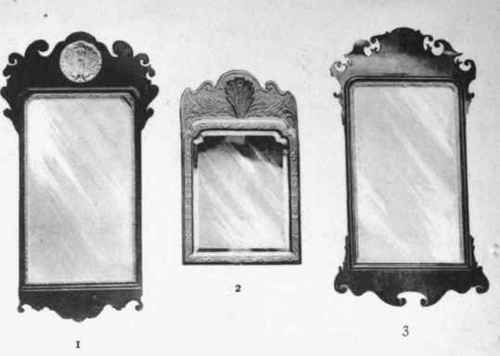

Plate LXXXII. Mirrors - 1, 3, 4, 5, 6, Mahogany, Gilt 2, Gilt Early 18th Century
LXXXII. Mirrors. Figs. 1, 3, 4, 5, 6, mahogany gilt; fig. 2, gilt. Early eighteenth century. Mr. Stephen Neate.
It is extremely unlikely that inlaid boxes would have been made for such a purpose. The shape of these boxes is rather that of the long end of a coffin. A 'term-shaped' one of this kind measures 13½ inches from the hinged lid to the bottom. It tapers from 7 inches at the lid to 4½ inches below. At the back of the lid and above it is open fret-work 6½ inches high by which it may be conveniently hung on a nail. It is of mahogany with strap-work inlay and a very good shell.
1 A fine specimen of inlaid satin, hare, and other woods, with lacquer panels, was sold by Lord Henry Thynne at Christie's, June 20, 1899.
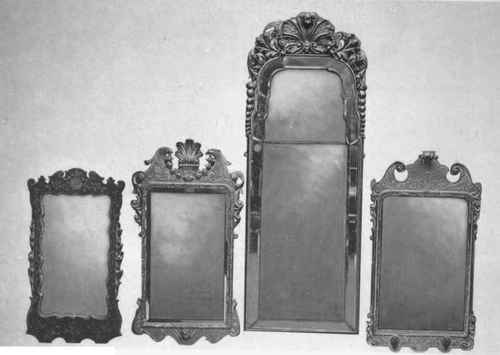
Plate LXXV. Mirror Frames, Gilt Early 18th Century
LXXV. (1) Mirror Frame, oak, gilt. Early eighteenth century. Henry Willett, Esq. (the late).
(2) Mirror Frame, gilt. Early eighteenth century. W. H. Spottiswoode, Esq.
(3) Mirror Frame, gilt. Early eighteenth century. The Hon. Sir S. Ponsonby-Fane, K.C.B.
(4) Mirror Frame, gilt. Early eighteenth century. The Hon. Sir S. Ponsonby-Fane, K.C.B.
At about the period 1780-1790 at which mirrors with the American eagle were popular, it was the fashion to use glass, blackened and gilt at the back, or else painted, as an ornament for the upper parts. I have also seen a commode with glass panels of this description, and they were a great blot on the design. Occasionally Worcester china plaques were used, as on a tea-caddy sold at Christie's some little time back. All these extraneous materials are to be deprecated upon furniture. The Wedgwood plaque alone occasionally looks well upon satin-wood examples (Plate cl.).
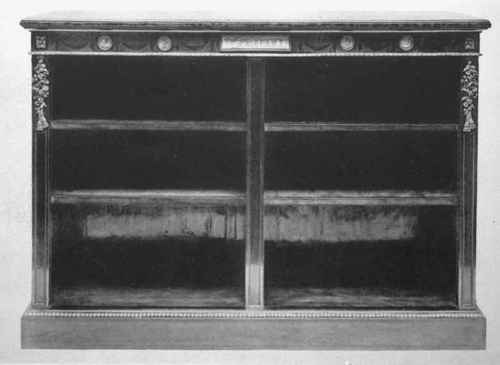
Plate CL. Book-Case, Satin Wood Mounted With Ormolu And Wedgwood Medallions
CL. Bookcase, satin-wood, mounted with ormolu and Wedgwood medallions. Messrs. Partridge.
Continue to:


My Books

