


Screens
Description
This section is from the book "English Furniture", by Frederick S. Robinson. Also available from Amazon: English Furniture.
Screens
It is said that Chippendale has left many of his screens behind him. These are either rectangular in outline or, especially if of French inspiration, irregularly shaped in the manner of Meissonier. The screen proper is, of course, attached immovably to the legs, and generally there is an opening in the top to serve as a lifting-handle. But there is an entirely different class of movable screen of a simpler kind. These are fastened with rings on a single pole supported upon a tripod. The legs are often of the same character as those of the tripod supper tables presently described, on a central pillar, and with pad, or lion's, or claw and ball feet. The largest part of the central pole just above the legs may be gadrooned, and on the legs there is, perhaps, a slight carving of acanthus leaves. This is the plainest type of mahogany tripod screen (Plate C111.2). The screen itself usually approaches a rectangular shape, but more elaborate examples are shaped in the French manner, and have tripods much decorated with the usual French flowers and C-curves.
Allied to the tripod screen is the tripod lamp table, of which Sir C. G. E. Welby, Bart, possesses a graceful example. It has the plain legs described as being usual, but spreads upwards and outwards into a species of slender cage of open-work concave curves. The extreme top is octagonal, with an open fretwork bulwark. This is a very slender and elegant little 'gueridon.' Tea table stands are of the same tripod arrangement with fretwork tops. Similar objects are the stands for tiny wash-hand basins, which seem so inadequate to our modern requirements. The central pole makes way for three turned supports upon a triangular platform, resting on the usual tripod legs. Halfway up is another tiny triangular platform, with perhaps a couple of small drawers. Another set of three uprights rests on this and supports a ring-opening for a china basin. Lord Barnard has at Raby Castle a stand which, instead of the basin-ring, is fitted with an octagonal table top, but all below is the same. Illustrated here is a four-legged specimen, the property of Mr. W. Wontner, 26 Edwardes Square, London, which with its fretted sides and shaped top is an excellent example (Plate CIV.2).
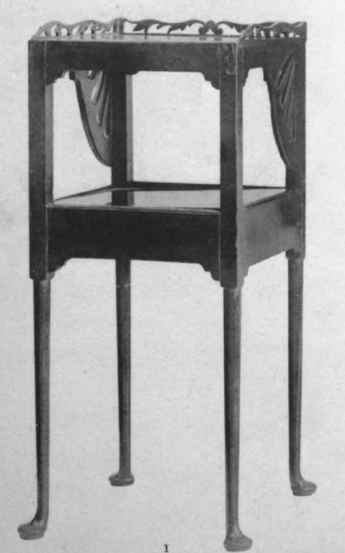

Plate CIV.
I - Whatnot, Mahogany Chippendale
2 - Washing Stand
CIV. (1) What-not, mahogany. Chippendale. The Hon. Sir S. Ponsonby-Fane, K.C.B.
(2) Washing-stand, mahogany. Chippendale. W. Wontner, Esq.
With some of these unambitious but typical pieces we have been led to anticipate an important category, that of tables, which includes many of the most delightful examples of Chippendale's genius.
To begin with the 'sideboard table,' this was his nearest approach to the sideboard as we know it. That, with its capacious drawers and cellarettes, was left for Sheraton to carry to the highest excellence. Chippendale's ' sideboard table' is simply a table upon four legs, and might be used for any ordinary purpose, unless it happens that the legs meant to be nearest the wall are less ornate than those in front, and that the strap-work on the frame below the top is only carried round three sides. The top slab is neatly moulded on the edge. The legs are upright and either 'hollow,' i.e. made of two ornamentally pierced planks set at an angle to give the outward appearance of rectangular legs, or else they are solid and bevelled off on the inside so as to make the same triangular shape as by the first method. There is often a bracket, carved and pierced, at the junction of leg and frame.
The richly carved table belonging to Mr. R. W. Partridge, which is illustrated here (Plate CVI.), with a large lion's head and ' swags' or festoons on either side of it, is a particularly fine example (see also Plate cv.).
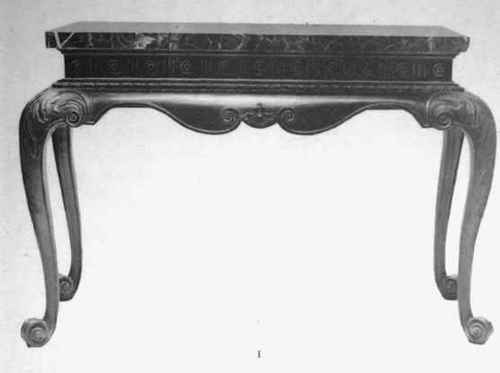
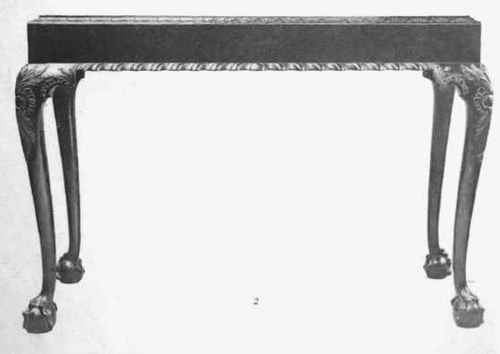
Plate CV.
I - Mahogany Slab Table
2 - ,, Occasional Table
CV. (1) Slab-table, mahogany. Messrs. Partridge.
(2) Occasional Table, mahogany. Chippendale. Messrs. Gill and Reigate.
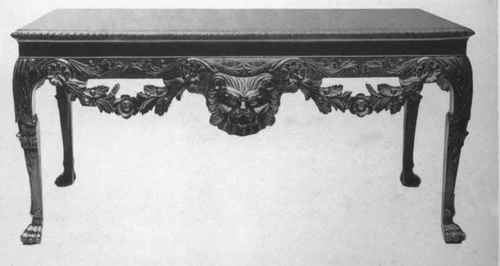
Plate CVI. Sideboard Table, Mahogany Chippendale
CVI. Sideboard Table, mahogany. Chippendale. Messrs. Partridge.
'Writing tables' are treated much in the same way, the chief difference being that they may have drawers in the frame. From these the step is short to the 'bureau table,' which corresponds very nearly with what we should now describe as a 'study table.' There is a knee-hole recess with drawers on one side, and a cupboard, perhaps, on the other. A long drawer takes up the whole of the framing, and the table rests on short shaped feet. These tables are either straight or with waved fronts. The 'library table' is not far removed from the last. The chief difference is that instead of a mere knee-hole recess, there is a wide opening between the two sets of drawers or cupboard and drawers, from front to back.
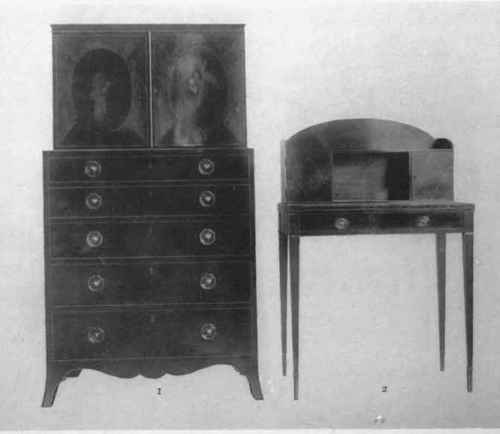
Plate CLIV.
I - Cabinet, Satin Wood, Inlaid And Painted Sheraton
2 - Writing Table, Inlaid With Ebony Shekaton
CLIV. (1) Cabinet, satin-wood, inlaid and painted. Sheraton - or Heppelwhite. The upper part, a cupboard with two doors, has elliptical panels painted with muses on a black ground. The two top drawer fronts turn down to form a writing-table, with small drawers and cupboard at the back. The front of each drawer is bordered with tulip-wood. James Orrock, Esq.
(2) Writing-table, satin-wood inlaid with ebony. Sheraton. The top of the table is a flap which folds over and is covered with leather within. The Earl of An-caster.
Continue to:


My Books

