


The Empire Style. Part 2
Description
This section is from the book "Furniture", by Esther Singleton. Also available from Amazon: Furniture.
The Empire Style. Part 2
In 1806 we read in a fashion paper that there has been a change in interior decoration, "a style of furniture drawn from the florid Ionic " being substituted for the Egyptian. Movables of domestic use are now "designed after the purest Grecian taste." The writer goes on to explain that "a more grand and beautiful outline is adopted in the shape of each piece of furniture," and that "all mahogany furniture is now divested of inlaid ornaments. Chairs, sofas, tables, etc., used in drawing-rooms are all covered with gold or a mixture of bronze and gold." In the following year we learn that chairs and sofas are made after drawings from the antique in rosewood and gold, mahogany and gold, or black and gold, and that the windows are draped in the Grecian and Roman style, and that antique and Grecian lamps in bronze and or moulu are suspended from the centres of rooms or alcoves, while antique candelabra, with branches for many candles, stand on the rosewood and gold pier-tables and the chimney-pieces.
An English fashion paper, in 1807, mentions that "Antique candelabras, rosewood and gold pier-tables and the chimney-pieces, are most adapted to receive lights on which are introduced bronze and or moulu figures, etc., with branches to receive wax candles. The antique and Grecian lamps in bronze and or moulu are also suspended in the centre of rooms or alcoves. Window curtains of chintz, with Roman and antique draperies, and silk fringes, etc., to correspond, are truly elegant. Chairs and sofas still continue from drawings after the antique, in rosewood and gold, mahogany and gold, or black and gold."
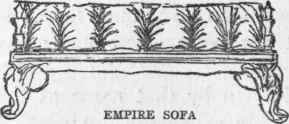

Plate XXXIX Sideboard in the Style of Shearer
Another fashion in the early days of the Nineteenth Century, which was much liked in this country, was a taste for the light "Fancy Chair" and "Fancy Sofa," which accorded well with the taste for straw matting, window-blinds, etc. In 1802 and 1803, straw matting, silk curtains, window-blinds and chinaware frequently come to New York from Canton. For instance, in 1803, King and Talbot, 14 Crane Wharf, receive "printed calicoes and chintzes, 950 Chinese chair bottoms, 100 boxes China ware, and 30 bundles of window-blinds." Checquered and straw-colored floor mats and Nankin mats and India hearth rugs and India straw matting are imported in 1803 and 1806; and "green window-blinds from China," "straw carpeting" and India straw matting come in 1809. In 1807, we also hear of India, Brussels and English rugs of Egyptian and Grecian figures and " Brussels and Venetian carpeting of different widths of the newest fashion in the Grecian and Egyptian style."
The New York newspapers contain many advertisements of Grecian, Roman and Etruscan sofas, chairs and lamps; and it seems that many people of fashion abolished their handsome old ball-and-claw foot mahogany furniture for the art nouveau of the day, just as they destroyed their old trees to make place for avenues of Lombardy poplars. Washington Irving notes this in his Salmagundi:
"Style has ruined the peace and harmony of many a worthy household; for no sooner do they set up for style, but instantly all the honest, old comfortable sans ceremonie furniture is discarded, and you stalk cautiously about amongst the uncomfortable splendor of Grecian chairs, Etruscan tables, Turkey carpets, and Etruscan vases. This vast improvement in furniture demands an increase in the domestic establishment, and a family that once required two or three servants for convenience now employ half a dozen for style."
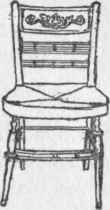
"Fancy chair," 1810
In 1809, a decorator notes that "bronze still prevails as a ground-work for chairs, etc., and will always be classic when delicately and sparingly assisted with gold ornaments. A great deal of black has been used in chairs, etc., but the appearance is harsh and the contrast too violent to be appreciated by genuine and correct taste; its cheapness can alone make its use tolerable."
"Gothic," as then understood, began to assert itself about 1810, but does not seem to have become popular until after 1813, when a writer pleads for it, noting meanwhile that "in our own time the French style gave way to the Roman and that to the Greek; and then the Persian and the Egyptian were brought forward "but" failed to supersede those chaste models of harmony and truth."
As it made its way, decorators recognized it, as will be seen in the following dictum in 1817 of one who thinks that "Every part of the furniture in a room should accord, as few things are so disgusting to the eye of taste as the incongruous mixture which is often seen, even in expensively furnished houses, where the Grecian and Gothic, the Roman and the Chinese styles are absurdly jumbled together."
The rise of the new Gothic taste is interestingly accounted for by a writer in Ackermann's Repository in 1819, who describes some new designs for furniture. It is interesting to see what he calls "Gothic," and how he traces its development. As far as he is concerned, the Chippendale "Gothic" never had an existence. He writes:
"The annexed examples are of the unsystemised art, which is often called Gothic, but which should properly be termed Tedeschi, or old German, being of the style which was substituted for the Greek and Roman forms of the purer ages. The Italians, to designate this perversion of art, called every departure from the genuine models by the name of Gothic, although widely differing from the style adopted by the Saxons and Goths; and left it to later times to give names to each particular style that the feeling and genius of any people might cultivate.
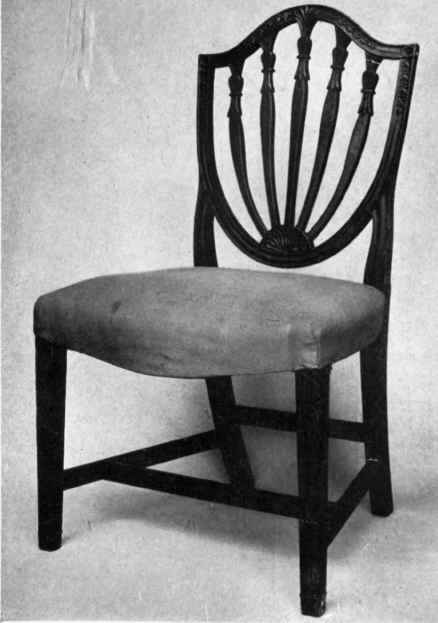

Plate XL - Heppelwhite and Sheraton Chairs - Metropolitan Museum
Continue to:


My Books

