


The Empire Style. Part 3
Description
This section is from the book "Furniture", by Esther Singleton. Also available from Amazon: Furniture.
The Empire Style. Part 3
"The style of furniture exhibited prevailed in the mansions of the first rank in Germany in the Fifteenth Century; and although a purer taste has succeeded from the high cultivation of art in that country, yet its fitness and correspondence to some of our own ancient buildings render the annexed examples of genuine Tedeschi furniture very desirable."
There was a great rage for drapery duxing this period. The draped sofa remained in fashion, and the fashion papers publish new designs for curtains in nearly every issue. In 1816, one of them says:
"Perhaps no furniture is more decorative and graceful than that of which draperies form a considerable part; the easy disposition of the folds of curtains and other hangings, the sweep of the lines composing their forms, and the har-monious combinations of their colors, produced a charm that brought them into high repute, but eventually occasioned their use in so liberal a degree as in many instances to have clothed up the ornamented walls, and in others they have been substituted entirely for their more genuine decorations, by which the rooms obtained the air of a mercer's or a draper's shop in full display of its merchandise, rather than the well imagined and correctly designed apartment of a British edifice: indeed, to so great an excess was this system of ornamental finishing by draperies carried, that it became the usual observation of a celebrated amateur in this way, that he would be quite satisfied if a well-proportioned barn was provided, and would in a week convert it, by such means, into a drawing-room of the first style and fashion. So long as novelty favored the application, this redundance was tolerated; but time has brought the uses of these draperies to their proper office of conforming to the original design, consisting of those architectural combinations that possess a far greater beauty, dignity and variety than draperies are capable of affording."
Another writes in the same year:
"In fashions as in manners it sometimes happens that one extreme immediately usurps the place of the others without regarding their intervening degrees of approximation. For the precise in dress the French have adopted the dishabille; and it has been applied to their articles of furniture in many instances, giving to them an air which the amateurs term the neglige. In the annexed plate the design of a lit de repos, or sofa bed, has a peculiar character of unaffected ease, and is not without its full claims to elegance. The sofa is of the usual construction, and the draperies are thrown over a sceptre rod, projecting from the walls of the apartment: they are of silk as is the courte-pointe also."
A suite of draperies for a bow window in 1819 "are fancifully suspended from carved devices relating to vintage and the splendors of the year; indicative of which, the central ornament is a golden peacock, whose displayed plumage being delicately colored in parts so as to imitate the richness of its nature, the effect is considerably increased. The swags are arranged with an easy lightness and the festoons with unusual variety of style and form; they are comprised of light blue silk and lined with pink taffeta."
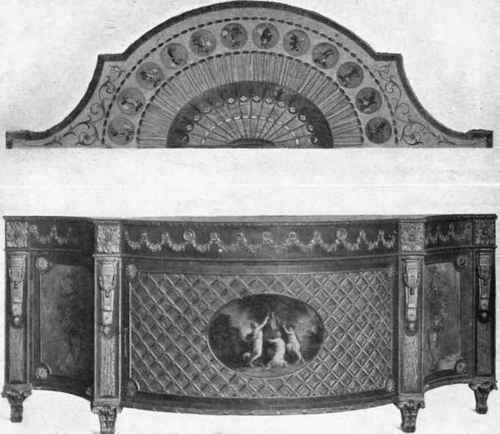
Plate XLI Sheraton Dwarf Cabinet and Top
Mr. Stafford of Bath gives, in 1819, "an elegant drapery of light green silk and pink taffetas linings; the sub-curtains are of clear muslin. The festoon draperies are supported by the eagle of Jupiter embracing the thunderbolt by arrows which have pierced the wall and by termini of foliages: these draperies are decorated by an embossed applique border which forms double rows upon the festoons and divides the curtains from the extreme supports over which it falls, as if suspended by them; the curtains are also bordered by a silk open fringe."
In 1820, Mr. Stafford designs some curtains that he describes as "playful swags of blue relieved by buff sub-curtains." Beneath them hang long white " under curtains." A "Paladian window," also of his invention, is draped in blue and lilac silk and taffetas with gilt carved supports, gold-colored lines, tassels, fringes and trimming and white transparent under curtains. The leading drapery is blue.
During the Restoration of the Monarchy, which lasted from 1815 to 1830, a distressing amount of fine old furniture was destroyed to make way for the cumbrous and heavy models that followed the general style of the Empire, with sabre legs and scrolled arms and feet and general heaviness. This period of mahogany and rosewood was succeeded by the " comfortable " period, when the seats consisted solely of upholstery and showed no wood-work. The soft-tufted sofas, easy-chairs, tete-a-tete pouf and borne are still within the memory of the present generation and are constantly met with in out-ofthe-way and old-fashioned hotels, on both sides of the ocean.
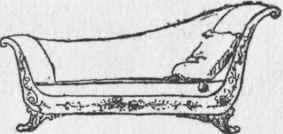
Meridienne, 1820
Simultaneously with the craze for upholstered furniture, French cabinet-makers had been trying to revive old types and models. Gothic forms and ornamentation were revived and then the Renaissance held its sway for a time. The artisans copied badly, but even bad copies helped the taste; and about 1850, excellent furniture, particularly chairs and sofas were made in the style Louis XV. and the style Louis XVI. The strange jumble that followed the Empire is sometimes referred to as the style troubadour.
A revival of the Louis XV. scrolls and curves, but with less character and restraint than the original, also took place and finally what is known as baroque 1or debased rococo took the field, when ornaments were prolifi-cally used for the sake of display rather than for appropriate adornment.
Continue to:


My Books

