


The Empire Style. Part 4
Description
This section is from the book "Furniture", by Esther Singleton. Also available from Amazon: Furniture.
The Empire Style. Part 4
From 1830 to 1850, fine arts were a passion in France, as well as a fashion. The wealthy collected paintings, and those in moderate circumstances followed suit; then, from 1840 to 1860 music reigned supreme, and no drawing-room was considered furnished without a piano.
After that period the rage for general collecting began, and houses were filled with curios of all kinds. The cabinet and the series of shelves known as the etagere descended into comparatively plain homes.
Of late years the return to good styles of old periods has been far more marked than the support of l'art nouveau.
Side by side with debased Empire forms, in England, we find so-called "Gothic" furniture in fashion publications, such as Ackermann's. Most of this was very poor stuff, from an artistic point of view. There was great improvement after 1835, when the famous architect, A. W. Pugin, published his Designs in Gothic Furniture.
1 The word baroque, which became a generic term, was derived from the Portuguese "barrocco," meaning a large irregular-shaped pearl. At first a jeweller's technical term, it came later, like "rococo," to be used to describe the kind of ornament which prevailed in design of the Nineteenth Century, after the disappearance of the Classic. (Litchfield.)
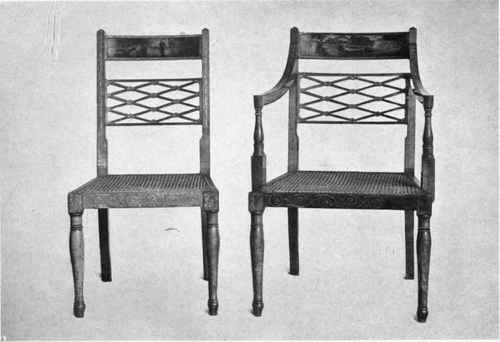
Plate XLII Sheraton Chairs
There was probably no period so dull and deathlike in furniture as the half century following the Empire. The best work that European cabinet-makers could produce, as shown in the Great Exhibition of 1851, reveals how the mighty had fallen; and the English display was very pitiful. During this period household furniture was made principally of mahogany, and rosewood, and the dining-room and sitting-room pieces were heavy and generally ugly. Great sideboards with mirrors let into the back; tomblike desks; console-tables in the form of a heavy lyre; sofas with enormous scrolls and with horsehair covering; chairs with the sabre leg; Trafalgar chairs; enormous bookcases; pillar-and-claw dining-tables; tripod tables with marble slabs; and French bedsteads with heavy foot and headboards of the same size are the favorite forms of the Victorian age. It seems incredible that furniture of the Chippendale, Heppel-white and early Sheraton periods should have been turned out of old homes for mahogany worked into such clumsy and repulsive forms - furniture which frequently masquerades to-day under the name of "Colonial," and which accords with what M. Molinier aptly describes as "the horrible simplicity of prison architecture."
As a matter of fact, there was no distinctive style at this period: everything was a jumble. Describing York House, which had just been magnificently furnished in 1841, a writer says: "The furniture generally is of no particular style, but, on the whole, there is to be found a mingling of everything, in the best manner of the best epochs of taste."
One change was noticeable, however, in the ottoman, couches and causeuses: "Some of them, in place of plain or carved rosewood or mahogany, are ornamented in white enamel, with classic subjects in bas-relief of perfect execution" a critic notes.
Papier mache was used in the manufacture of many articles of furniture, and was very popular about the middle of the century. It had long been known, but came into favor about 1825, when we read:
"A different style of decoration has lately been introduced from France by the manufacture of a composition of paper into every species of ornament, whether for the walls of an apartment or interior decoration in general. This species of manufacture has been called papier mache, which in fact is nothing more than paper reduced to paste, and then forced into moulds of the form required. In this instance we now excel our inventive neighbors in the execution of the same article; the English manufacture being more durable as well as more imitative of real carved work, from its sharpness of edge and depth in cast. But with respect to the elegance and phantasy of design in paper decoration, the French offer patterns very far superior to all others."
Reviewing the furniture of the period, Litchfield says:
"Large mirrors, with gilt frames, held the places of honor on the marble chimney-piece, and on the console, or pier-table, which was also of gilt stucco, with a marble slab. The chiffonier, with its shelves and scroll supports like an elaborate S, and a mirror at the back, with a scrolled frame, was a favorite article of furniture.
"Carpets were badly designed, and loud and vulgar in coloring; chairs, on account of the shape and ornament in vogue, were unfitted for their purpose, on account of the wood being cut across the grain; the fire-screen, in a carved rosewood frame, contained the caricature, in needlework, of a spaniel, or a family group of the time, ugly enough to be in keeping with its surroundings.
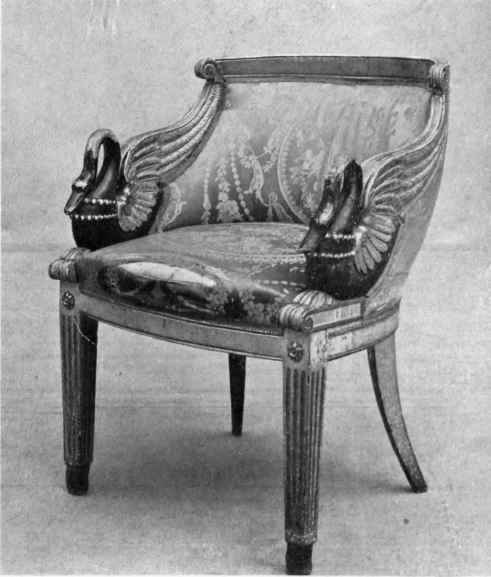

Plate XLIII - Empire Chair (English) - Metropolitan Museum - Empire Chair (French) - Metropolitan Museum
"The dining-room was sombre and heavy. The pedestal sideboard, with a large mirror with a scrolled frame at the back, had come in; the chairs were massive and ugly survivals of the earlier reproductions of the Greek patterns, and though solid and substantial, the effect was neither cheering nor refining.
"In the bedrooms were winged wardrobes and chests of drawers; dressing-tables and washstands, with scrolled legs, nearly always in mahogany; the old four-poster had given way to the Arabian or French bedstead, and this was being gradually replaced by the iron or brass bedsteads, which came in after the 'Exhibition of 1851' had shown people the advantages of the lightness and cleanliness of these materials.
"In a word, from the early part of the present century, until the impetus given to Art by this great Exhibition had had time to take effect, the general taste in furnishing houses of all but a very few persons was at about its worst.
"In other countries the rococo taste had also taken hold. France maintained a higher standard than England, and such figure work as was introduced into her furniture, was better executed, though her joinery was inferior. In Italy, old models of the Renaissance still served as examples for reproduction, but the ornament was more carelessly carved and the decoration less considered. Ivory inlaying was largely practised in Milan and Venice; mosaics of marble were specialties of Rome and of Florence, and were much used in the decoration of cabinets; Venice was busy manufacturing carved walnut-wood furniture, in buffets, cabinets, negro page boys elaborately painted and gilt; and carved mirror frames, the chief ornaments of which were cupids and foliage."
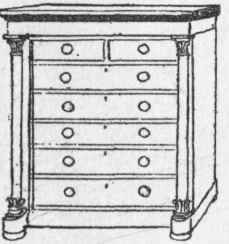
"Dressing-Room Commode," 1826

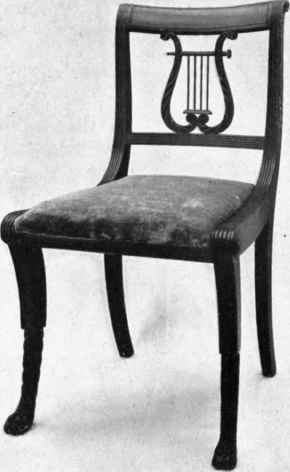
Plate XLIV - Table and Chair, by Duncan Phyffe, owned by Mr. R. T. Haines Halsey, New York
Continue to:


My Books

