


Embroidery. Part 7
Description
This section is from the book "A History Of Furniture", by Albert Jacquemart. Also available from Amazon: A History Of Furniture.
This section is from the "" book, by .
Embroidery. Part 7
In these embroideries there are some more prominent parts that require a special embellishment. This is effected by means of bullion, lama, spangles, even pearls and precious stones are sometimes added. In Italy there were also executed on velvet, the fronts of altars and sacred vestments of the utmost richness.
We shall not treat of the so-called embroidery "en rapport," except as an accessory to the foregoing. It consists in fact of detached portions executed independently, and then fitted into an ornamental whole. Many copes and other sacerdotal vestments of the fifteenth century are thus adorned. The orphreys were sewn on to the velvet, samit, or other silken materials, borders of cording being added to conceal the joinings. The ground was strewn either with ornaments of gold representing the flowers of the thistle, or with figures of archangels bearing phylacteries inscribed with some sacred text. In the armorial pieces, the escutcheons are most frequently embroidered "en rapport".
On rich church vestments and altar ornaments subjects have frequently been executed entirely in gold, the apparent relief being produced by working in silk. The gold is extended in pretty thick strips covering the whole surface, and fixed only at the two extremities. Taking up the strips of gold by twos on his needle in order to cover them over, after the tints of a painted design, the worker recovers the outline and follows it, working out the darker portions in such a way that the stitches touch and conceal the gold, which, however, he allows to be seen in the half-tints by keeping the thickness of a silk between each stitch, and by thus increasing the spaces until he reaches the light, where the gold is no longer fixed except at considerable distances by means of very fine and very light silks. This is called "broderie en or nue," that is, embroidery in shaded gold.
We need say nothing of embroidery in feather stitch, "au passe;" its process is so well known, and it has been so universally employed for furniture and dress during the two last centuries, that there is no occasion to describe either its method or its effect. It may, however, be explained that in gold embroidery work there is sometimes employed to save expense the "passe epargne," which is no longer the same process. The very fine gold no longer envelopes the material above and underneath, but covers the upper part only. The needle is inserted underneath close to the stitch where it has just passed through, and the thread is brought back to be disposed by the side of the one preceding it. In many embroideries "au passe," worked with coloured silks, twisted silk is substituted for flat silk, which produces a forcible and vigorous effect.
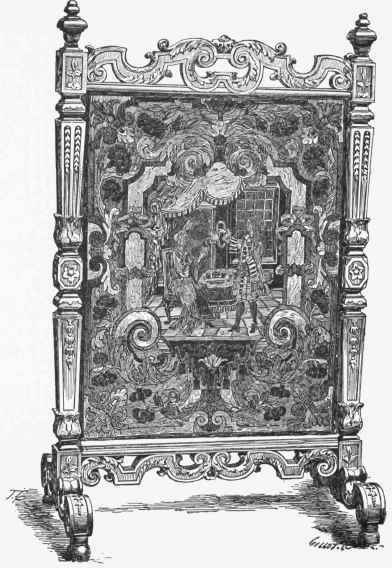
Screen embroidered with various coloured beads, en couehure, mounted in gilt wood; epoch of Louis XIV. (Collection of M. H. Barbet de Jouy).
Embroidery is to some extent confused with tapestry in the case of designs worked on canvas and with the cross-stitch. But it should be observed that so early as the eleventh century the Countess Ghisla employed what is now called "point de marque" (marking-stitch), simultaneously with "point de chainette" (chain-stitch), and embroidery stitches on pieces in the Arabian style, executed for the abbey of Saint Martin du Canigou. The point de marque is therefore very old, and it was to some extent indicated by the very material itself on which the embroidery was worked - a fabric with open threads like canvas.
Tapestry worked on canvas, "au petit point," lent itself to all the delicacies of the art, and tapestries of this description are in fact found rivalling painting itself. For ornamentation, the "gros point" succeeds admirably, and it is made still more effective by varying the disposition of the grounds upon which it is worked.
A word in conclusion on the chain-stitch, which we find, as just observed, in the embroideries of the Countess Ghisla, and again in the twelfth century in Italy on a camaieu subject, where it reproduces the hair and encircles certain details. When employed alone, and worked with a twisted and close-grained silk, it assumes a pearly appearance extremely agreeable to the eye.
It may be remembered that amongst the rich hangings, tapestries, etc, belonging to Cardinal Mazarin, we have mentioned "the gold brocades with velvet flowers of various colours, cut cut at Milan, and applique on very rich velvet grounds, at great cost and with wonderful art." What is thus described by Louis de Lomenie in his memoirs is a true mosaic work in various materials, which we find making its appearance in Italy with the sixteenth century, and which is doubtless the embroidery "en taillure" of the old writers. The "epargne," that is to say the foliage, flower-work, and ornaments of all sorts, are prepared apart, and are then pasted to the ground, according to the design previously traced. The outline is fixed by means of a stitch which passed through the cutting, and it is edged round with cording or "Milanese" work. Often, to give more relief and effect to the designs, or to prevent the embroidery from sinking, especially into velvet, the work is raised by sewing to the ground a bit of felt somewhat narrower than the piece to be laid on over it, and by which it will of course be concealed. When the effect of the relief is to be still more heightened, shadings are produced by means of long stitches in silk or wool, a description of shading known in French as "harpe" or "hache-bache".
These few general remarks, it may be hoped, will suffice to help amateurs in recognising the various styles and dates of such embroideries as may come under their notice. It could not form part of our scheme to enter into more ample details any more than we have been able to gather from the old records all the curious particulars connected with the history of embroidery. Those who would like to know how costly might be a coat embroidered in pearls belonging to Marshal de Bassompierre, will find a full description of it in his memoirs. We must here limit ourselves to a passage from the "Ceremonial Francais," referring to an attire worn on one occasion by Mary dei Medici: "Robe of the queen studded with 32,000 pearls and 3000 diamonds, which she wore at the baptism of the royal infants in 1606. This robe, valued at 65,000 crowns, was so heavy that the queen, who was, moreover, enceinte, was unable to put it on again".
This recalls reminiscences of Buckingham with his costumes glittering with diamonds, which broke off themselves and fell amongst the crowd of surrounding courtiers.
Continue to:


My Books

