


Sec. I. - Furniture Of Sculptured Wood
Description
This section is from the book "A History Of Furniture", by Albert Jacquemart. Also available from Amazon: A History Of Furniture.
This section is from the "" book, by .
Sec. I. - Furniture Of Sculptured Wood
What we have said previously of the uses of primitive furniture, renders it needless to insist on the fact that the greater part was of oak; nothing less than this solid material, put together by the stout joining of the carpenters, could serve for resisting the constant journeys and endless joltings. It will be understood that it is unnecessary to dwell long on the subject of the first chests, the majority of which must have disappeared. It is when art begins to manifest itself that interest commences. We have already mentioned the iron-bound coffer of the hotel Carnavalet; we will also examine as a characteristic of the end of the thirteenth century, the curious piece purchased at Alfred Gerente's sale by the musee de Cluny. It is a chest (bahut) of which the sides are ornamented with arcades, enclosing figures of men-at-arms in full armour, and jugglers; one of the ends exhibits a warlike cavalcade, and the other, a tree with spreading branches laden with leaves; the top, slightly rounded, is of quadrilobate medallions, containing scenes illustrative of manners and customs, and civil and military personages. The iron work is in a more advanced style of art than the wood; indeed we may fix the apogee of the smith's art at the commencement of the thirteenth century.
A sort of gap occurs between this period and the fifteenth century, when examples become plentiful, a gap which is indeed filled up by works in sculpture which sufficiently manifest the gropings of art; it is a period of transition, and the different appellations by which workers in furniture were designated, are an evident proof of the indecision existing in the exercise of their trade; some are called carpenters, others are "huchiers" and coffer makers, finally the name of joiner (menuisier) appears, so to speak, with the new form of art, and when it begins to display its elegancies. To find cabinet-makers, we must pass over another century, and enter upon the full period of the Renaissance.
Here, however, are the first names which appear in the archives of the Middle Ages:-
1316. Richart d'Arragon, coffer-maker.
1349. Hue d'Yverny.
1352. Guillaume le Bon, coffer-maker.
1355. Jean Grosbois, huchier.
1355. Jacques de Parvis, huchier.
1360. Jehan Petrot, chessboard-maker.
1365. Colin de la Baste huchier.
1365. Hannequin de la Chapelle.
1365. Thibaut le Roulier.
1387. Jehan le Huchier.
1388. Jehan de Richebourt. 1391- Jehan de Troves.
1396. Simonnet Aufernet, huchier.
1397. Robin Gamier, coffer-maker.
1398. Girardin, huchier.
1399. Jehan de Liege. carpenter.
1399. Sandom, huchier.
In the fifteenth century we hear of Mahier, a wheelwright, who, in 1415, made a wheeled chair in walnut wood to carry the queen, Isabeau de Baviere, on her recovery from an illness. Was it a work of art? Two things may cause us to suspect so; first, the choice of the material, and next, the habitual elegance of the woman of coquettish memory who was to be borne in it.
The other workmen : -
1448. Piercequin Hugue.
1454. Sauveton Fumelle.
1465. Guillaume Bassett,
1477. Guillaume Boyrin,
1478. Jehan de la Planche.
take the name of huchiers, excepting Fumelle, designated as a joiner.
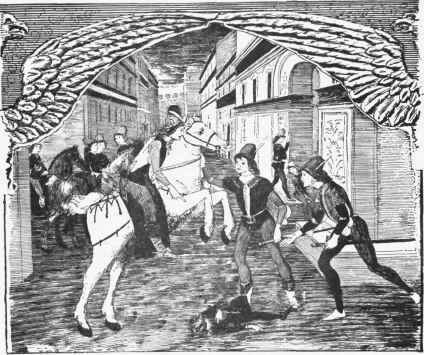
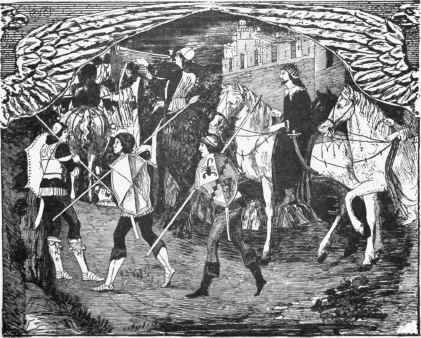
Panels of an Italian cassonc decorated with paintings, middle of the Fifteenth Century. (Collection of M. H. Cernusohi).
There were even specialists, like Lucas, making chessboards in 1496, as Jehan Petrot had done in 1360.
With the progress of luxury and talent, trades become confused, and the different branches mingle together. Already, in 1450, Italy, while preparing the development of her special genius, exhibits men of unusual talent in every profession. Giuliano da Maiano and Benedetto, sculptors and joiners, not satisfied with the resources afforded by rich architectonic compositions combined with statuary, desire to add to it a variety of shades, and imagine the plan of incrusting wood with divers inlaid work, or marquetry. They thus form a school whence spring the intarsiatori, of whom we shall speak further on. The pure cabinet-maker carvers nourished none the less; in 1406, Marco Brucolo and Antonio Torrigiani constructed the kind of tabernacle made to preserve the manuscript of the Pandects at Florence. Thomas Soderini, the gonfalonier, employed Lorenzo de Bicci in 1451, to add to the richness of the work by painting on the pediment of Saint John the Baptist; and on the doors, Moses surrounded with golden lilies, and the symbols of the four Evangelists. This custom of uniting painting to wood carving then very much prevailed, and Dello, the painter, who died about 1455, had gained a reputation in this branch of art.
We should doubtless be rash in attributing to him the scenes we reproduce from two panels of a chest (bahut) belonging to M. Henri Cernuschi; all that can be said is, that they are from the hand of a master. A similar chest from the same collection is also valuable on more than one account. Of incontestable Italian origin, it is sculptured with ornaments of an elegant Gothic style which are curiously combined with certain antique and romanesque reminiscences; thus, the upper frieze is a classic scroll (poste), arranged in the Gothic style; the four front compartments are composed of arcades of elliptic shape (anse de panier), trilobed interiorly, and supported by small twisted columns; all this architecture is with coloured grounds, and completely frames the subjects, which represent the same young man presenting himself successively before men in religious costumes; then in a castle, where his presence is announced by men sounding the trumpet, while women advance to receive him, and introduce him into the interior of the dwelling. The last picture represents a room in which the young man is seated between a matron and a young girl, who has appeared in the two preceding pictures; musicians are sounding trumpets, and everything suggests that it is a betrothal ceremony. Thus the chest (bahut) of the fifteenth century is already the cassone, or marriage coffer, which was presented with the wedding gifts, a custom we shall see reproduced throughout the whole of the following century in Italy, and which has been adopted in our own country, where the splendidly furnished "corbeille" is still an object of great costliness.
Continue to:


My Books

