


Chapter III. Different Kinds of Furniture
Description
This section is from the book "A History Of Furniture", by Albert Jacquemart. Also available from Amazon: A History Of Furniture.
This section is from the "" book, by .
Chapter III. Different Kinds of Furniture
The furniture of the Middle Ages must be divided under two different heads; the most important examples are evidently those for religious use. Where indeed should the greatest splendour of art be exhibited, than in the house of the Almighty ? Were not the workmen established in monastic houses specially bound to devote all their energies to the adornment of the Church? History proves it; and the masterpieces of art must be sought amongst the stalls of the choirs and the ornaments of the sacristy.
We shall dwell but little, however, on this branch of furniture, which diverges slightly from the special object of this study; it will be sufficient for us to point out the types in our museums which exhibit its characteristics. First of all we shall mention the sumptuous sacristy "dressoir," or sideboard, preserved at Cluny, taken from the church of Saint Pol-de-Leon. Its triple staged construction, the lace-like delicacy of its pierced canopies, its panels on which the arms of France and Brittany, and those perhaps of some donor, stand in relief; its beautiful locks of wrought iron decorated with beaten and chased work, bearing the same arms as the wood, make it one of the most interesting specimens of the cabinet work of the fifteenth century. A no less important piece of the same period is the carved woodwork grating forming the enclosure of one of the chapels of the church of Augerolles (Puy-de-D6me). We may also mention a large refectory bench with the arms of France, probably taken from some royal abbey, and we will stop on the threshold of the Renaissance when religious and secular furniture become assimilated.
To discover the remnants of the latter, we must necessarily search the manorial habitations. The first workmen employed in the construction of the different recipients of all sizes destined to contain and transport each person's property, were simply carpenters. Neither is it a matter void of interest, to pass in review the various terms which have served to qualify this primitive style of furniture. The "bahut" was originally a leathern or wicker envelope covered with cloth, used to contain and protect a large box, in which other smaller boxes were lodged; in the course of time the name passed from the covering to the box itself, and served to designate even armoires (wardrobes) and ecrins (jewel caskets). The coffer is subject to a still greater number of variations; it is often confounded with the bahut, or chest, and becomes synonymous with trunk (malle), casket, and the large trunk, called "bouge," as capacious as the osier basket. When very large the coffer was used as a receptacle for the other boxes when on a journey, and at home its interior served the purpose of our armoires. It was also used as a seat, and even as a table. As for the smaller chests or caskets (coffrets), they varied as much in shape as in material, and those made of gold, silver, precious woods, chased or enamelled copper, played an important part in the elegant life and the splendour of the Middle Ages; the custom of locking up in coffers not only valuable jewels, but specie, caused the name to be adopted to express the finances of king or state.

Moveable Stall. Flemish work of the middle of the Fifteenth Century. (Collection of Baron J. de Rothschild).
The huche is again another coffer or bahut, sometimes called arche, huceau, hucheau, huchel, and buffet; the hucheau was not so large as the huche, and nothing enables us to distinguish whether the other varieties of the name indicated a difference of form or use. M. de Laborde, in his learned glossary, only remarks that by reason of the many precious objects contained in the huches, the domestic officers of the royal palace took the name of "garde-huches".
To return to our primitive workmen, the carpenters: art with them was held naturally a secondary rank; solidity, it may well be imagined, was the first qualification for these chests, which were destined to frequent journeys on the back of powerful sumpter horses (called chevaux bahutiers), to circulate through the winding staircases and narrow passages of feudal towers, and bear the weight of those who used them as a seat; accordingly one of the most ancient of decorations consisted in the application of complicated iron mounts, which added their strength to that of the skilfully fashioned woods. The Parisian museum of the hotel Carnavalet possesses one of these coffers, iron bound on the same system and perhaps by the same hand as the celebrated entrance doors of Notre-Dame, one of the masterpieces of the thirteenth century.
From the close of the eleventh century, however, the necessity of embellishing with ornaments in relief such objects as were constantly placed within sight, and which required to be in greater harmony with the splendour of hangings and dress, began to be understood; they even went farther, and broad surfaces were covered with gold grounds, set off with paintings.
In the following century elegance of form began to be considered; and wood turned with the lathe was introduced in the construction of furniture, and then in the thirteenth century the grounds were ornamented with sculptures in low relief.
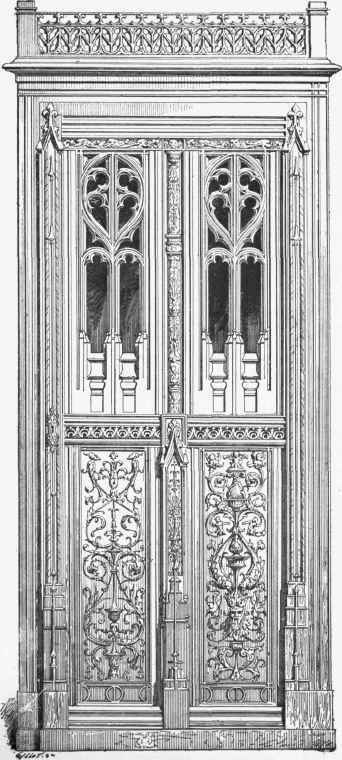
Armoire of carved wood, French work of the Sixteenth Century, (Museum of the Louvre).
During these two centuries, however, furniture remained within very narrow limits; as we have just observed, huches and bahuts constituted its basis, clothes, linen, valuables, and money being consigned to them; the bedstead came next, then the chair, or chaiere, of the master of the house, high-backed benches, some stools (escabeaux), the sideboard (buffet), which was moveable, and permitted circulation round it for the convenience of service, and the dressoir, in the form of an etagcre, on which cloths were spread at meals, and the most valuable plate laid out on the narrow shelves which rose in steps at the back. The beds were hung round with curtains suspended by a system of cords, and the larger pieces of furniture ornamented with portable cushions and Saracenic carpets.
The thirteenth century, while bringing tools to perfection, also caused a separation amongst the workmen specially employed in the construction of furniture, who thenceforth were divided into two different classes: carpenters and joiners. The first applied themselves solely to massive works; the others, advancing further and further into the domain of art, became assimilated with the "ymaigiers" or regular sculptors, and traced on the pliant wood flowery patterns, with elegant scrolls of foliage forming a framework to personages and scenes from sacred or profane history, or else representing in Gothic or quadrilobate compartments subjects of fabliaux or legendary songs.
In the fourteenth century and during the first years of the fifteenth, elegant luxury was displayed more especially in costly stuffs, and tapestries with which the furniture, seats, and benches were covered. The flowing draperies of the beds partook of this taste, which originated with the Crusades, and had been inspired by the sight of the magnificent fabrics of the East. Sculpture, nevertheless, continued progressing, and in Italy marquetry, evidently of Oriental derivation, began to have a share in the working of wood.
In the fifteenth century, the appearance of a bedchamber is thus represented; the curtained bedstead, with corniced tester, displayed its costly coverlets; on one side was the master's chair, then the devotional picture or small domestic altar attached to the wall. The dressoir and other small pieces of furniture were to be seen ranged round the apartment, and often in front of the immense fireplace was a high-backed seat where the inmates came to seek warmth. This arrangement, which is seen in miniatures and tapestries taken from various sources, proves the uniformity of habits in the different classes of society. Here we find personages whose dress and elegance denote their high position; here again are plain citizens surrounded by their serving men, and by a number of objects which allow us to judge that the apartment is at once the bedchamber, reception-room, and refectory of the family.
If we enter the study of the statesman or of the writer, we find the high-chair, or faldistoire, with its monumental back, the revolving desk called a "wheel," used to keep a certain number of books within reach, lecterns, and various other sorts of desks for writing.
This age, moreover, corresponds with the complete development of Gothic architecture, and the pieces of furniture inspired by the same taste, are divided into flamboyant Gothic arcades, and crowned by fine needle-shaped crockets, and floriated croziers; their niches contain elegantly quaint figures, and the panels, with their bas-reliefs, rival in perfection the retables (altar-pieces) and triptychs of intricate workmanship.
Accordingly, these articles of furniture have no parts of them covered, except such which must be so from necessity, so that the ingenious conceptions of the artist may be left exposed to view. Much of this furniture served only for luxurious display, while that which was destined for travelling remained simple in form, and was modestly concealed in those parts of the dwelling reserved for private life.
We shall not extend this brief sketch any further, for, from the sixteenth century, both public and private life is pictured in so large a number of monuments, paintings, tapestries, engravings, and manuscripts, that it would be superfluous to attempt an analysis essentially colourless beside the originals.
What we have now to do, is to study furniture no longer as a whole, but in its different kinds, so as to show its progress and connections, and cause its styles to be appreciated in their successive transformations.
Continue to:


My Books

