


Chapter II. Eclectic Furniture
Description
This section is from the book "A History Of Furniture", by Albert Jacquemart. Also available from Amazon: A History Of Furniture.
This section is from the "" book, by .
Chapter II. Eclectic Furniture
These difficulties need not discourage those who desire to borrow from the past the objects which surround them; if, from the severity of its exigencies, history should escape them, they can make use of a compromise, which taste admits, by composing a purely eclectic set of furniture.
Let us here explain; among the connoisseurs of our day, there are some who, like their ancestors of the Renaissance and the following centuries, openly assume the name of the collectors and possess a cabinet. In those days, as we know, the cabinet, which was an appendage and ornament to a habitation, contained, besides jewellery and other articles of personal ornament, specimens of goldsmith's work, bronzes, arms, marbles, medals, crystals, and pietre dure, pictures, in short, all that constitutes a collection. In the present day many who collect relics of the past, refuse, from modesty, to avow that they possess a cabinet. Are they less rich in rarities than the old connoisseurs? Not so; but what they acquire is not grouped in a single gallery, in the cabinet; it is scattered about everywhere, surrounding them wherever they may be, and their enjoyment of it is increased because every moment they have within reach one of the thousand objects they love. This, therefore, is precisely what constitutes eclectic furniture.
Can it be concluded from this that it is sufficient to possess valuable things, and to bring them together by chance, in order to come within the rules of eclecticism? Certainly not; and whoever may have been able to see the hotels of M. Adolphe Moreau, of M. Georges Bergcr, of Baron Charles Davillier, and of M. Edmond Bonnaffe, will be convinced of this; he will remark that a strict rule of propriety and good taste governs this apparent caprice. A rich interior should not indeed resemble the well-furnished shop of a dealer, and ill-assorted objects are always disagreeable; works bearing the special date of their style, possess obvious harmony; the credence tables of the Middle Ages, and the chests with their delicate Gothic tracery, would be out of place, if placed side by side with commodes and bureaux of tortured forms, glaring with twisted and intrusive brasswork; the solid French faience would look coarse placed in contact with the furniture of Louis XVI., and Sevres porcelain would appear insipid on a Boule cabinet, by the side of rock crystals of the seventeenth century.
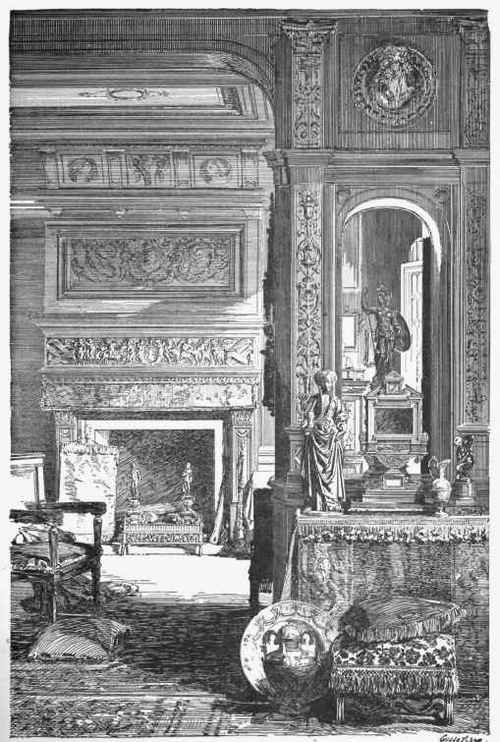
Salon, Renaissance style of XI. Edmond Bonnaffe.
It will be asked, then, where is a rule to be found? We repeat, in taste. Let us declare to the credit of our artists that it is principally to them that we may go for advice on the scientific assembling together of these different objects; the choice of form, the true key-note in the assortment of colours, the supreme elegance of the whole put together, denote the experience gained in their daily studies, and in their historical information, bringing to light amongst such as are colourists by instinct, all the power of this particular talent.
The showing off to advantage an Arras or Flanders tapestry, to display a lacquered cabinet, a "pique" of India, or an ebony incrusted with ivory, in their best light, to find the suitable place for arms, porcelain, and bronzes, to exhibit a terra-cotta of Clcdion, an ivory of Duquesnoy, or the goldsmith's work of Baslin; to suspend in their right place a Persian embroidery, an Indian brocade, a Japanese rouleau could never be the work of the first comer. The anachronisms between two ill-assorted pieces may be as offensive to the eye, as between the scattered parts of a complete set of furniture, the finest pieces of armour will assume the look of old iron, according to the background which serves to set them off.
The true secret lies in finding out transitions; it is in this that M. Barbet de Jony excels, not only in the judicious grouping of the public treasures of which he is the keeper, but in the arrangement of his private abode.
Of all things, the least difficult to arrange are those of oriental origin; their purity of taste, and brilliancy admits of their braving every contact. Francis I. admitted them, notwithstanding his passion for works of the Renaissance. Under Louis XIV. the furniture and porcelain of China and Japan, were associated with marquetry and bronze to relieve their severity. Their part in decoration gradually increased in the following reigns, and at the end of the eighteenth century, became dominant, as we may judge by this description of a boudoir, taken from "Angola," an Indian story, a work contrary to all probability. Agra (Paris) 1746.
"Un lit de repos en niche de damas couleur de rose et argent, paraissait comme un autel consacre a la volupte; un grand paravent immense l'en-tourait; le reste de l'ameublement y repondait parfaitement; des consoles et des coins de jaspe, des cabinets de la Chine charges de porcelaines les plus rares, la cheminee garnie de magots a gros ventre de la tournure la plus neuve et la plus bouffonne, des ecrans de decoupures, etc".
Yes; such was precisely the buffoonery and luxury of a gallant and frivolous age, rushing with heedless mirth into the gulf which was to swallow it up. Neither the hidden sarcasms, like those of Angola, the remonstrances of austere philosophers, nor the honest efforts of Louis XVI., could arrest the fatal leap, and bring back taste and manners into more reasonable paths.
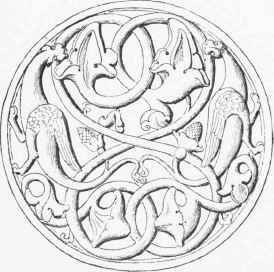
Ornament taken from the Bible of Souvigny.
Continue to:


My Books

